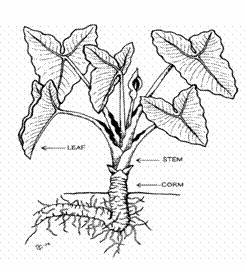
Figure 1a. New Cocoyam or Giant Taro (Xanthosoma sagittifolium)
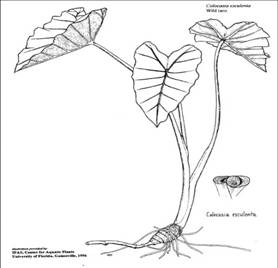
Figure 1b:
Old cocoyam or Taro
(Colocasia esculenta)
Formal and informal interviews and survey activities were conducted to compile data on what varieties of Taro the farmers used for pigs in Thua Thien Hue, their characteristics, seasonal availability, variation between the year, and how to use them for pig feeding; Agronomical trials were set up to determine biomass productivity according to the rainy and dry season, and re-growth ability after harvest of the vegetative parts. Chemical composition was determined and a feeding trial conducted with 12 cross-breed pigs to determine effects of feeding the plant fresh, cooked or as silage. The overall was to determine the best way to use of Taro in pig diets as a means of improving benefits from pig raising in small scale household condition.
Taro (Colocasia esculenta (L.) Schott) is an ancient crop grown throughout the humid tropics for its edible corms and leaves, as well as other traditional uses. It occupies a significant place in the agriculture of the Asia-Pacific Region and supplies much-needed protein, vitamins and minerals, in addition to carbohydrate energy (Inno Onwueme, 1999).
The New Cocoyam (also referred to as "Giant Taro") is a member of the family of Araceae, of which there are one hundred genera and more than fifteen-hundred species. Their preferred habitats are in tropical or subtropical environments which are moist and shady. Some are terrestrial plants while others are vines, creepers, or climbers. Many species of the Araceae are also epiphytes. The major edible species are classified in two tribes and five genera: Lasioideae (Cyrtospermaand Amorphophallus); and Colocasiodeae (Alocasia, Colocasia, and Xanthosoma). Taro (Colocasia esculenta [L.] Schott) is considered as a single polymorphic specie.
Taxonomic classification: Xanthosoma saggitifolium Schott:
Type: Fanerogamas
Sub-type: Angiospermae
Phylum or division: Mangnoliophyta
Class: Liliopsida (Monocotyledonous)
Order: Arum
Family: Araceae
Genus: Alocasia, Colocasia and Xanthosoma
Species: Xanthosoma saggitifolium
Colocasia is widely distributed in the Indo-Malayan region (India and Bangladesh), Asia, Pacific islands, Egypt and the Mediterranea, Africa, Caribbean and America. Xanthosoma is native to South and Central America. In Viet nam Alocasia, Colocasia is widely distributed in the whole country while Xanthosoma is mainly distributed in the north and high land, some in central region and the south.
"New Cocoyam" (Xanthosoma sagittifolium) can be identified by the presence of a corm (see Figures 1a) which is absent in "Old Cocoyam" (Colocasia esculenta) (Figures 1b).
|
|
|
|
|
Figure 1a. New Cocoyam or Giant Taro (Xanthosoma sagittifolium) |
|
Figure 1b:
Old cocoyam or Taro |
According to Wang (1983), Taro has great potential as animal feed in the tropics and subtropics where it is often a staple food for pigs. However, because of the problem of the presence of calcium oxalate, the leaves, petioles and corms of Taro are often considered unacceptable for direct use as an animal feed (Jiang Gaosong et al 1996). Wang (1983) claimed that this problem could be solved by the fermentation occurring during the process of ensiling. This has been confirmed recently by Chittaving Malavanh et al (2007), who successfully fed ensiled Taro leaves to pigs during reproduction and lactation, and by Peng Buntha et al (2007) and Chhay Ty et al (2007) who fed ensiled and dried leaves of Taro to growing pigs.
In the Central region in Vietnam, Taro is very easy to grow, naturally or by planting. Some Taro varieties are used only for pigs; some are harvested to produce roots for human consumption while the petiole and leaves have been used as by-product feeds for pigs. Farmers have experience in feeding their pigs with several kinds of Taro but without any information about their composition or nutrient value. Until now, there are no research results recorded about what kinds of Taro are used for pigs, their biomass production, seasonal availability, composition and nutrient content; or how to use better these resources in pig diets.
The aim of this research was: i) to identify: species of Taro popularly used by farmers; ii) their characteristics including biomass productivity, seasonal availability, variation between years, and nutritive value; and iii) how to make better use of this local feed resource for pig production
A survey was conducted in three areas in Hue province (upland, flat land and coastal area). One commune per area was selected for investigation (Hong Ha commune in the upland area, Thuy Duong commune in the flat land, and Phu Da commune in the coastal area). Interviews were arranged with 150 households (about 25% of the total of pig raisers in each commune) to understand which species of Taro the farmers commonly used for pig feeding, and their characteristics such as seasonal availability, adoptability during the year and what parts of Taro could be used to feed pigs.
Staff of the Department of Agriculture and Rural Development (DARD) and Grass roots extension workers working closely with pig raisers in the targeted areas were also interviewed to collect data and relevant information. Some tools introduced in Rapid Appraisal Approach were time-lining analysis, scale games and questionnaires (Mikkelson 1994).
Based in the information compiled on Taro, an agronomical trial was planned to determine biomass yield of Taro species used for pigs in the dry and wet seasons and their re-growth ability after cutting. Samples of leaves, petioles and corms were collected and analyzed for their chemical composition (DM, CP, CF, and Ash) according to AOAC (1990).
The experiment was a completely randomized blocks (RCB) design with 5 species of Taro used popularly (5 treatments) and 3 replications. The suckers taken from root was planted with a density of 60,000 – 65,000 plants per ha (35 cm between plants in the row and 45 cm between rows). Fertilization rates (per ha) were 10 tonnes of composted pig manure, 200 kg urea, 30 kg P2O5 and 30 kg K2O. All the manure, the P2O5 and one third of the amount of urea and K2O were applied during the period of land preparation. One third of the total amount of urea and K2O were applied along with weeding when all the Taro had germinated. The remaining urea and K2O were applied after 50 to 60 days when the Taro was harvested the first time. (Hoanh Mai Thach and Vinh Nguyen Cong 2003).
A feeding experiment was conducted in Thuy Duong Farm to measure feed intake and performance of pigs fed diets containing Taro processed in three different ways. 12 crossbred pigs (Yorkshire x Mong Cai) consisted of 6 female and 6 castrated pigs at 2 months old with an average initial live weight of 11.4 kg were used. They were vaccinated against hog Cholera and Pasteurellosis, and de-wormed 2 weeks before starting the experiment which was a completely randomized design with 3 treatments and 4 replications (1 pig per replicate). The pigs were housed in individual pens and fed diets containing Taro leaves and petioles in fresh style (FL), cooked (CL), or ensiled (SL) form. The Taro foliage (leaves and petioles) were the protein supplements to a basal diet of rice bran and ensiled cassava root (2:1 ratio in DM) and 5% of groundnut cake. The basal diet containing 12% Crude Protein and about 3,000 Kcal ME/kg were fed at around 2% of live weight (DM basis) while the Taro leaves and petioles were fed ad libitum (about 20% above recorded intake) .
The Taro leaves and petioles (Colocasia esculenta (L.) Schott, green stem) were chopped into small pieces, after which a part was used immediately to feed the pigs in treatment FL. Another part was cooked for 15 minutes to feed pigs in treatment CL. The Taro silage was made by using chopped Taro leaves and petioles with rice bran at the ratio of 5% (fresh basis) as additive. The mixture was placed into plastic bags with a volume of 40 litres and sealed to maintain anaerobic conditions. The bags were stored at room temperature (27-33oC) and the ensiled material used for pigs experimented in treatment SL after 3 weeks ensiling.
Live weight (10 day intervals) of the pigs and daily feed intake were recorded. At slaughter, back fat thickness and loin muscle area were measured.
The general linear model (GLM) of Minitab Version 13 (2000) was used to analyze the data. Results are presented as least squares means with the pooled standard error of the means.
Eight species of Taro were found in the targeted areas of which 5 were planted traditionally (Table 1). In the upland area the “wild” Taro was growing naturally, while in the lowland and coastal areas it was planted.
| Table 1. Taro species found and planting rate of interviewed farmers in the targeted areas (%) | ||||
|
Vietnamese name |
Latin name |
Upland n=30* |
Flat land n= 60* |
Coastal n=60* |
|
Mon Nuoc |
Colocasia esculenta (L) Schott (Green stem) |
20.0 |
100.0 |
100.0 |
|
Mon Chia voi |
Colocasia esculenta (L) Schott (Light Green stem) |
10.0 |
76.7 |
63.3 |
|
Mon Tho (mon do) |
Colocasia esculenta (L) Schott (Red stem) |
16.7 |
86.7 |
70.0 |
|
Mon Bac Ha |
Alocasia odora C. Koch (Green stem) |
20.0 |
83.3 |
88.3 |
|
Mon Moi |
Alocasia odora C. Koch (Red stem) |
3.3 |
25.0 |
33.3 |
|
Mon Chum (mon tim) |
Alocasia odora C. Koch (Purple stem) |
23.3 |
78.3 |
90.0 |
|
Mon sap vang |
Xanthosoma nigra (Vell.) Stellfeld |
0 |
8.3 |
25.0 |
|
Mon rung |
Wild Taro |
100.0 |
- |
- |
|
*. n: number of farmers interviewed in each area |
||||
Wang; Steinke; Carpenter (1981) found that Taro is indigenous to the humid tropics and can be grown under flooded or upland conditions. In the targeted areas, Taro were planted in different time based on species of Taro, e.g. Mon Nuoc and Chia Voi were planted during the year, Mon Moi and Mon Sap vang were planted in Spring season while Bac Ha, Chum and Tho were planted in Summer season (Table 2).
| Table 2. Crop Seasonal Calendar of Taro planted in targeted areas | ||
| Vietnamese name | Latin name | Planting time |
| Mon Nuoc | Colocasia esculenta (L) Schott (Green stem) | Year round |
| Mon Chia voi | Colocasia esculenta (L) Schott (Light Green stem) | Year round |
| Mon Tho (mon do) | Colocasia esculenta (L) Schott (Red stem) | July |
| Mon Bac Ha | Alocasia odora C. Koch (Green stem) | July |
| Mon Moi | Alocasia odora C. Koch (Red stem) | January |
| Mon Chum (mon tim) | Alocasia odora C. Koch (Purple stem) | July |
| Mon sap vang | Xanthosoma nigra (Vell.) Stellfeld | January - February |
| Mon rung | Wild Taro | - |
Taro is planted with different kind of species due to different use, some (mon nuoc, mon chia voi, mon tho) are to get stem and leaves, others (mon sap vang, mon moi) are mainly to get root while another (Chum, Bac Ha) are for both purposes. Because of that, the Taro stem and leaves were available during the year in the targeted areas. However, there was some different in availability of Taro stem and leaves used for pig raising between species, duration and ecological zone (Table 3).
|
Table 3. Taro availability during the year in targeted areas |
|||
|
Months |
Upland |
Flat land |
Coastal |
|
1 |
+++ |
++ |
+++ |
|
2 |
+++ |
+++ |
++++ |
|
3 |
+++ |
+++ |
++++ |
|
4 |
+++ |
+++ |
++++ |
|
5 |
++ |
++ |
+++ |
|
6 |
++ |
++ |
++ |
|
7 |
++ |
+ |
++ |
|
8 |
++ |
+ |
++ |
|
9 |
++ |
+ |
+++ |
|
10 |
+++ |
++ |
++++ |
|
11 |
+++ |
++ |
++++ |
|
12 |
+++ |
++ |
++++ |
|
++++: Plenty; +++: Many; ++: Moderate; +: Few |
|||
Taro leaves were mainly used for pig, Taro stems were also use for pigs and some can be used for human as vegetable. Taro roots were only used for human consumption purpose. Taro stem and leaves were used as main feed source for pigs raising in the targeted areas, especially in upland area where is lack of protein source for pigs. They were fed to pigs daily, every 2-3 days or weekly depended on planted Taro source in each family (in the flat land and coastal areas and how much Taro leaves and stem collected from the forest (in the upland area). (Table 4)
|
Table 4. Taro Leaves and Stem used for pig raising Frequency (% total interviewed farmers) |
|||
| Zone | Daily | Every 2-3 days | Weekly |
| Upland | 100 | - | - |
| Flat land | 25 | 42 | 33 |
| Coastal | 100 | - | - |
The data showed that 100% farmers interviewed in the upland fed to their pigs daily with Taro stem and leaves. The farmers have just collected them in the forest free of charge. The same situation to coastal area but the reason for use was quite different. It is quite very difficult for the farmers in coastal to plant other vegetables instead of Taro with the aim at feeding to the pigs only. In the flat land, many vegetables can be chosen for pig raising such as Sweet potato leaves, Water spinach, duck weed, banana stem, rice bran, groundnut cake, concentration feed, etc so Taro leaves and stem were used daily (25%), every 2-3 days (42%), and weekly (33%).
In general, Taro was available in the rural areas in Vietnam in term of flat land, coastal and upland areas. Taro leaves and stem were used as the main feed source for pig raising. It is important that their seasonal biomass, re-growth ability and their chemical composition need to be identified due to better use the local feed source for pig raising.
An agronomical experiment was conducted to identify seasonal biomass of 5 Taro’s species that were popularly planted in the flat land and coastal areas, and their re-growth ability. The results are given in table 5.
Different species of Taro had significant different biomass yield, the highest yield of Taro stem and leaves (373.1 tons/ha) was Alocasia odora C. Koch (Green stem) while the lowest one(247.6 tons/ha) was Alocasia odora C. Koch (purple stem). Within species of Colocasia esculenta (L) Schott, the specie with Light Green Stem had the highest biomass yield (354.7 tons/ha) while the lowest one was the specie with Green Stem (272.9 tons/ha). However, the seasonal biomass is strongly effected by season, weather, soil fertility, and cultivate methodologies.
Re-growth ability of Taro was so high, it reached the level of 65 - 95% compared to the first harvest depended on species, season as well as harvest times. In the dry season re-growth ability of Taro was higher than wet season and harvest times interval (about 30 - 40 days) was also shorter than (about 40 - 50 days).
|
Table 5. Seasonal biomass of Taro’s species planted and their re-growth ability (ton/ha) |
|||||
|
Seasonal harvested times |
Taro’s species |
||||
|
CELS* (Green stem) |
CELS (Light Green stem) |
CELS (Red stem) |
AOCK* (Green stem) |
AOCK (Purple stem) |
|
| Dry season (March - August) | |||||
| 1st Harvest |
39.3 |
47.0 |
46.0 |
51.3 |
34.0 |
| 2nd Harvest |
34.7 |
42.8 |
40.7 |
43.8 |
32.0 |
| 3rd Harvest |
30.6 |
39.5 |
36.4 |
42.0 |
29.6 |
| 4th Harvest |
28.7 |
36.8 |
34.4 |
38.4 |
26.4 |
| 5th Harvest |
28.2 |
39.0 |
36.0 |
40.6 |
24.0 |
| Wet season (September - February) | |||||
| 6th Harvest |
31.2 |
40.6 |
39.5 |
42.4 |
27.8 |
| 7th Harvest |
26.9 |
36.0 |
34.0 |
38.0 |
26.0 |
| 8th Harvest |
25.4 |
34.6 |
32.6 |
35.6 |
23.2 |
| 9th Harvest |
27.9 |
38.4 |
35.8 |
39.3 |
24.6 |
| Total |
272.9d |
354.7b |
335.4c |
373.1a |
247.6e |
|
*CELS: Colocasia esculenta (L) Schott; AOCK: Alocasia odora C. Koch a,b,c,d,e Means with different superscripts within rows are significant different ( p<0.05) |
|||||
The samples of different species of Taro leaves combined with stems was analyzed according to AOAC, 1990; the composition of Taro leaves and stems within species is given in table 6 as below:
|
Table 6. The composition of different species of Taro leaves combined stems (%DM basis) |
|||||
|
Composition |
Taro’s species |
||||
|
CE(L)S (Green stem) |
CE(L)S (Light Green stem) |
CE(L)S (Red stem) |
AOCK (Green stem) |
AOCK (Purple stem) |
|
| DM |
7.43 |
8.05 |
6.98 |
7.48 |
7.36 |
| Crude Protein |
17.58 |
16.51 |
18.20 |
17.90 |
17.43 |
| Crude Fibre |
16.93 |
21.70 |
18.26 |
20.61 |
17.82 |
| Ash |
15.98 |
16.51 |
17.05 |
17.26 |
15.40 |
Taro plant has acridity. According to Wilfred Lee, the acridity is due to the presence of the calcium oxalate crystals in the taro plant. Calcium oxalate crystals in taro exist in two forms: druses (80-95 percent of the total) and bundles (called raphides). The density of crystals in corms may be as high as 120,000/cm . In leaves the number of the crystals is even higher. Acridity has been attributed to the presence of bundles of calcium oxalate crystals in the taro tissues. Presumably, itchiness arises when the crystals are released and inflict minute punctures on the skin when in contact with it. More recent evidence (Bradbury & Holloway, 1988) suggests that the crystals have to interact with a certain chemical on the raphide surface before acridity is experienced. Fortunately for the consumer, acridity disappears when the taro corm or taro leaf is cooked by boiling, roasting, frying or other means.
The taro leaf, like most higher plant leaves, is rich in protein. It contains about 23% protein on a dry weight basis. It is also a rich source of calcium, phosphorus, iron, Vitamin C, thiamine, riboflavin and niacin, which are important constituents of human diet. The fresh taro lamina has about 20% dry matter, while the fresh petiole has only about 6% dry matter (Inno Onwueme, 1999).
As the composition and nutritive values mentioned above, Taro leaves and stems are quite a good local protein resources for pigs. However, due to acridity and itchiness released from Taro the way of processing it has become very important activity to better use of Taro for pigs raising in Central Vietnam, especially pig raised at small scale condition.
According to the feeding experiment designed, 3 treatments were tested included in FL, CL and SL with the aimed at pointing out the best processing method of Taro leaves and stems in term of performance and economic effect to fattening pig (Large White x Mong Cai) production. Feed Intake (FI), Daily Weight Gain (DWG), Feed Conversion Ratio (FCR) and lean meat percentage are given in table 7 as below:
| Table 7. FI, DWG, FCR and lean meat of F1 pigs (LW x MC) raised in different treatments | ||||
| Parameters |
Treatments |
P | ||
| FL | CL | SL | ||
| Initial Live Weight (LW) kg/head | 11.3 | 11.5 | 11.4 | 0.45 |
| Experiment time (days) | 122 | 122 | 122 | - |
| Slaughter LW (kg/head) | 65.3 c | 72.2b | 77.4a | 0.01 |
| Average FI (kg/day) | 1.52c | 1.58b | 1.66a | 0.04 |
| Average DWG (g/day) | 443c | 498b | 541a | 0.01 |
| Average FCR (kg Feed/kg BWG) | 3.43a | 3.18b | 3.07c | 0.03 |
| Lean meat percentage (%) | 46.55b | 48.49a | 46.12b | 0.005 |
|
a,b,c, Means with different superscripts within rows are significant different ( p<0.05) |
||||
Wang; Steinke; Carpenter (1981), research has demonstrated that taro; despite its high moisture content can be ensiled. The resultant silage stores well and is acceptable to sheep and pigs and can be used as animal feed. In our study, silage Taro leaves and stems were fed to F1 pigs (Treatment SL) with the highest FI (1.66 kg/day) compared to FI (1.58 kg/day and 1.52 kg/day) of pigs fed by Cooked Taro leaves and stems (treatment CL) and Fresh one (treatment FL) respectively. It means that silage method made FI of pigs be significant higher than cooking and fresh feeding (P<0.05). This comment was similar to DWG as indicated in table 7. DWG in treatment SL was the highest (541 g/day), the lowest DWG was in treatment FL (443 g/day). Feed Conversion Ratio of pigs fed by different treatments was also computed. The lowest FCR was in treatment SL while the highest FCR was in treatment FL. It indicated that Silage Taro leaves and stems had a good contribution to make lower FCR than cooking or fresh feeding.
However, the research showed that lean meat percentage of pigs fed by cooked Taro leaves and stems (48.49%) was significant higher than others at p<0.05 level (46.55% in FL treatment and 46.12% in SL treatment). Taro leaves and stems ensilaged did not contributed to lean meat percentage improvement. This was also similar to fresh Taro leaves and stems treatment.
Benefit cost analysis was made to determine which treatment is the best in term of economic effect (Table 8). The result showed that pigs fed by treatment SL achieved the highest net
|
Table 8. Benefit – cost analysis to the pigs fed Taro leave and stems with different processing (computed for 1 pig raised in 4 months total - in VND dong basic) |
|||
| FL | CL | SL | |
| Gross income (16,500 VND/kg BW) | 1,077,450 | 1,191,300 | 1,277,100 |
| Total cost | 1,033,625 | 1,057,326 | 1,096,855 |
| Net income | 43,825 | 133,974 | 180,245 |
| Return of investment (ROI) - % | 4.2 | 12.7 | 16.4 |
income (180,245 VND/pig) with the highest ROI (16.4%). Good performance and better PCR due to proper processing methodology have contributed to higher benefit from pig production. This met requirement of sustainable pig production development at small scale in the Central Region, Vietnam.
· Taro with 8 species belonged to sub-family of Colocasiodeae (Alocasia, Colocasia, and Xanthosoma) were available during the year in flat land, upland and coastal areas in Thua Thien Hue, Vietnam. They were popularly planted in flat land and coastal areas with very good seasonal biomass yield and their re-growth ability (272.9 – 273.1 tons/ha/year) and grown well in the upland wildly.
· Taro leaves and stems have a good composition with high crude protein content (16.51-18.20 % DM basic), they were used as local protein resource for pig production.
· Ensilaged Taro leaves and stems contributed significantly to higher Feed Intake, Daily Weight Gain and better Feed Conversion Ratio than Cooked and Fresh styles to F1 pigs (Large White x Mong Cai) raised in small scale condition. So ensilaged Taro leaves and stems contributed to higher net income and Return of Investment achieved from pig production.
Ensilaged Taro leaves and stems should be introduced to the pig raisers for widely adoption. Deeply understanding on amino acids profile should be explored.
Financial support from the Swedish International Development Cooperation Agency – Department for Research Cooperation (SIDA/SAREC) is gratefully acknowledged, and we would also like to thank Prof. Dr. Le Duc Ngoan, Vice Rector of Hue University of Agriculture and Forestry, Vietnam and Prof. Dr. Britta Ogle, Uppsala University, Sweden for their valuable advice and comments.
Bradbury H J and Holloway W D 1988 Chemistry of tropical root crops. ACIAR, Canberra. 201 pp.
Gao Y X 1995 Bai's Taro Food in Dali of China. In: Proc. 6th Inter. Aroid Conference, held in Kunming, China, pp.85-86.
Inno Onwueme 1999 Taro Cultivation in Asia and the Pacific. Food and Agriculture organization of the United Nation (FAO). Regional office for Asia and the Pacific. Bangkok, Thailand. RAP publication: 1999/16
Jiang Gaosong, Ramsden L and Corke H 1996 Multipurpose uses of Taro (Colocasia esculenta). Review. In Proceedings of the Inter. Symposium held in Nanning, Guangxi, China. November 11-15, 1996. pp.262-265.
Hoanh Mai Thach and Vinh Nguyen Cong 2003 Varieties and intensive cultivation on Root Crops. Agricultural Publisher. Ha Noi, Vietnam
Mikkelsen B 1994 Methods for development work and research. A guide for practitioners. Copenhagen, Denmark, SAGE Publishers
Wang J K 1983 Taro, a review of Colocasia esculenta and its potential. University of Hawaii Press. pp. 300-312.
Wang J K, Steinke W E and Carpenter J R 1981 Food, feed and fuel from Taro. Proceedings of the International Conference on Agricultural Engineering and Agro-Industries in Asia, Asian Institute of Technology, Bangkok, Thailand, 10-13 November 1981 (edited by Jindal, V. K. et al) 1983, 454-470; 17 ref. Bangkok, Thailand; Asian Institute of Technology.