|
|
|
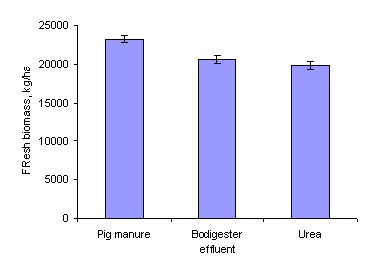
Figure 1. Fresh biomass yield of sweet potato vines according to source of fertilizer N |
|
MEKARN Regional Conference 2007: Matching Livestock Systems with Available Resources |
Two experiments were carriet out to determine the effect of different nitrogen sources and harvesting time on forage biomass yield and chemical composition of sweet potato (Ipomoea Batatas L.) and investigate the effect of replacing soybean meal with sweet potato meal on feed intake and performance of growing pigs on small holder farms. The first experiment was a split-plot arrangement to evaluate the biomass production of sweet potato, with 3 farms, each with three nitrogen sources (raw manure liquid [RML], biodigester effluent liqud [BEL] and urea liqid [UL]).
Vine (stem and leaf) and leaf biomass production at 30 day cutting intervals were 23.6 tonnes and 11.2 tonnes/ha for RML, higher compared to the BEL (20.6 tonnes and 9.9 tonnes) and UL (19.8 tonnes and 9.1 tonnes). The DM, CP, CF, ADF contents of sweet potato vines (SWPV) were significant higher for the RML treatment compared to the BEL and UL treatments. However, the DM, CP, CF and ADF contents of sweet potato leaf (SWPL) were not significantly among treatment (P>0.05).
The second experiment was with 54 crossed pigs F1 (Large White x Mong Cai) at three farms with 3 dietary treatments (0, 25 and 50% of soybean meal replaced by sweet potato leaf meal [SWLM]) and 3 replicates per treatment (2 pigs/replicate). Feed intakes were highest for the SPLM50 diet, but growth rates and feed conversion were best on the SPLM25 diet.
Sweet potato is planted widely in the Red River Delta, and the sweet potato vines and leaves are potential feed sources for livestock especially for pigs. Sweet potato leaves (SWPL) can be used for feeding pigs in fresh, dry and ensiled forms. However, the economic efficiency of these different forms has not been researched under farm conditions. SWPL are high in protein content (from 25.5 to 29.8 % in DM). Crude protein of sweet potato stems is lower (range from 11.5 to 13.7% (Le Van An 2004). Vegetables require many nutrient elements for good growth and production, but N, P and K are three elements of most concern. Leafy vegetables are especially heavy users of nitrogen (Luyen and Preston 2004). The practice of the farmers especially in rural areas of Red River Delta with shallow soils is to plant and harvest sweet potato but with little investment in fertilizers, for economic reasons (low prices for sweet potato root and high cost of fertilizer). Normally, the farmers use some of kind of traditional fertilizer: livestock manure, green manure or ash. It is very important to find out a cheaper way of supplying plant nutrients such as integrating livestock into the system, with utilization of the manure in biodigesters and application of the effluent as fertilizer for crop production such as sweet potato (Rodriguez and Preston 1996). Despite the potential for improved fertilizer capacity of effluent compared with raw manure there are few reports of trials to compare the two sources of plant nutrients. In Vietnam, Le Ha Chau (1998a,b) showed that the effluent from biogas-digesters charged with cattle or pig manure was superior to the fresh manure when applied to plots growing forage cassava and ponds growing duckweed. In both cases biomass yield and protein content were increased by the effluent compared with the fresh manure. The effluent resource from biodigesters is an abundant and cheap fertilizer easily applied by farmers. It can be used to replace the inorganic fertilizers. Biogas-digesters can play a pivotal role in integrated farming systems by reducing health risks, facilitating control of pollution and at the same time adding value to livestock excreta through production of biogas and improved nutrient status of the effluent as fertilizer for ponds and crop land (Preston et al 1996).
Soybean meal (SBM), fishmeal and meat meal are the main protein sources in commercial pig diets in many developed and developing countries. However, an increasing human demand for protein in developing countries and the relatively high cost of imported ingredients has turned attention to the exploitation of non-conventional ingredients and by-products, which these regions have in abundance (D´Mello 1995). In Vietnam, soybean meal and fishmeal are the major protein sources used in commercial feed for pigs. However, they tend to be rather scarce and expensive for small producers in the rural areas of Northern Vietnam. This has stimulated animal nutritionists to search for cheaper locally available feedstuffs and to investigate their composition and nutritive value.
In the present study, there were two experiments: application of three sources of nitrogen (biodigester effluent, raw manure and urea) to sweet potato cultivation; and replacement of soybean meal with sweet potato leaf meal in the diets of growing pigs.
The treatments applied to sweet potato were:
RML: raw pig manure
BEL: biodigester effluent
UL: urea
There were 9 main plots with 27 sub-plots (Table 1). The area of each main plot was 12*30 m (360 m2), and of the sub-plots 4*10m. Total area was 1080 m². The sweet potato was planted with 40 cm between rows and 10- 15cm between stem cuttings. All the nitrogen sources were applied in equal amounts every month at an overall level of 120 kg N/ha. Urea and raw pig manure were diluted with water to have the same solids (DM) content as the biodigester effluent before application to the sweet potato. The biodigester was charged with pig manure.
|
Table 1. Experimental layout of plots |
|||
|
Farm 1 |
RML |
BEL |
UL |
|
BEL |
UL |
RML |
|
|
UL |
RML |
BEL |
|
|
Farm 2 |
RML |
BEL |
UL |
|
BEL |
UL |
RML |
|
|
UL |
RML |
BEL |
|
|
Farm 3 |
RML |
BEL |
UL |
|
BEL |
UL |
RML |
|
|
UL |
RML |
BEL |
|
The study was carried out in Catque commune, Hoai Duc district, Hatay province with 54 F1 growing pigs (Large White x Mong cai) on three farms allocated to 3 dietary treatments with 3 replicates/treatment (2 pigs/replicate). A randomized factorial block design was used with each farm as one block.
The treatments were:
· SPLM0: Basal diet of maize meal, rice bran, soybean meal, fish meal and vitamin and mineral premix
· SPLM 25: Same as SPLM0 but with 25% of the soybean meal replaced by sweet potato leaf meal supplemented with synthetic lysine and methionine
· SPLM 50: Same as SPLM25 but with 50 % of soybean meal by with sweet potato leaf meal
Pigs were weighed every month. Feed intakes were calculated daily.
All analyses were performed in accordance with the methods of AOAC (1990).
Economic analyses were carried out using current prices in Vietnamese Dong (VND) to comparefeed costs per kg live weight gain.
The data from the agronomy and feeding trials were subjected to ANOVA using the General Linear Model (GLM) option in the MINITAB (Release 13.31) software for Windows (Minitab 2000) with the statistical model below. Pair-wise comparisons of treatment means were made using the Tukey test.
Yij = m + ai + βj + (aβ)ij + eij
m seq level0 \h \r0 seq level1 \h \r0 seq level2 \h \r0 seq level3 \h \r0 seq level4 \h \r0 seq level5 \h \r0 seq level6 \h \r0 seq level7 \h \r0 = the general mean
ai = the effect of ith dietary treatment
Βj = the effect of jth farms
(aβ)ij = the interaction between dietary treatment and farms
eij = the eth error term
Effect of different nitrogen sources on biomas yield, leaf:stem ratios and chemical composition of sweet potato
Application of nitrogen from raw pig manure supported higher forage biomass production compared to biodigester effluent and urea (Table 2; Figure 1).
|
Table 2. Least square means for biomass yield and leaf percent of vines in sweet potato fertilized with difference N sources |
|||||
|
|
RML |
BEL |
UL |
SEM |
|
|
Fresh biomass, kg/ha |
|
|
|||
|
Vines |
23257a |
20656b |
19842b |
506 |
0.001 |
|
Leaves |
11136a |
9938b |
9106c |
258 |
0.001 |
|
Leaf, % of vine |
48.2 |
48.4 |
46.7 |
0.95 |
0.38 |
|
abc Means in the same row without a common superscript are different at P<0.05 |
|||||
|
|
|
Figure 1. Fresh biomass yield of sweet potato vines according to source of fertilizer N |
Edited to here
The results in table 3 show that the DM, CP and CF contents of sweet potato vines were significantly higher for RML treatment compared to the BEL and UL treatments, however, the DM, CP, CF, ADF and NDF contents of sweet potato leaf were not significantly among treatment dry season in north Vietnam.
3.2. Feeding trial
The interaction between dietary treatment and farms on feed intake and performance of growing pigs were non-significantly difference.
seq level0 \h \r0 seq level1 \h \r0 seq level2 \h \r0 seq level3 \h \r0 seq level4 \h \r0 seq level5 \h \r0 seq level6 \h \r0 seq level7 \h \r0 Chemical composition, nutritive value of the dietary ingredients and experimental diets
The chemical composition and nutritive value of the dietary ingredients are given in Table 1. The soybean meal (SBM) used was a local variety with rather low crude protein (CP) (392 g/kg), lysine (20.0 g/kg) and methionine (5.4 g/kg) contents. The sweet potato leaf meal (SPLM) was make by sun-dried and milled to obtain the meals. The CP was 255 g /kg DM, the crude fibre (CF), NDF and ADF contents were 117 g, 269 g and 193 g/kg DM, respectively, the lysine and methionine contents were 3.8 g/kg and 2.9 g/kg DM, respectively for SPLM.
Experimental diets were formulated to contain 0 (control), 120 and 80 g/kg of SPLM (Table 2a, 2b), for first (20 to 50 kg) and second (50 to finish) period of growing pigs with supplementation of 150 g of SPLM and lysine and methionine. The diets used in the study were formulated to contain slightly lower levels of crude protein than the requirements of NRC (1998) which from 20 to 50 kg is 16 % CP and from 50 to 80 kg is 15 % CP. However, the present study was carried out on the crossed breed. The lysine and methionine contents of the basal diet (BSD) and SPLM diets were from 6.0 to 7.0 g/kg and 2.5 to 3.9 g/kg, respectively. This is agreed with recommendations of McDonald et al., (2001) that 7.5 and 3.9 g/kg, for lysine and methionine, respectively, which are also slightly lower compared to the feeding standards for pigs of NRC (1998). There was no difference among the BSD and SPLM diets with NRC (1998) standards for the lysine and methionine. The crude fiber (CF), neutral detergent fiber (NDF) and acid detergent fiber (ADF) contents of the SPLM diets were higher compared to the BSD diet.
Feed and nutrient intakes
Daily DM, CP, ME and nutrient intakes of growing pigs are shown in table 7. The mean DM, CP intake were 2.06, 2.08 and 2.20 kg DM/day for basal diet (BSD), SLPM25 and SPLM50 diet, respectively and significantly higher for the SPLM50 diet compared to the BSD and SPLM25 diet with supplementation of lysine and methionine (P<0.05). Especially, feed and nutrient intakes were significantly higher during first and second month of experimental period (20 to 50 kg of body weight). This indicated that feed intake is not only affected by crude fiber content but also depended on supplementation of lysine and methionine, and soybean meal could not completely replace with SPLM in the diet of growing pigs during first period at body weight of 20 to 50 kg. However, DM, CP, ME and feed intakes at second period of fattening pigs were non-significantly different among treatment. This indicated that dietary fiber is effected lower in adult pigs (second period) than in young pigs (first period), and soybean meal can be replaced with 50 % of SPLM in the diets of fattening period at body weight of 50 to 80 kg with supplementary lysine and methionine. This is agreed with some previous research that digestibility of dietary fiber is lower in young pigs than in adult pigs and negative effects to energy and nutrient digestibility (Bach Knudsen, 1997; Bach Knudsen and Jørgensen, 2001).
Average daily weight gains (ADG), feed conversion ratios (FCR) and feed costs/ kg gain (FCS) are shown in Table 8. The mean ADG was 701 g, 743 and 658 g/day, for the BSD, SPLM25 and SPML50 diets, respectively. The ADG was significantly higher for the SPLM25 diet compared to the BSD and SPLM50 diet (P<0.05). This indicated that soybean meal could not replace completely with SPLM. However, ADG was non-significantly difference between SPLM50 and BSD treatment during second period (fattening pigs), it indicated that soybean meal could be replaced 50 % with sweet potato leaf meal (SPLM) in the diets of adult pigs. Feed conversion ratio (FCR) was 2.94 kg DM, 2.80 kg DM and 3.34 kg DM/kg BWG, for the BSD, SPLM25 and SPML50 treatments, respectively. The ADG was significantly higher for the SPLM25 treatment compared to the BSD and SPLM50 treatments (P<0.05), however, there was no significant difference between BSD and SPLM50 treatments. It indicated soybean meal could be replaced 50 % with SPLM with supplementation of lysine and methionine. Feed cost per kg gains (FCS) was significantly higher for the BSD and SPLM50 treatments compared to the SPLM25 treatment. However, there was no significantly difference between BSD and SPLM50 treatments. It indicated that soybean meal can be replaced 50 % with sweet potato leaf meal with supplementary lysine and methionine, and improved economic efficiency of growing pig production under smallholder conditions.
4. Conclusions
It can be concluded that application of nitrogen at 120 kg N/ha from raw manure source lead to higher forage biomass production compared to the bio-digester effluent and urea sources. The DM, CP, CF, ADF and NDF contents of sweet potato leaves were not significantly different while applied diffrence of nitrogen sources from raw manure, biogas-digester and urea liqid, during dry season in north Vietnam. The soybean meal could replace 50 % with sweet potato leaf meal in the diets of growing pigs.
Note: Nitrogen content (%) of RM=1.15 %; BE=0.4 %, U=46 %.
Table 2. Effect of different nitrogen sources on biomas yield and ratios of fresh sweet potato vines (SWPV) (stem and leaf) and leaf (SWPL)
|
SWPV |
SWPL |
Ratios L/V (%) |
|||||||
|
|
Kg/ha |
SE |
P value |
Kg/ha |
SE |
P value |
L/V |
SE |
P value |
|
RML |
23257a |
506 |
0.001 |
11136a |
258 |
0.001 |
48.2 |
0.95 |
0.38 |
|
BEL |
20656b |
522 |
0.001 |
9938b |
266 |
0.001 |
48.4 |
0.98 |
0.38 |
|
UL |
19842b |
506 |
0.001 |
9106c |
258 |
0.001 |
46.7 |
0.95 |
0.38 |
a, b,c Means in the same colum without a common superscript are significantly different.
Table 3. Effect of different nitrogen sources on chemical compositions of SWPV and SWPL
|
Items |
SWPV |
SWPL |
||||
|
|
RML |
BEL |
UL |
RML |
BEL |
UL |
|
DM (g/kg DM)
|
143a |
135b |
131b |
127 |
128 |
120 |
|
- SE mean |
0.9 |
0.9 |
0.9 |
2.3 |
2.3 |
2.3 |
|
- P value |
0.001 |
0.001 |
0.001 |
0.07 |
0.07 |
0.07 |
|
CP (g/kg DM) |
174 |
181 |
164 |
288 |
267 |
264 |
|
- SE mean |
2.9 |
2.9 |
2.9 |
4.7 |
4.7 |
4.7 |
|
- P value |
0.01 |
0.01 |
0.01 |
0.01 |
0.01 |
0.01 |
|
CF (g/kg DM) |
179a |
168b |
166b |
144 |
143 |
142 |
|
- SE mean |
1.67 |
1.67 |
1.67 |
1.2 |
1.2 |
1.2 |
|
- P value |
0.001 |
0.001 |
0.001 |
0.65 |
0.65 |
0.65 |
|
ADF (g/kg DM) |
336 |
339 |
326 |
175 |
174 |
176 |
|
- SE mean |
3.7 |
3.7 |
3.7 |
1.7 |
1.7 |
1.7 |
|
- P value |
0.06 |
0.06 |
0.06 |
0.94 |
0.94 |
0.94 |
|
NDF (g/ kg DM) |
476 |
470 |
468 |
268 |
267 |
260 |
|
- SE mean |
2.3 |
2.3 |
2.3 |
5.0 |
5.0 |
5.0 |
|
- P value |
0.06 |
0.06 |
0.06 |
0.57 |
0.57 |
0.57 |
a, b Means in the same row without a common superscript are significantly different.
Table 4 . Second experimental design
|
Parameter |
Basal diet (BSD) |
SPLM25 |
SPLM50 |
|
No of farm |
3 |
3 |
3 |
|
No of treatment |
3 |
3 |
3 |
|
No of pig/replicate |
2 |
2 |
2 |
|
No of pig/treatment |
6 |
6 |
6 |
|
Total no of pig/treatment |
18 |
18 |
18 |
|
|
|
|
|
Table 5: Chemical composition of the dietary ingredients (g/ kg, DM basis)
|
Parameter |
Maize meal |
Rice bran |
Soybean meal |
Fish meal |
Sweet potato leaf meal |
|
DM (g/kg) |
863 |
875 |
910 |
890 |
910 |
|
CP (g/kg) |
106 |
113 |
392 |
510 |
255 |
|
EE (g/kg) |
39 |
115 |
141 |
102 |
37 |
|
NFE (g/kg) |
699 |
469 |
296 |
103 |
396 |
|
CF (g/kg) |
15 |
110 |
37 |
8.9 |
117 |
|
Ash (g/kg) |
14 |
83.7 |
44 |
244 |
109 |
|
Ca (g/kg) |
0.8 |
1.7 |
2.3 |
50.9 |
1.4 |
|
P (g/kg) |
2.4 |
16.5 |
6.3 |
28.8 |
6.0 |
|
NDF (g/kg) |
173 |
257 |
209 |
113 |
269 |
|
ADF (g/kg) |
31 |
118 |
80 |
91 |
193 |
|
Lysine (g/kg) |
2.7 |
4.6 |
20.0 |
24.3 |
3.8 |
|
Methionine (g/kg) |
1.7 |
2.4 |
5.4 |
8.4 |
2.9 |
|
ME (MJ / kg) (calculated) |
13.8 |
10.6 |
14.1 |
11.8 |
11.0
|
Table 6a: Ingredient and chemical composition of the experimental diets of first period (20 kg to 50 kg) of growing pigs, with supplementary lysine and methionine (DM basis)
|
Ingredient |
Basal diet (BSD) |
SPLM25 |
SPLM50 |
|
Maize meal (g / kg) |
560 |
520 |
510 |
|
Rice bran (g / kg) |
250 |
235.5 |
235.5 |
|
Soybean meal (g / kg) |
120 |
90 |
60 |
|
Fish meal (g / kg) |
50 |
50 |
50 |
|
Sweet potato leaf meal (SPLM) |
0 |
120 |
80 |
|
Lysine (g / kg) |
0 |
3 |
3 |
|
Methionine (g / kg) |
0 |
1.5 |
1.5 |
|
Vitamin premixa (g / kg) |
5 |
5 |
5 |
|
Mineral premixb (g / kg) |
15 |
15 |
15 |
Analyzed nutrients |
|
|
|
|
DM (g / kg) |
856 |
856 |
860 |
|
CP (g / kg) |
160 |
163 |
161 |
|
ME (MJ / kg) # |
12.7 |
12.5 |
12.5 |
|
EE (g/kg) |
72.5 |
60.9 |
61.0 |
|
NFE (g/kg) |
549 |
531 |
533 |
|
CF (g / kg) |
40.8 |
46.8 |
50.3 |
|
NDF (g / kg) |
194 |
209 |
210 |
|
ADF (g / kg) |
61 |
89 |
90 |
|
Ash (g / kg) |
46.2 |
62.5 |
62.9 |
|
Ca (g / kg) |
9.7 |
9.6 |
9.6 |
|
P (g / kg) |
7.7 |
7.8 |
7.8 |
|
Lysine (g / kg) |
7.3 |
8.8 |
7.4 |
|
Methionine (g / kg) |
3.6 |
4.1 |
3.9 |
|
Cost/kg (VND) c |
3420 |
3320 |
3455 |
Note: a Contains per 1,000 g vitamin premix supplied per kg diet: 1600 IU vitamin A, 300 IU, vitamin D3, 2 mg thiamine, 3 mg riboflavine, 300 mg choline, 15 mg niacin, 5 mg panthotenic acid, 15 mg pyridoxine, 0.5 mg folic acid. b Contains per 1,000 g mineral premix supplied per kg diet: 27 mg FeSO4.7H2O, 10 mg MnSO4.4H2O,, 15 mg CuSO4.5H2O, 85 mg MgSO4.7H2O, 0.3 mg CoSO4.7H2O, 0.1 mg KI, 0.02 mg Na2SeO3. C 1 USD = 16,100 Vietnamese Dong (VND), and # Calculated values
Table 7b: Ingredient and chemical composition of the experimental diets of second period (50 kg to finish) of fattening pigs, with supplementary lysine and methionine (DM basis)
|
Ingredient |
BSD |
SPLM25 |
SPLM50 |
|
Maize meal (g / kg) |
600 |
600 |
600 |
|
Rice bran (g / kg) |
230 |
210.5 |
195.5 |
|
Soybean meal (g / kg) |
100 |
75 |
50 |
|
Fish meal (g / kg) |
30 |
30 |
30 |
|
Sweet potato leaf meal (SPLM) |
0 |
150 |
150 |
|
Lysine (g / kg) |
0 |
3 |
3 |
|
Methionine (g / kg) |
0 |
1.5 |
1.5 |
|
Vitamin premixa (g / kg) |
5 |
5 |
5 |
|
Mineral premixb (g / kg) |
15 |
15 |
15 |
Analyzed nutrients |
|
|
|
|
DM (g / kg) |
854 |
856 |
856 |
|
CP (g / kg) |
154 |
153 |
151 |
|
ME (MJ / kg) # |
12.6 |
12.5 |
12.5 |
|
EE (g/kg) |
68.7 |
56 |
56 |
|
NFE (g/kg) |
573 |
576 |
576 |
|
CF (g / kg) |
38.4 |
40.0 |
44.2 |
|
NDF (g / kg) |
165 |
199 |
200 |
|
ADF (g / kg) |
60 |
73 |
74 |
|
Ash (g / kg) |
41.8 |
48.4 |
48.8 |
|
Ca (g / kg) |
8.7 |
8.5 |
8.6 |
|
P (g / kg) |
7.3 |
6.4 |
6.5 |
|
Lysine (g / kg) |
6.0 |
7.0 |
6.8 |
|
Methionine (g / kg) |
2.5 |
3.9 |
3.7 |
|
Cost/kg (VND) c |
3332 |
3390 |
3270 |
Note: a Contains per 1,000 g vitamin premix supplied per kg diet: 1600 IU vitamin A, 300 IU, vitamin D3, 2 mg thiamine, 3 mg riboflavine, 300 mg choline, 15 mg niacin, 5 mg panthotenic acid, 15 mg pyridoxine, 0.5 mg folic acid. b Contains per 1,000 g mineral premix supplied per kg diet: 27 mg FeSO4.7H2O, 10 mg MnSO4.4H2O,, 15 mg CuSO4.5H2O, 85 mg MgSO4.7H2O, 0.3 mg CoSO4.7H2O, 0.1 mg KI, 0.02 mg Na2SeO3. C 1 USD = 15,750 Vietnamese Dong (VND), and # Calculated values
Table 7: Effect of replacing soybean meal with sweet potato leaf meal and supplementation of lysine and methionine on nutrient intakes of growing pigs
|
Parameter |
BSD
|
SPLM25 |
SPLM50 |
SEM |
Sig. level |
|
Nutrient intake (DM basis) |
|
|
|
|
|
|
DM intake (kg/d) |
2.06a |
2.08a |
2.20b |
0.04 |
* |
|
First month |
1.56a |
1.62ab |
1.69b |
0.03 |
* |
|
Second month |
2.0a |
2.0a |
2.2b |
0.05 |
* |
|
Third month |
2.63 |
2.62 |
2.71 |
0.08 |
NS |
|
CP intake (g/d) |
311a |
317a |
335b |
11.2 |
* |
|
First month |
249a |
259ab |
273b |
5.2 |
* |
|
Second month |
313a |
323a |
351b |
8.6 |
** |
|
Third month |
371 |
369 |
382 |
11.2 |
NS |
CF intake (g/d) |
85a |
112b |
115b |
3.0 |
** |
|
First month |
64a |
92b |
95b |
1.5 |
** |
|
Second month |
80a |
115b |
119b |
2.9 |
** |
|
Third month |
110a |
126b |
132b |
3.7 |
** |
|
Lysine intake (g/d) |
11.9a |
14.9b |
9.2c |
0.3 |
** |
|
First month |
9.8a |
12.0b |
7.6c |
0.2 |
** |
|
Second month |
12.3a |
14.9b |
9.8c |
0.3 |
** |
|
Third month |
13.7a |
17.8b |
10.2c |
0.5 |
** |
|
Methionine (g / kg) |
5.2a |
8.0b |
5.1a |
0.2 |
** |
|
First month |
4.1a |
6.3b |
4.1a |
0.1 |
** |
|
Second month |
5.1a |
7.9b |
5.2a |
0.2 |
* |
|
Third month |
6.3a |
9.7b |
6.0a |
0.3 |
* |
|
ME intake (MJ/d) |
25.9 |
25.4 |
26.6 |
0.70 |
NS |
|
First month |
19.8 |
19.4 |
20.3 |
0.40 |
NS |
|
Second month |
24.8 |
24.2 |
26.2 |
0.65 |
NS |
|
Third month |
33.2 |
32.5 |
33.5 |
1.00 |
NS |
* and ** Significantly different at P< 0.05 and P<0.01, respectively.
NS is not significant, P>0.05. SEM is standard error of means.
a, b,c Means in the same row without a common superscript are significantly different.
Table 8: Effect of replacing soybean meal with sweet potato leaf meal with supplementation of lysine and methionine on average daily weight gains (ADG), feed conversion ratio (FCR), feed cost (FCS) of growing pigs.
|
Parameter |
BSD
|
SPLM25 |
SPLM50 |
SEM |
Sig. level |
|
Initial weight (kg) |
19.6 |
19.8 |
19.4 |
0.43 |
NS |
|
Final weight (kg) |
82.7a |
86.6b |
78.7c |
0.91 |
** |
|
ADG (g/d) |
701a |
743b |
658c |
8.9 |
** |
|
ADG1 |
520a |
554a |
458b |
13.8 |
** |
|
ADG2 |
712ab |
757b |
659a |
16.8 |
** |
|
ADG3 |
870a |
919 b |
858 a |
14.2 |
** |
|
FCR (DM/kg WG) |
2.94a |
2.80a |
3.34b |
0.06 |
** |
|
FCR1 |
3.03a |
2.93 a |
3.71 b |
0.07 |
** |
|
FCR2 |
2.82 a |
2.71 a |
3.30 b |
0.08 |
** |
|
FCR3 |
3.03 ab |
2.84 b |
3.20 a |
0.08 |
* |
|
FCS (VND/kg WG) |
11,017a |
9,579b |
10,999a |
247 |
** |
|
FCS1 |
10,370a |
8,933 b |
10,695 a |
231 |
** |
|
FCS2 |
13,115 a |
11,361 b |
13,384 a |
502 |
* |
|
FCS3 |
9,566 a |
8,442 ba |
8,918 a |
240 |
** |
|
DM intake (kg/d) |
2.06a |
2.08a |
2.20b |
0.04 |
* |
|
|
|
|
|
|
|
* and ** Significantly different at P< 0.05 and P<0.01, respectively.
NS is not significant, P>0.05. SEM is standard error of means.
a, b,c Means in the same row without a common superscript are significantly different.
1 USD = 16,100 Vietnamese Dong (VND).
5. References
An, B.X. and Preston T R., 1997. Gas production from pig manure fed at different loading rates to polyethylene tubular biogas-digesters. . Livestock Research for Rural Development (11) 2: http://www.cipav.org.co/lrrd/lrrd11/1/an111.htm
An, L.V., 2004. Sweet potato leaves for growing pigs, PhD thesis, Swedish University of Agricultural Sciences, Uppsala, Sweden, 2004.
AOAC, 1990. Official Methods of Analysis, (15th Edition, Association of Official Analytical Chemists, Washington, DC) .
Bach Knudsen, K.E. 1997. Carbohydrate and lignin contents of plant materials used in animal feeding. Animal Feed Science and Technology 67, 319-338.
Bach Knudsen, K.E., Johansen, H.N., Glitsø, V. 1997. Methods for analysis of dietary fibre advantages and limitations. Journal of Animal and Feed Sciences 6, 185-206.
Bach Knudsen, K.E., Jørgensen, H. 2001. Intestinal degradation of dietary carbohydrates –from birth to maturity. In: Lindberg, J.E. and Ogle, B. (Eds). Digestive Physiology of Pigs – Proceedings of the 8th Symposium. CABI Publishing, Wallingford, UK. p. 109-120.
Chau, L.H., 1998. Bio-digester effluent versus manure from pigs or cattle as fertilizer production of cassava foliage (Manihot esculenta). Livestock Research for Rural Development, Volume 10, Number 3 http://www.cipav.org.co/lrrd/lrrd10/3/chau1.htm
D, Mello, J.P.F., 1995. Leguminous leaf meals in non-ruminant nutrition. In Tropical Legumes in: Animal Nutrition. D, Mello, J.P.F and P. Devendra (Ed.). Biddles, Guildford, London, pp.247-281.
Dominguez P L and Ly J., 1997. An approach to the nutritional value for pigs of sweet potato vines (Ipomoea batatas (l.) lam). Livestock Research for Rural Development. Volume 9 Number 2 http://www.cipav.org.co/lrrd/lrrd9/2/ly92.htm
Dominguez P L., 1992. Feeding of sweet potato in monogastrics. In: Roots, tubers, plantains and bananas in animal feeding (Editors: David Machin and Solveig Nyvold). Animal Production and Health paper No 95, FAO: Rome, 1992. pp. 217-233. http://www.fao.org/ag/aga/agap/frg/AHPP95/95-217.pdf
Dominguez P L., 1990. Ipomoea batatas. Sweet potato. Animal Feed Resources Information System. http://www.fao.org/ag/AGA/AGAP/FRG/afris/Data/542.HTM
Farrell, D.J., Jibrila, H., Perez-Maldonadob, R.A. and Mannionb, P.F., 2000. A note on a comparison of the feeding values of sweet potato vines and Lucerne meal for broiler chicken. Animal Feed Science and Technology, 85, 145-150.
Garcia C, Gonzalez C, Diaz Ivonne and Vecchionacce H 1999. Features of behavior in pigs fed with root and foliage of Batata (Ipomoea batatas L.). http://bibliovet.veter.ucv.ve/Revistafcv/4003/vo;4003.htm
Giang, H.H., Ly, L.V. and Ogle, B., 2004. Evaluation of ensiling methods to preserve sweet potato roots and vines as pig feed. Livestock Research for Rural Development. Vol. 16, Art. #45. Retrieved, from http://www.cipav.org.co/lrrd/lrrd16/7/gian16045htm
Giang, H.H., Ly, L.V. and Ogle, B., 2004: Evaluation of ensiling methods to preserve sweet potato roots and vines as pig feed. Livestock Research for Rural Development. Vol. 16, Art. #45. Retrieved, from http://www.cipav.org.co/lrrd/lrrd16/7/gian16045htm
Giang, H.H., Ly, L.V. and Ogle, B., 2004. Digestibility of dried and ensiled sweet potato roots and vines and their effect on the performance and economic efficiency of F1 crossbred fattening pigs. Livestock Research for Rural Development. Vol. 16, Art. #50. Retrieved, from http://www.cipav.org.co/lrrd/lrrd16/7/gian16050.htm
Giang, H.H., Ly, L.V. and Ogle, B., 2004: Digestibility of dried and ensiled sweet potato roots and vines and their effect on the performance and economic efficiency of F1 crossbred fattening pigs. Livestock Research for Rural Development. Vol. 16, Art. #50. Retrieved, from http://www.cipav.org.co/lrrd/lrrd16/7/gian16050.htm
Goering H K and Van Soest P J., 1970. Forage fiber analysis (apparatus, reagents, procedures and some applications. ARS-USDA Handbook No. 379. Washington DC
Hartemink, A.E., Poloma, S., Maino, M., Powell, K.S., Egenae, J., O’Sullivan, J.N. 2000. Yield decline of sweet potato in the humid lowlands of Papua New Guinea. Agriculture, ecosystems & environment 79, 259-269.
Ishida, H., Suzuno, H., Sugiyama, N., Innami, S., Tadokoro, T., Meakawa, A., 2000. Nutritive value on chemical components of leaves, stalks and stems of sweet potato (Ipomoea batatas Poir). Food Chemistry. 68: 359-367.
Kean Sophea and Preston T R 2001 Comparison of bio-digester effluent and urea as fertilizer for water spinach vegetable. Livestock Research for Rural Development (13) 6: http://www.cipav.org.co/lrrd/lrrd13/6/Kean136.htm
Kyriazakis I and Emmans G C., 1995. The voluntary feed intake of pigs given feeds based on wheat bran, dried citrus pulp and rass meal, in relation to measurements of food bulk. British Journal of Nutrition 73: 191-207
Lin Y H, HuangT C and Huang C., 1988. Quality improvement of sweet potato (Ipomoea batatas L. Lam.) roots as feed by ensiling. The British Journal of Nutrition, volume 60, Issue 1, July 1988. pp 173-184.
Luyen, L.T. and Preston T R., 2004: Effect of level of urea fertilizer on biomass production of water spinach (Ipomoea aquatica) grown in soil and in water. Livestock Research for Rural Development. Vol. 16, Art. #81. Retrieved, from http://www.cipav.org.co/lrrd/lrrd16/10/luye16081.htm
Ly J., 2002. The effect of methionine on digestion indices and N balance of young Mong Cai pigs fed high levels of ensiled cassava leaves. Livestock Research for Rural Development 14 (6) 2002. http://www.cipav.org.co/lrrd/lrrd14/6/ly146.htm
Manfredini M, Badiani A, Nanni N and Chizzolini R 1993 Sweet potato chips in heavy pig production. Livestock Production Science, 35 (1993), pp. 329-340
McDonald P, Edwards RA, Greenhalgh J F D and Morgan C A (Editors) 2001. Animal Nutrition. Sixth edition. Longman Scientific and Technical, Longman Group Limited, Longman house, Burn Mill, Harlow, Essex CM20, 2JE, England.
Minitab, 2000. Reference Manual, 2000, Release 13.31 for Windows, Minitab Inc, PA, USA
Moat, M. and Dryden, G.M. 1993. Nutritive value of sweet potato (Ipomoea batatas (L.) Lam.) as a ruminant feed. Papua New Guinea Journal of Agriculture, Forestry and Fisheries 36, 79-85.
Nehring K. & Haenlein, G.F.W. 1973. Feed evaluation and ration calculation based on net energy. Journal of Animal Science, 36, 949-964
NIAH (National Institute of Animal Husbandry), 2001. Nutrient requirements of Tam Hoang meat type strains. In: Composition and Nutritive Value of Animal Feeds in Vietnam, (Agricultural Publishing House, Hanoi)
NRC, 1994. Nutrient Requirements of Pigs. 9th revised Ed, (National Academy Press, Washington DC)
Rodriguez, L. and Preston T R 1996 Use of effluent from low cost plastic biodigester as fertilizer for duckweed ponds. Livestock Research for rural Development. (9) 2: http://www.cipav.org.co/lrrd/lrrd9/2/lylian92.htm
Ruiz, M. E., Pezo, D., Martinez, L. 1980. The use of sweet potato (Ipomoea batatas, L. (Lam.)) in animal feeding. I. Agronomic aspects. Tropical Animal Health and Production, 5 (2), 144-151.
Spackman, D.H., Stein, W.H. & Moore, S. 1958. Automatic recording apparatus for use in chromatography of amino acids. Analytical Chemistry, 30, 1190-1206.
Viet, T.Q., Len, N.T., Giang, H.H., 2003. Digestibility and nitrogen retention of diets containing different levels of fiber in local (Mong Cai), F1 (Mong Cai x Large White) and exotic (Large White) fattening pigs in Vietnam. NUFU workshop, Agricultural Publishing House, Hanoi.
Woolfe, J. A. 1992. Sweet potato: an untapped food resource. Cambridge University Press, Cambridge, 643 pp.
Zhang, L.Y., Xie, Y.Z. 1990. Preliminary studies on potential uses of protein in sweet potato. Jiangsu-Nongye-Kexue 1, 22-24. ( English abstract).