 |
 |
|
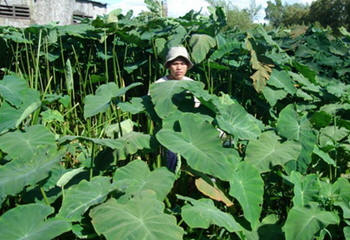
Photo 1. Harvesting water taro leaves |
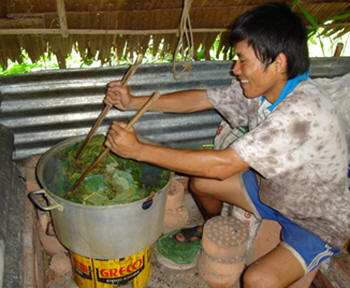
Photo 2. Cooking taro leaves before feeding to pigs |
|
MEKARN Regional Conference 2007: Matching Livestock Systems with Available Resources |
An experiment was conducted on a household farm in the agricultural suburb of Omon district, Cantho City to evaluate the effects of feeding water taro (Colocasia esculenta) leaves processed that completely replaced commercial protein in diets for fattening crossbred pigs. The experiment included 12 fattening pigs, with three treatments and four replicates and 1 pig allocated per pen. The three diets were fed and based on soya bean meal as a commercial protein suplement in diet (CTr, control), protein suplement completely replaced by cooked taro leaves (TLC) and silaged taro leaves completely replaced for commercial protein supplement (TLS). These diets were fed to fattening pigs which weighed around a 50 kg live weight at beginning to finishing 100 kg. Total mean daily dry matter (DM) intakes were 2506, 2164 and 2349 g (P<0.05) and daily weight gains of the pigs were 788, 720 and 739 g for the control (CTr), TLC and TLS treatments, respectively. Corresponding feed conversion ratios (dry matter basis) were 3.18, 3.01 and 3.19 kg (P>0.05) per kg weight gain for the pigs. Complete replacement of the commercial protein feed by cooked or silaged water taro leaves in the diets of the crossbred fattening pigs decreased the feed costs by 31 – 34 % compared to the control diet.
A big problem of pig raisers in the Mekong Delta has been very low or no benefits if they use commercial feeds purchased from the feed companies in 2007. Because the input costs are so high, several farmers did not want to continue with pig production based on commercial feeds at that time.
Taros are water plants that grow very well in both wet soil or submerged soil the year round. They resist attack from insects and viral diseases and can withstand the harsh conditions of the acid sulfate soil in the Mekong Delta in the dry season. On the other hand, the taros give high biomass yield with leaves that contain a crude protein level of around 23% of DM (Bui Xuan Men 2006, unpublished data). The water taros (leaf and petiole) have been used as a partial feed replacements in diets of local or crossbred pigs by several pig farmers in some areas of Vietnam but very rarely in the Mekong Delta. The taros will grow naturally on any wet and waste soils, especialy on the sides of roads, where the natural grass alternates with taros in the agricultural localities of Cantho City.
In order to solve the problems above, an on-farm trial was proposed using taro leaves processed as a protein source to completely replace the protein supplement in diets of fattening pigs.
Use of water taro leaves available in the village is a local protein feed source to replace imported materials and to keep raising pigs the year round. Collecting and processing taro leaves as a feed for pigs create local jobs for farmers during out of crop time, and increase income for producers, especially smallholdings commonly in the Delta.
Water taro leaves were collected every a two day from fallow areas in shallow ditches, two sides of roads or waste puddles. After collected the leaves were put on floor of a shed built under the tree shades to keep the the leaves in cooling temperature conditions whole days during storage times.
|
|
|
Photo 1. Harvesting water taro leaves |
Photo 2. Cooking taro leaves before feeding to pigs |
Whole taro leaves were cooked in a pan with 35 cm diameter and 40 cm deep, and the time for boiling around 15 minutes in each batch of cooking. Then the cooked leaves were drained before feeding to the pigs.
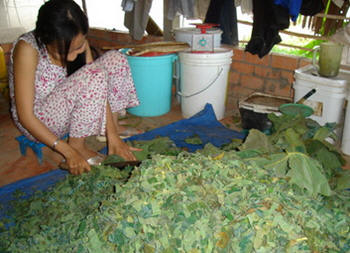
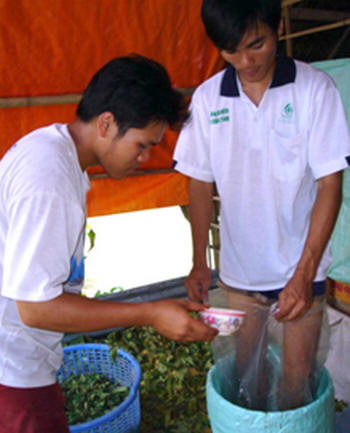
After collecting, whole taro leaves were separated on floor of a shed one day to decrease moisture of the leaves. Then the leaves were chopped in 3 cm pieces before ensiling as shown in Photo 3. Plastic bags (50 x 100 cm) were used to keep the leaves under anaerobic conditions. After a two week period, the ensiled leaves became a yellowish colour with an acid smell, and were considered to be ready to use in diets for the pigs.
 |
 |
|
Photo 3. Chopping taro leaves into pieces 3 cm in length |
Photo 4. Ensiling the water taro leaves in the household |
It is important that to ensile successfully it needs to add to the leaves 5% of molasses based on dry matter, and the molasses diluted in fresh water with the rate 1:10. During silaging it needs to mix all leaf pieces with the molasses solution, then press the mixture into the nylon bag which put inside a plastic barrel to expel some air out of the silage to prevent development of mold in silage.
A total of 12 castrated growing crossbred pigs with an average 50 kg live weight for each. These pigs were randomly allocated to 3 treatments with 4 replicates. The treatments were:
(1) the pigs were supplied commercial mash, control treatment (CTr)
(2) fresh taro leaves cooked as a complete replacement for soya bean meal (TLC), and
(3) ensiled taro leaves as a complete replacement for soya bean meal (TLS).
All pigs were fed these diets up to 100 kg live weight. The experimental pigs were kept in individual pens in a concrete shed in an integrated household farm of Omon district, an agricultural suburb of Cantho City.
The cooked and ensiled leaves were supplied to the pigs in treatments TLC and TLS, respectively around 30 minutes before these pigs received carbohydrate mixtures (maize and rice bran). All diets were offered to the pigs twice a day, in the morning (10:00) and in the afternoon (17:00).
Table 1. Estimated composition of the experimental diets (based on 90% of DM)
|
Ingredient |
CP in DM, % |
DM, % |
Experimental diet |
|||||
|
CTr |
TLC |
TLS |
||||||
|
As fed |
90%DM |
As fed |
90%DM |
As fed |
90%DM |
|||
|
Taro leaf |
23 |
20 |
0 |
0 |
135 |
30 |
135 |
30 |
|
SBM |
44 |
90 |
16 |
16 |
0 |
0 |
0 |
0 |
|
Maize |
9 |
90 |
60 |
60 |
16 |
16 |
16 |
16 |
|
Rice bran |
13 |
90 |
24 |
24 |
54 |
54 |
54 |
54 |
|
Total, kg |
- |
- |
100 |
100 |
205 |
100 |
205 |
100 |
|
CP, %a |
- |
- |
- |
14 |
- |
14 |
- |
14 |
a The ration will be formulated with 14% CP and offered to fattening crossbred pigs from 50 to 100 kg of body live weight (VN Husbandry Association, 2002)
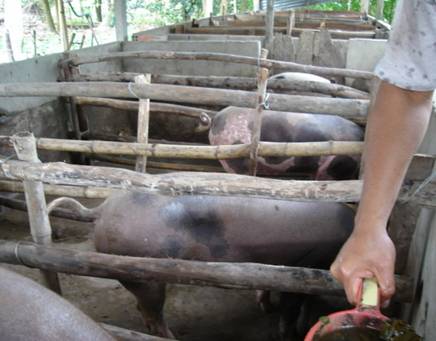
Photo 5. Experimental pigs were allocated in invidual pens
Parameters to be measured include yields of taro biomass wildly grown on the waste puddles, and nutrient composition of the taro leaves, and the other dietary ingredients. Pigs were weighed at the beginning and the end of the trial, and intake of feed recorded daily. Manure from the pigs were used for producing earthworms, and for a biodigester. The overall economics of the system were calculated.
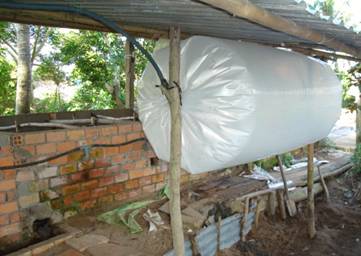
Photo 6. Biogas produced from wastes of the pigs
The samples of maize, fine rice bran, soya bean meal and water taro leave processed were analyzed for dry matter (DM), crude protein (N x 6.25), crude fibre, ether extract, nitrogen free extract and ash by standard AOAC methods (OAOC, 2000) at the laboratories of Cantho University.
Metabolizable energy (ME) contents of the diets were calculated from chemical analysis data using the equation of Bo Gohl, 1992: ME (kcal/kg) = 5,01 X1 + 8.93 X2 + 3.44 X3 + 4.08 X4.
The calculated digestable protein, digestible fat, digestible fibre and digestible nitrogen free extractives (g/kg of feed) are presented by X1 through X4, respectively. Estimated digestibility coefficients are according to NIAH (1992).
Data were analysed by analysis of variance using the General Linear Models procedure of Minitab, Version 13.2 program statistical software (2000).
RESULTS AND DISCUSION
Chemical composition of feeds used for fattening pigs
Table 2. Chemical composition of the feeds used in diets for fattening pigs
|
Ingredient |
DM |
Protein |
EE |
CF |
NFE |
Ash |
ME, kcal/kg* |
|
Maize meal, % |
91.3 |
9.6 |
4.8 |
1.7 |
73.9 |
1.4 |
3,430 |
|
Fine rice bran, % |
89.4 |
12.6 |
16.6 |
3.8 |
48.2 |
8.2 |
2816 |
|
Soybean meal, % |
91.6 |
45.7 |
2.4 |
2.5 |
34.1 |
6.9 |
3486 |
|
Cooked taro leave, % |
13.30 |
3.98 |
0.59 |
1.70 |
6.35 |
1.09 |
400 |
|
Silaged taro leave, % |
20.62 |
5.54 |
1.78 |
2.26 |
8.52 |
2.52 |
603 |
* data calculated
The data obtained in Table 1 show that taro leaves cooked higher moisture than the leaves silaged, so when the leaves cooked offered to the pigs needs a biomass higher. Protein level in soya bean meal is double higher than in the taro leaves silaged based on dry matter. Values of chemical composition of ingredients in Table 2 are a little bit higher than of those estimated in Table 1.
Impacts of experimental diets on feed intakes
Table 3. Effect of dietary treatment on daily intake
|
Parameter |
Treatment |
P value |
||
|
CTr |
TLC |
TLS |
||
|
Mash intake, g |
2,756a |
1,964b |
1,980ab |
0.001 |
|
Intake of taro leaves processed, g |
- |
3,019 |
2,763 |
- |
|
Total intake, g of DM |
2,505a |
2,164b |
2,349ab |
0.029 |
|
ME intake, kcal |
9,073a |
7,015b |
7,518ab |
0.001 |
|
Protein intake, g |
444a |
356b |
391ab |
0.006 |
a,b means without common superscripts within rows are significantly different (p<0.05)
Data in Table 3 show that after 66 days of experiment, live weight and daily live weight gains were higher for the CTr treatment, but there were no significant differences between treatments (P>0.05). Total DM, ME and protein intakes are higher for the control diet than for the leaves cooked diet (P<0.05)
Effect of dietary treatment on live weight gains
Data in Table 4 show that although offered double higher biomass of taro leaves diets than of control diet but the daily gains, feed conversion ratios are not significantly different between the pigs supplied soya bean meal and those offered taro leaves in diets.
Table 4. Live weight gains and feed conversion of fattening pigs
|
Parameter |
CTr |
TLC |
TLS |
P value |
|
Live weight, kg |
|
|
|
|
|
Initial |
51.8 |
51.8 |
52.0 |
0.987 |
|
Final |
103.8 |
99.3 |
100.8 |
0.515 |
|
Daily live weight gain, g |
788 |
720 |
738 |
0.289 |
|
FCR, kg DM/kg gain |
3.18 |
3.01 |
3.19 |
0.371 |
|
ME, kcal/ kg gain |
11,534a |
9,757b |
10,216ab |
0.008 |
|
Protein, g/kg gain |
564 |
495 |
531 |
0.085 |
a,b means without common superscripts within rows are significantly different (p<0.05)
Economic analysis
The results of the economic analysis are given in Table 5, which show that the lowest feed costs per kg live weight gain were for the TLS diet, in which the protein supplement was completely replaced by silaged taro leaves. There would thus appear to be marked economic benefits to the producers using taro leaves collected in the nature of villages by household labour.
Table 5. Estimates of feed cost assuming situation of farm based collection taro leaves
|
Parameter |
CTr |
TLC |
TLS |
|
Feed cost/kg gain, VND |
15,665 |
11,294 |
10,523 |
|
Rate, % of control |
100 |
72 |
67 |
* Based on price per kg for maize 4,000, rice bran 3,600 and soya meal 6,500, premixVit 50,000, salt 3500, bone meal 3500 VND; 16,000 VND=1US$
CONCLUSIONS
Water taro grows well in waste soil and puddles of the Mekong Delta and give leaf biomass in the year round. Fresh taro leaves were simply processed in cooking or silaging by household labour. The cooked or silaged taro leaveas were easily consumed as a replacement for soya bean meal, a the conventional protein source in diets for fattening crossbred pigs. Replacements of protein supplement for processed taro leaves in diets of pigs decreased feed costs for live weight gains for household producers. Use of water taro leaves to replace imported soya meal will decrease pressures of fluctuating costs, and pig producers can get more benefits and contribute to maintain raising pigs in a sustainable situation of the Delta.
In addition, raising pigs by households contributed the effects of recycling locally available low value wastes into valuable materials such as earth worms for poultry, vermicompost for vegetables and biogas for cooking.
REFERENCES
AOAC. 2000. Official methods of analysis. Association of Official Analytical Chemists,
Washington, DC.
Minitab Reference Manual (2000). Release 13.20 for Windows, Mintab Inc. USA.
National Institute of Animal Husbandry (NIAH). 1992. Feed for Pig. Composition and Nutritive
Value of Animal Feeds in Vietnam. Agricultural Publishing House, Hanoi. pp.140-188.
National Institute of Animal Husbandry (NIAH). 2000. Feed for Pig. Composition and Nutritive
Value of Animal Feeds in Vietnam. Agricultural Publishing House, Hanoi. p.8.
National Husbandry Association . 2002. Animal Nutrition Manual. Agricultural Publishing House
Hanoi. 116p.