|
MEKARN Regional Conference 2007: Matching Livestock Systems with Available Resources |
Hong Ha is one of 16 poor communes in Aluoi District, Thua Thien Hue Province, where there are different groups of the ethnic minority people living together. On farm feeding trials were carried out in Hong Ha Commune.
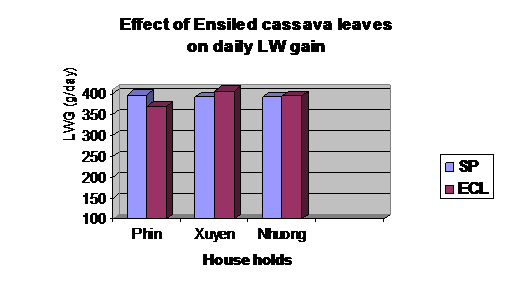
In experiment 1, twelve crossbred (Mong Cai x Large White) pigs of 18-20 kg initial live weight were randomly assigned to two treatments in 3 farms. There were 4 pigs per household. Six pigs were fed the control diet consisting of rice bran, ensiled cassava roots, fish meal and sweet potato vines with 160 g to 200 g crude protein/day and ME content 3,300 to 4,200 kcal/day for pigs (20 - 60 kg) and six pigs were fed ensiled cassava leaves to replace sweet potato vines. Daily weight gains were similar for the two treatments. Mean live weight gains were 394 g/day for the control treatment and 390 g/day for the diet with ensiled cassava leaves. There were no differences between treatments for feed conversion ration (3.57 and 3.61 kg DM/kg gain). Feed costs per kg live weight gain were 16% less for pigs fed ensiled cassava leaves compared to those given control diet.
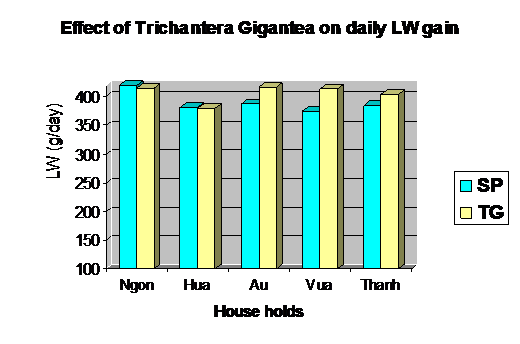
In experiment 2, eighteen crossbred (Mong Cai x Large White) pigs, with an average initial live weight of 9 kg, were randomly allocated to two treatments in 5 farms. The control diet consisted of rice bran, ensiled cassava roots, sweet potato vines and fish meal with 150 to 230 g crude protein/pig/day and ME content 2,900 to 4,800 kcal/pig/day for pigs (10 – 60 kg). In the experimental diet Trichanthera Gigantea leaves replaced sweet potato vines in control diet. Daily weight gains were similar for the two treatments. Mean live weight gains were 391 g/day for the sweet potato vines treatment and 403 g/day for Trichanthera treatment. There were no differences for feed conversion ratio (3.39 and 3.38 kg DM/kg LW gain). Feed costs per kg live weight gain were 11% less for pigs fed Trichanthera compared those given sweet potato vines.
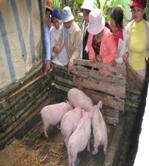
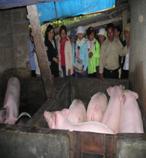
Activities designed to enhance the capacity of women in pig production were: Farmer to farmer exchange; study tours in Aluoi and Huong Tra districts for women; technical training courses on processing, preserving and using cassava roots and leaves and on planting and using Trichanthera gigantea. These activities resulted in building confidence and improving awareness for women in pig production.
Key words: Pigs, cassava root silage, cassava leaf silage, Trichanthera gigantea leaves,
performance, economics, women
Hong Ha commune is located in the mountainous area of Thua Thien Hue province. There are 224 house holds with 1262 people among which ethnic minority people (Catu, Taoi, Pahy) occupy 90% of the population. Most of cassava leaves are currently returned to the soil as a green manure and are therefore under utilized as a feed resource. The main ingredients used in pig feeds by farmers are generally low in protein. Conventional protein sources are rarely available. Cassava leaves is a good source of protein, minerals and carotene (Nguyen Thi Loc, 2000). Ensiled cassava leaves can be used for pig as a protein source.
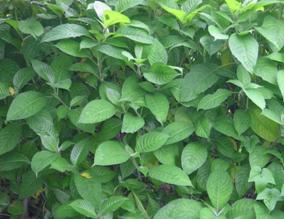
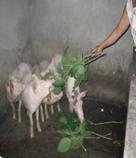
The multi-purpose tree Trichanthera gigantea was introduced into Vietnam from Colombia in 1990 (Nguyen Ngoc Ha and Phan Thi Phan, 1994) and developed to Thua Thien Hue province as a potential source of feed for livestock in 1995. In Hong Ha commune, sweet potato vines are commonly used as vegetable for pigs but in the dry season they are not growing well as Trichantera gigantea. After nine years of observations, it was clear that the plant could grow well in Thua Thien Hue province. In addition to being a good source of fresh feed in summer, leaves were readily consumed by pigs, ducks, chickens and goats.
The statistical analysis on the surveyed data in Hong Ha showed that there was gender division of labor in animal production. The men allocated more labor hours than women to cattle raising. Unlike for cattle production, women contributed much more of their time than men to pig and chicken raising. In reality, as in other areas of the country, pig raising is a female farmers’ job (Hoang Thi Sen, 2002). The investment and the knowledge on animal husbandry are limited although local people have tried their best to develop the animal husbandry. In this context, the research on using recommended protein feed resources and enhancing capacity for women in pig production is necessary for farmers.
The experiments were carried out in Hong Ha commune- Huong Tra Dicstrict-Thua Thien Hue province from 2004 to April 2006.
Experiment 1: Effect of ensiled cassava leaves in the diet to fattening pigs F1 (LW x MC) on pig performance and economic.
Twelve crossbred (MC x LW) pigs of 18-20 kg initial live weight were randomly assigned to two treatments in 3 farms. There were 4 pigs per house holds. 2 pigs were fed the control diet with 160 g to 200 g crude protein/day and ME content 3,300 to 4,200 Kcal/day and 2 pigs were fed ensiled cassava leaves to replace sweet potato vines. The pig ration was shown in table 1.
|
Table 1. Pig Ration |
||||||||
|
Live weight (kg) |
20-30 |
30-40 |
40-50 |
50-60 |
||||
|
Feed, (kg) |
SP |
ECL |
SP |
ECL |
SP |
ECL |
SP |
ECL |
|
Rice bran |
0.5 |
0.6 |
0.7 |
0.7 |
0.9 |
0.9 |
0.9 |
1.1 |
|
Fresh cassava |
1.5 |
1.5 |
1.5 |
1.5 |
1.7 |
1.7 |
1.9 |
1.9 |
|
ECL |
|
0.4 |
|
0.6 |
|
0.7 |
|
0.8 |
|
Fish meal |
0.2 |
0.15 |
0.2 |
0.1 |
0.22 |
0.1 |
0.15 |
0.1 |
|
Sweet potato vines |
0.5 |
|
0.5 |
|
0.5 |
|
0.5 |
|
|
DM (g) |
1225 |
1271 |
1337 |
1310 |
1605 |
1584 |
1709 |
1722 |
|
ME (Kcal) |
3297 |
3463 |
3433 |
3418 |
4071 |
4071 |
4099 |
4160 |
|
Protein (g/day) |
162 |
168 |
175 |
169 |
208 |
198 |
194 |
196 |
Experiment 2: Using Trichanthera Gigantea leaves for crossbred (LW x MC) pigs.
Eighteen crossbred (MC x LW) pigs with an average initial live weight of 9 kg, were randomly allocated to two treatments in 5 farms. The control diet with 150 to 230 g crude protein/pig/day and ME content 2,900 to 4,800 kcal/pig/day for pigs from 10-60 kg. In the experimental diet Trichanthera Gigantea leaves replaced sweet potato vines in control diet.
The pig ration was shown in table 2.
- Identifying the roles of gender in pig production.
- Training on processing, preserving and using recommended feed resources for pigs.
- Improve Women’s social activities in pig production.
- Study tours to some communes in Thua Thien Hue province.
- On farm workshops for evaluating trials on using recommended protein feed resources and sharing experience.
|
Table 2. Pig ration |
||||||||||
|
LW (kg) |
10-20 |
20-30 |
30-40 |
40-50 |
50-60 |
|||||
|
Feed, kg |
SP |
TG |
SP |
TG |
SP |
TG |
SP |
TG |
SP |
TG |
|
Rice bran |
0.8 |
0.8 |
0.8 |
0.8 |
0.9 |
0.9 |
0.9 |
0.9 |
1.0 |
1.0 |
|
ECR |
0.6 |
0.6 |
1.0 |
1.0 |
1.2 |
1.2 |
1.5 |
1.5 |
1.7 |
1.7 |
|
SPL |
0.3 |
|
0.5 |
|
0.5 |
|
0.5 |
|
0.5 |
|
|
TG |
|
0.25 |
|
0.45 |
|
0.45 |
|
0.45 |
|
0.45 |
|
Fish meal |
0.1 |
0.1 |
0.1 |
0.1 |
0.1 |
0.1 |
0.15 |
0.15 |
0.2 |
0.2 |
|
DM,g |
1030 |
1050 |
1220 |
1230 |
1370 |
1381 |
1470 |
11483 |
1730 |
1741 |
|
ME (Kcal) |
2920 |
2928 |
3367 |
3375 |
3815 |
1839 |
4209 |
4216 |
4761 |
4772 |
|
Protein (g/day) |
150 |
153 |
157 |
161 |
171 |
177 |
194 |
192 |
228 |
233 |
Parameters recorded: Samples of the concentrate mixture was taken at the beginning and the end of the trial for analysis DM, CP, EE, OM. Monthly live weight gain; Feed conversion ratios; Economic benefits; Technology Transfer in pig production.
The data were analysed by ANOVA using GLM option of the Minitab 10.2 (1998) software.
|
Table 3. Changing pH HCN content of cassava leaves in the ensilage process |
|||
|
Time (days) |
pH |
HCN (mg/kg fresh) |
% initial HCN |
|
0 |
6.7 |
286 |
100 |
|
21 |
3.8 |
179 |
63 |
|
28 |
3.8 |
129 |
45 |
|
56 |
3.7 |
112 |
39 |
Results of the experiment of using cassava leaves for the ensilage
|
Table 4. Effect of using ensiled cassava leaves (ECL) on growth performance of pigs |
||||
|
Treatments Parameters |
SP |
ECL |
SE |
P |
|
No. of pigs |
|
|
|
|
|
Days in experiment |
90 |
90 |
|
|
|
Initial live weight, kg |
18.2 |
20.2 |
0.744 |
0.086 |
|
Final live weight, kg |
53.6 |
55.3 |
0.833 |
0.187 |
|
Daily gain, g |
394 |
390 |
8.075 |
0.755 |
|
FCR, DM kg/kg gain |
3.57 |
3.61 |
0.075 |
0.669 |
|
Feed costs/kg gain (VND) |
8951 |
7550 |
|
|
|
% of control diet |
100 |
84 |
|
|
(Sweet potatoes vines: 500 VND/kg; Fish meal: 7.500 VND/kg; Rice bran: 2000 VND/kg; Fresh cassava roots: 300 VND/kg, Ensiled cassava leaves: 200 VND/kg).
Daily weight gains were similar for two treatments. Mean LWG were 394 g/day for the SP treatment and 390 g/day for ECL treatment. There were no differences between treatments for feed conversion ration (3.57 and 3.61 kg DM/kg gain). Feed costs per kg LWG were 16% less for pigs fed ensiled cassava leaves compared to those given control diet.
|
Table 5. Effect of using Trichantera Gigantea on growth performance of pigs |
||||
|
Treatments Parameters |
SP |
TG |
SE |
P |
|
No. of pigs |
9 |
9 |
|
|
|
Days in experiment |
120 |
120 |
|
|
|
Initial live weight, kg |
9.3 |
9.1 |
0.482 |
0.810 |
|
Final live weight, kg |
56.2 |
57.5 |
0.832 |
0.293 |
|
Daily gain, g |
391 |
403 |
5.577 |
0.141 |
|
FCR, DM kg/kg gain |
3.39 |
3.38 |
0.047 |
0,934 |
|
Feed costs/kg gain (VND) |
9854 |
8786 |
|
|
|
% of control diet |
100 |
89 |
|
|
(Rice bran: 2000 VND/kg; Sweet potato vices: 1000 VND/kg; Trichantera gigantea: 500 VND/kg; Ensiled cassava roots: 500 VND/kg; Fish meal: 9000 VND/kg).
In the experimental diet, Trichanthera Gigantea leaves replaced sweet potato vines in control diet. Daily weight gains were similar for the two treatments. Mean live weight gains were 391 g/day for the sweet potato vines treatment and 403 g/day for Trichanthera treatment. There were no differences for feed conversion ratio (3.39 and 3.38 kg DM/kg LW gain). Feed costs per kg live weight gain were 11% less for pigs fed Trichanthera compared those given sweet potato vines.
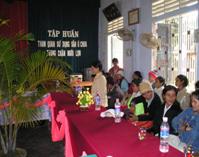
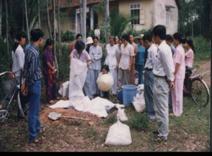
Technical training course on processing, preserving and using cassava roots and leaves.
Contents of the training:
- Process of cassava root and leaf ensilage
- Use of ensiled cassava roots and leaves in pig production.
|
|
|
|
|
Photo1. Training course on pig production |
Photo 2. Training course on ensiling cassava roots and leaves |
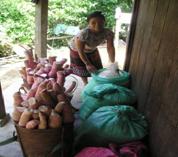
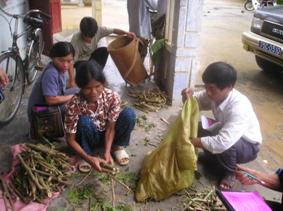
Photo 3. Farmers apply cassava root silage technique |
Technical training course on planting and using Trichantera Giantea.
|
|
|
|
Photo 4. Training course on planting and using Trichanthera Gigantea |
Photo 5. Trichanthera Gigantea trees planting in 18 farmer households |
Farmer to farmer exchange, study tours in Aluoi and Huong Tra districts
|
|
|
|
|
|
Photo6. Visiting farmer households to learn experiences on pig production in Hong Ha |
Photo 7. Visiting some farmers using TG
|
Photo 8. Women visited farmer households in Huong Van commune |
Photo 9. Sharing experiences on processing and using ECL and roots
|
Results: After 1 year training and visiting, villagers are improved:
71% of women who participate in this activity are enhanced communication and discussion capacity.
77% of women are able to carry out techniques such as cassava silage and use of available feed to raise pigs by themselves.
57% of women are more confident and active in their work so that their position in family and in society is raised.
45% of women are improved ability to organize working in animal husbandry, ability to mobilize members in their family and neighbors to work together and ability to work collectively.
83% of women said that via trainings on techniques of CR and leaf silage, techniques of TG planting and using, they could able to apply better so that income from pig production is higher.
• Feeding TG leaves replaced SP vines in control diet. LWG were similar for two treat (391 and 403 g/day). There were no differences for FCR (3.39 and 3.38 kg DM/kg gain). Feed costs per kg LWG were 11% less for pigs fed TG.
• Feeding ECL replaced SP vines in control diet. There were no differences between treatments for LWG (394 and 390 g/day) and FCR (3.57 and 3.61 kg DM/kg gain). Feed costs per kg LWG were 16% less for pigs fed ECL.
• Activities resulted in building confidence and improving awareness for women in pig production
Gomez G 1992 Use of cassava products in pig feeding. In: Roots, tubers, plantains and bananas in animal feeding FAO 1995. pp 157.
Limon R L 1992 Ensilage of cassava products and their use as animal feed. In: Roots, tubers, plantains and bananas in animal feeding FAO 1995, pp 99-109.
Nartey F 1978a Studies on cassava (Manihot utilissima Pohl) cyanogenesis. The biosynthesis of Phytochemistry 7: 1307-1312 pp.
Nguyen Thi Hong Nhan, Nguyen Van Hon, Vo Van Son, Preston T R and Dolberg Frands 1996 Effect of shade on biomass production and composition of the forage tree Trichanthera gigantea. Livestock Research for Rural Development. Volume 8, Number 2
Nguyen Thi Hong Nhan, Preston T R and Dolberg Frands 1997 Use of Trichantera gigantea leaf meal and fresh leaves as livestock feed. Livestock Research for Rural Development. Volume 9, Number 1:
Nguyen Thi Hong Nhan 1998 Agronomic and nutritional studies on Trichanthera gigantea. MSc Thesis, Cantho University, Vietnam
Rosales Mauricio 1997 Trichanthera gigantea (Humboldt & Bonpland.) Nees: A review. Livestock Research for Rural Development. Volume 9, Number 4.