Effect of slurry from low-cost plastic film biodigester on yield and chemical composition of cassava foliage and tuber yield
Duong Nguyen Khang
Department of Animal Physiology and Biochemistry,
Faculty of Animal Husbandry and Veterinary Medicine,
Nong Lam University, Vietnam
ABSTRACT
A 4*2 randomized complete block design with 4
replications was conducted from June 2002 to March 2003 at the
experimental farm of the Nong Lam University, Ho Chi Minh City,
Vietnam, to determine effect of slurry from low-cost plastic film
biodigester on yield of foliage and root tubers, and chemical
composition of the foliage. Cassava of the variety KM 94 grown in
plots of 10 m x 20 m at a planting distance of 30 cm x 50 cm was
hand-harvested according to respective treatments, starting 100
days after planting. All tubers was harvested at the final harvest
280 days after planting. Dry matter and crude protein foliage
yields increased in treatment compared to the control. Mean dry
matter foliage yields were 5.36 and 4.33 tonnes per ha with or
without the slurry, respectively. The leaf dry matter proportion
was high, ranging from 60 to 66%. The proportion of leaf increased
and the stem decreased with the slurry. Crude protein content in
cassava foliage ranged from 18.6 to 20.7% and affected by slurry.
The CP production was 39% higher with the slurry. The ADF and NDF
contents of foliage varied between 24.3 and 28.4%, and 35.3 and
37.6% of DM, respectively. The fresh tuber yield in the control
treatment was 25.5 tonnes per ha. The slurry had significant
positive effect on tuber yield. The mean fresh weight of root
tubers was 7% higher with the slurry. It is therefore concluded
that the slurry from biodigester could be fertilized for foliage
production as well as tubers under these conditions.
Key words: cassava, foliage, tuber, slurry,
biodigester
INTRODUCTION
Economic evaluation studies have shown the importance of using
the digested slurry after the anaerobic digestion process, as well
as the biogas. The economic importance of the digested slurry is
becoming more acceptable in recent years in the developing
countries as well, and this concept is presented in many
publications of China, India and other countries. The slurry
discharged from a digester contains 1 - 12% solids and consists of
refractory organics, new cells formed during digestion, and ash.
The slurry can be used in its liquid or solid fractions, dried or
as total slurry. In most countries where biogas plants were
constructed, the slurry was used as a fertilizer. According to
studies in Sichuan province of China in year 1979, the nutrient
contents of the effluent increased yields by 6 - 10%, regardless of
kinds of soil; group has reported the same results in other parts
of the world. In long-term experiments, it was shown that the
chemical and physical properties of the soil were improved
markedly, after a few years of applying digester effluent, while
total yields of severa1 crops were 11- 20% higher than controls.
Cassava (Manihot esculenta Crantz), a tropical root crop
widely cultivated in Vietnam, has great potential as a starch
source for both human and animal consumption. The cassava plant
also produces a lush crop of leaves, which are rich in protein,
minerals and vitamins (Oomen and Grubben, 1978) and are regarded
as a good protein source (Lancaster and Brooks, 1983). The crude
protein content in cassava foliage ranges from 19 to 23% of dry
matter (Khang and Wiktorsson, 2000; Man and Wiktorsson, 2001; 2002;
Arvidsson and Sandberg, 2003). Up to the present time, most of the
experimental work reported has been focused on the production
potential of cassava root for human and animal food, and only a few
published reports have focused on cassava foliage production as a
protein feed for livestock, together with tuber production (Hong et
al., 2003; Tung et al., 2001; Khang et al. 2004). However, the
effects of slurry from biodigester on foliage and tuber yields and
nutritive value of cassava foliage have not yet been fully
investigated. The objectives of this experiment were to determine
whether a high tuber yielding variety, KM 94, could yield
reasonable amounts of foliage as well as tubers under these
conditions.
MATERIALS AND METHODS
Location, land and climate
The study was conducted from June 2002 to March 2003 at the
experimental farm of Nong Lam University, Ho Chi Minh City,
Vietnam. The soil contained 54% sand, 39% silt, 7% clay, 0.62%
organic carbon, with 6.87, 76.21, 3.69, 1.13 and 0.13 meq per 100 g
of N, P, K, Ca and Mg, respectively, and a pH KCl of
5.79 at 15 cm depth (Soil Chemistry Lab. Data, Nong Lam University,
Ho Chi Minh City, Vietnam, 2002).
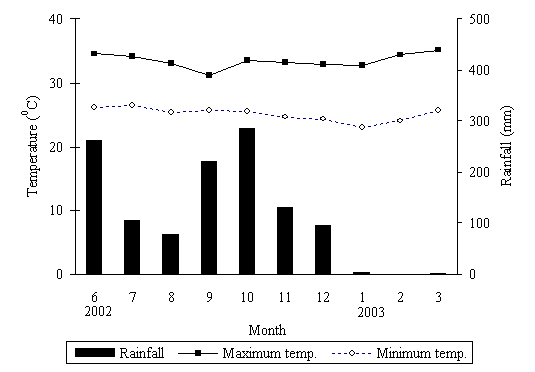 |
The climate in the area is a tropical monsoon, with the rainy season between May and December and the dry season from February to April. The monthly mean temperatures ranged from about 27.5 0C to 34 0C with minima in December and February and maxima during the dry season. The mean relative humidity was 76% (Figure 1).
Figure 1. Monthly rainfall and temperature at the time of
the experiment
The land was first cleared from weeds, and then ploughed by
tractor to a depth of 20 - 25 cm to loosen the soil. Weeds were
also removed twice during the establishment period.
Experimental design and treatments
Cassava was planted in monoculture for all the plots. The
plots are each 10*20 m (200 m2) arranged in a
randomized complete block design with 4 replications. Allocation of
treatments was shown in Table 1. The experiment was set up in a
field of 1940 m2, of which 1600 m2 was used
for planting and 340 m2 was border areas.
Table 1: The layout of the experiment
|
Blocks |
Treatments |
|
|
1 2 3 4 |
C CS C CS |
CS C CS C |
- C: Cassava without slurry
- CS: Cassava with slurry Cassava with slurry
Establishment and management
Cassava, variety KM 94, was planted early June 2002 and the
final harvest was 280 days after planting. Planting materials were
chosen from healthy and disease-free plants and cut into segments
just before planting. Cassava stem was planted in continuous rows
with 50 cm between rows, 30 cm between stem cuttings, and grown as
a pure stand. The length of stem was 20 - 25 cm. The planting depth
was 15 cm. Only cattle slurry was applied to the plots cassava with
slurry at 5 tones of DM per ha. The same rate of slurry was applied
after each harvest in these plots. No other fertilizers were
applied during the experimental period.
Harvesting and chemical analysis
The first harvest was made when the cassava plants reached 100
cm in height (about 100 days after planting). All the foliage was
cut at 30 cm above the ground. The same pattern was followed for
the re-growth at 60 days interval. Cassava foliage (comprising
young stems, leaves and petioles) was hand-harvested. Cassava
foliage was harvested between 08:00 h to 10:00 h to avoid HCN
fluctuation, which occurs later during the day due to the hot sun
(Yeoh and Oh, 1979). Cassava tubers from all treatments were
harvested at the final harvest. All cassava foliage and tubers from
each plot were weighed to determine the fresh yield. The fresh
foliage was sampled and pooled from the 3 replicates (1.5 kg fresh
weight each), and was placed in a porous paper bag for dry matter
determination and chemical analyses. A similar sample was collected
to determine the ratio of leaf, petiole and stem to total foliage
on a DM basis. The contents of crude protein (CP), ether extract
(EE) and total ash in the samples were determined according to the
procedure of AOAC (1990). The contents of neutral detergent fiber
(NDF) and acid detergent fiber (ADF) were determined according to
the procedure of Van Soest et al. (1991). Total condensed tannin
was determined by the butanol-HCl method (Terrill et al., 1992).
The HCN content was determined by the alkaline titration method
(AOAC, 1990).
Statistical analysis
Data were statistically analyzed by using General Linear Model
Procedure of Minitab Statistical Software version 13.31. When the
F-test was significant (p < 0.05), the Tukey's Tests for
paired comparisons was used to compare means. The relationship
between foliage yields or tuber yield, respectively, and cutting
intervals were determined using the linear or quadratic responses
in Fitted Line Plot procedure of Minitab 13.31.
RESULTS
Effects of slurry from low-cost plastic film
biodigester on yield of foliage and tubers
Data on foliage and tuber yields of cassava for the whole period
of 280 days after planting are summarized in Table 1. The slurry
from low-cost plastic film biodigester had significant effects on
yield. The control treatment without slurry had a significantly
lower foliage yield than the other. Compared with the control
treatment, there was an average increase of 24% in total DM foliage
yield when the foliage was applied with the slurry from
biodigester.
The slurry from low-cost plastic film biodigester had
significant positive effects on tuber yield (Table 2). The mean
fresh tuber yield increased by 7% in total when the foliage was
applied with slurry at 5 tonnes of DM per ha.
Table 2. Forage and tuber yields of cassava applied with
or without slurry
________________________________________________________________________
Slurry
___________________
Yield (tonnes ha-1)
Without With SEM p
________________________________________________________________________
DM foliage 4.33
5.36 0.19
0.01
Crude protein 0.80
1.11 0.04
0.001
Tuber root 25.49
27.25 1.10
0.30
________________________________________________________________________
Effects of slurry from low-cost plastic film
biodigester on fresh and dried weight proportions of
foliage
Fresh and dried weight proportions of cassava foliage applied
with or without slurry are presented in Table 3. There were
significant differences in the proportion of leaf and stem between
treatments. Percent of leaf increased with the slurry from
biodigester, while proportion of stem showed the opposite trend.
The results were the same for both fresh and dried weight
proportions of cassava foliage.
Table 3. Fresh and dried weight proportions of cassava
foliage applied with or without slurry
________________________________________________________________________
Slurry
___________________
Proportion (%) Without
With SEM p
________________________________________________________________________
Fresh proportion
Petiole 20.46
20.72 0.19 0.53
Stem 19.09
17.43 0.52 0.05
Dry proportion
Petiole 20.13
18.39 0.14 0.001
Stem 19.75
16.08 0.49 0.001
________________________________________________________________________
Effects of slurry from low-cost plastic film
biodigester on chemical composition of foliage
The analyses showed that CP content in cassava foliage varied
from 18.6 to 20.7% of DM (Table 4). The slurry from biodigester
influenced CP content. The mean value increased by 12% when the
foliage was applied with slurry at 5 tonnes of DM per ha. The ADF
and NDF contents of foliage varied between 24.3 and 28.4%, and 35.3
and 37.6% of DM, respectively, and were affected by slurry from
biodigester. The mean HCN content of fresh foliage increased, while
the mean tannin and ash contents decreased with the slurry from
biodigester (Table 4). There were no differences in the content of
ether extract.
Table 4. Average chemical composition (% DM) of cassava
foliage applied with or without slurry
________________________________________________________________________
Slurry
___________________
Item
Without With SEM p
________________________________________________________________________
Dry matter of foliage (%) 18.68
17.08 0.32 0.01
Percentage of dry matter (%)
CP 18.55
20.72 0.45 0.01
Ash 5.68
5.14 0.07 0.001
NDF 37.64
35.33 0.45 0.001
ADF 28.36
24.33 0.43 0.001
Tannin 3.98
3.64 0.11 0.05
HCN (mg 100 g-1 fresh weight) 84.32
91.89 0.59
0.001
________________________________________________________________________
DISCUSSION
Dry matter yield of cassava foliage in the present study
increased from 4.3 to 5.4 tonnes per ha when cassava foliage
applied with slurry at 5 tonnes DM per ha. The foliage yields were
slightly lower than the figures reported by Tung et al. (2001).
They conducted an experiment in which three cassava varieties (MM
92, Black Twig and Local) were grown for foliage yield estimation.
The results showed that dry foliage yields of MM 92, Black Twig and
Local cut at 45 day cutting intervals and about 15 cm harvesting
height over the 5 harvests were 5.9, 5.7 and 4.3 tonnes
ha-1, respectively. Thus, differences in DM foliage
yield could be due to the differences in variety (Gomez and
Valdivieso, 1984; Simwambana et al., 1992), fertilizer (Molina and
El-Sharkawy, 1995), age at first cutting and interval between
cuttings (Lockard et al., 1985; Simwambana et al., 1992; Tung et
al., 2001; Hong et al., 2003). Although there is no data shown from
the present study on the effects of seasons on cassava foliage
yield, DM yield was reduced in all the treatments, strongly on the
control treatment during the last three months of the experimental
period, most likely due to the onset of dry season.
The mean dry leaf proportion of the foliage was high (63%)
but with a wide range, from 60 to 66% (Table 3). The mean was
higher than found in an earlier study by Meyrelles at al. (1977)
where the leaf proportion of cassava foliage on DM basis was almost
52% of shoot yield. The yield difference between varieties is
obvious, in addition to environmental and treatment factors. In the
present study, the dry leaf proportions were higher with applying
the slurry.
Crude protein content of cassava foliage ranged from 18.6 to
20.7% on DM basis in all treatments (Table 4). These results were
similar to the figure of 22.8% reported by Khang and Wiktorsson
(2000), and 18.8% reported by Man and Wiktorsson (2001). The
results showed that CP content on DM basis increased from 18.6 to
20.7% with applying the slurry from biodigester. Estimated protein
yield in the present study ranged from 0.8 to 1.11 tonnes per ha
with applying the slurry from biodigester during the growing period
of 280 days. This was lower than the levels of 1 to 1.5 tonnes per
ha with five cuts at 45 day interval for three cassava varieties
reported by Tung et al. (2001).
Fibre components of cassava foliage varied from 35.3 to
37.6% of NDF and from 24.3 to 28.4% of ADF. Applying the slurry
decreased NDF and ADF contents. The levels of NDF and ADF were
equal to those found by Arvidsson and Sandberg (2003), but lower
than those reported by Man and Wiktorsson (2001, 2002). The
differences were probably due to differences in cassava variety,
study site and seasonal conditions.
Root yield was affected by the slurry, with
a increase in tuber yield of 7% compared to the control treatment
without the slurry until 280 days after planting. A similar, but
less pronounced affect has been reported by Dahniya et al. (1981)
with a high yielding cassava tuber variety. However, they only
picked the leaves from the top 30 cm of each branch at 1, 2, and 3
month intervals.
CONCLUSIONS
The slurry from biodigester strongly influenced the DM and CP
yields of cassava foliage, the fresh weight of root tubers and to a
less extent the nutritional quality of foliage produced during a
growing season of 280 days. The DM foliage, fresh weight of root
tubers and CP yields were higher when the foliage was applied with
slurry at 5 tonnes per ha. It is therefore concluded that slurry
from biodigester could be fertilized for foliage production as well
as tubers under these conditions.
ACKNOWLEDGMENTS
The authors are grateful to the Swedish International
Development Cooperation Agency, Department for Research Cooperation
(Sida/SAREC) for funding this study and Mr. Tuan and Mr. Thanh for
their technical help.
REFERENCES
AOAC, 1990. Official methods of analysis of the Association of Official Analytical Chemists (15th Ed.), Washington, DC. 1: 69-90.
Arvidsson, K. and Sandberg, J., 2003. Cassava (Manihot esculanta Crantz) foliage: a crop by-product and potential protein feed for dairy cattle in Vietnam. MSc thesis. Swedish University of Agricultural Sciences, Uppsala, Sweden.
Dahniya, M.T., Oputa, C.O. and Hahn, S.K., 1981. Effects of harvesting frequency on leaf and root yields of cassava. Expl. Agric. 17: 91-95.
Gomez, G. and Valdivieso, M., 1984. Cassava for animal feeding: effect of variety and plant age on production of leaves and roots. Anim. Feed Sci. Technol. 11: 49-55.
Hong, N.T.T., Wanapat, M., Wachirapakorn, C., Pakdee, P. and
Rowlinson, P., 2003. Effects of timing of initial cutting and
subsequent cutting on yields and chemical compositions of cassava
hay and its supplementation on lactating dairy cows. Asian-Aus. J.
Anim. Sci. 16: 1763 - 1769.
Khang, D.N. and Wiktorsson, H., 2000. Effects of cassava leaf
meal on the rumen environment of local yellow cattle fed
urea-treated paddy straw. Asian-Aus. J. Anim. Sci. 13:
1102-1108.
Khang, D.N., Wiktorsson, H. and Preston, T.R., 2004. Yield and
chemical composition of cassava foliage and tuber yield as
influenced by harvesting height and cutting interval. In: Cassava
foliliage as a protein source for cattle in Vietnam. Doctoral
thesis.
Lockard, R.G., Saqui, M.A., and Wounuah, D.D., 1985. Effects of time and frequency of leaf harvest on growth and yield of cassava (Manihot esculenta Crants) in Liberia. Field Crops Res. 12: 175-180.
Man, N.V. and Wiktorsson, H., 2001. Cassava tops ensiled with or
without molasses as additive effects on quality, feed intake and
digestibility by heifers. Asian-Aus. J. Anim. Sci. 14:
624-630.
Man, N.V. and Wiktorsson, H., 2002. Effect of molasses on
nutritional quality of cassava and Gliricidia tops silage.
Asian-Aus. J. Anim. Sci. 15: 1294-1299.
Meyrelles, L., MacLeod, N.A. and Preston, T.R., 1977. Cassava forage as a source of protein: effect of population density and age of cutting. Trop. Anim. Prod. 2: 18-26.
Molina, J.L. and El-Sharkawy, M.A., 1995. Increasing crop production in cassava by fertilizing production of planting material. Field Crops Res. 44: 151-157.
Simwambana, M.S.C., Ferguson, T.U. and Osiru, D.S.O., 1992. The effects of time to first shoot removal on leaf vegetable quality in cassava (Manihot esculaenta Crants). J. Sci. Food Agric. 60: 319-325.
Terrill, T.H., Rowan, A.M., Douglas, G.B. and Barry, T.N., 1992. Determination of extractable and bound condensed tannin concentrations in forage plants, protein-concentrate meals and cereal grains. J. Sci. Food Agric. 58: 321-329.
Tung, C.M., Liang, J.B., Tan, S.L., Ong, H.K. and Jelan, Z.A.,
2001. Foliage productivity and growth persistency of three local
cassava varieties. Asian-Aus. J. Anim. Sci. 14:
1253-1259.
Van Soest, P.J., Robertson, J.B. and Lewis, B.A., 1991. Methods for dietary fiber, neutral detergent fiber and non-starch polysaccharides in relation to animal nutrition. J. Dairy Sci. 74: 3583-3597.
Yeoh, H.H. and Oh, H.Y., 1979. Cyanide content of cassava, Malayan Agri. J. 52: 24-28.