| Workshop-seminar, 23-25 May, 2005, MEKARN-CTU |
Water spinach (Ipomoea
aquatica) as replacement for guinea
grass for growing and lactating rabbits
Tran Hoang Chat, Ngo Tien Dung, Dinh Van Binh and T R Preston
Abstract
Experiment 1: This trial was conducted in the field at Goat and
Rabbit Research Centre, Sontay, Hatay, Vietnam from April to
December to evaluate response of water spinach to fertilization
with increasing level (0, 10, 20, 30, 40, 50, 60 kg N/ha for 28
days) of Nitrogen (Worm cast and Urea) on biomass yield, soil
characteristics. The biomass yield of water spinach were 0.67;
1.13; 1.85; 2.11; 2.24; 2.44; 2.49 and 0.64, 1.27; 1.96; 2.34;
2.54; 2.74; 2.85 tones DM/ha with 0, 10, 20, 30, 40, 50, 60 kg N/ka
of Urea and worm cast, respectively. There was positive effect on
biomass yield of water spinach with level of Nitrogen application.
The results were showed significant higher of biomass yield, better
soil fertility expressed of OM, N, P205 and
K20 of using worm cast as fertilizer for water spinach
than using Urea.
Experiment 2: Forty-eight weaned rabbits (New Zealand white)
with average initial weight of 1423g (growth trial) and thirty-six
lactating rabbits (New Zealand white) with average initial weights
of 3461g in the third lactation were used in the studies to
evaluate water spinach replaced guinea grass in the diet of
concentrate and molasses block. The experiments were designed as a
completely randomized design arrangement. The guinea grass replaced
by water spinach at six levels: 0, 20, 40, 60, 80, 100 % based on
dry matter. The experiments period were 42 days for growth trial
and 75 days for lactating trial. The growth rates at the six
levels of inclusion were 25.5; 26.9; 27.2; 29.19; 29.33; and 31.4
g/day, feed conversion ratio were 4.79; 4.66; 4.64; 4.28; 4.26 and
3.87 kg DM/kg, live weight gain (LWG) and feed costs were 18 310;
17 490; 17 330; 17 250; 16 480 and 15 290 Vietnamese dong (VND)/kg
LWG, respectively(in the growth trial).The milk yield at the six
level were 83.2; 86.0; 90.2; 94.4; 97.8 and 100.9 g/day and daily
gain of baby rabbits were 15.9; 18.5; 18.7; 19.8; 19.5 and 21.1
g/day respectively (in the lactating trial). Increasing levels of
water spinach had a positive effect on CP intake but the DM intake
was similar for all treatments.
Key words: Water spinach, Worm cast, Urea, Rabbits, Growth,
Replacement
Introduction
The vegetable production in Vietnam is mainly dependent on
external inputs in the form of seeds, pesticides and chemical
fertilizers. The cultivation of vegetables is according to the
microclimate, soil characteristics and fertility and seasons. Most
farmers cannot afford the chemical inputs and this leads to very
low yields. Vegetables require many nutrient elements for good
growth and production but N, P and K are the three elements of most
concern. Vegetable leaves are especially heavy users of
nitrogen.
Animal manure is a potential replacement for chemical fertilizer and is traditionally used by poor farmers in Vietnam. However, it is not properly managed so that the efficiency of utilization of the manure is very low. According Le Ha Chau (1998a,b), effluent from plastic bio-digesters charged with pig or cow manure as fertilizer for cassava and duckweed, gave higher biomass yield and protein content. Using earthworm compost has been done at the Goat and Rabbit Research Centre. Earthworm compost was compared with the original manure for growth of maize plants. The maize grew at twice the rate on the worm compost compared with the manure (Nguyen Quang Suc et al 2000).
Water spinach (Ipomoea aquatica) spinach is a
variable water and marsh plant with creeping, hollow, water filled
stems and shiny green leaves and planted as a vegetable in
Southeast Asia, China, India, Malaysia, Africa, Brazil, the West
India, and Central America. It is cultivated for food and used as
pig and cattle feed throughout Southeast Asia. The fresh leaves and
stems of water spinach have a crude protein content of around 28%
in DM. Crude fibre and ash concentrations are around 12% and 19% of
DM, respectively (Göhl 1981). Water spinach is readily eaten
by pigs and is a locally available feed resource throughout the
Mekong delta of Vietnam. It has been used successfully to replace
part of the protein in a diet of sugar cane juice for breeding sows
(Le Thi Men and Bui Hong Van 1993). Recent results from Vietnam
show that rabbits grew at 18 g/day when fed only on fresh water
spinach (Hongthong Phimmmasan et al 2004).
The objective of the study were to
-
Evaluate response of the water spinach to fertilization of compost from earthworm and urea on biomass yield and chemical composition
-
Effect of percentage replacement of guinea grass with water spinach on growth rate, feed conversion ratio (FCR) of growing rabbits
-
Effect of percentage replacement guinea grass with water spinach on reproductive performance of lactating rabbits.
Materials and methods
Location: Three experiments were conducted at the Goat and
Rabbit Research Centre, Sontay, Hatay province, North Vietnam in
2004-2005
Experiment 1: Response of water spinach to
fertilization of increasing levels of compost from earthworm and
urea
Design and treatments:
The experiment was laid out in a completely randomized block design with 8 replications. The treatment was arranged in a 2 x 6 split-plot design. The main plots are levels of Nitrogen (0, 10, 20, 30, 40, 50, 60 kg N/ha) and split-plot is compost versus urea
Land preparation, planting, fertilizing and irrigation
The soil was cultivated by hoe, two times and a raised bed prepared, which was 12-15 cm high. The water spinach was planted by seeds in rows across the bed, and spacing between seeds of 1-2 cm and at 2-3 cm depth. The distance between rows was 20cm. The distance between plots was 50 cm. The fertilizers were applied 3 times in the growing period. The quantities were increased to 10, 40 and 50% of the total allowance at 7, 14 and 21 days, respectively. The compost was analysed for total nitrogen (N) and ammonia-N (NH3-N). The quantities of compost were calculated on the basis of the total amount of N in each level and the proportion of the total (10, 40 or 50%) was applied. A watering can was used to apply water twice a day (morning and afternoon) at the rate of 3 to 4 litres/m²). On rainy days no water were applied.
Measurements
The first harvest was made at 28 days after planting. All plants in individual plots were weighed. Leaf and stem were separated for determination leaf ratio of yield. The samples were collected randomization in each treatment plot and analysed for DM, CP, ash, ADF (AOAC, 1990) and NDF (Van Soest 1991). Samples of soil were taken from each plot before planting and after harvest for analysis of pH, OM, N, P, K.
Maize bio-test
Before planting and after harvesting the water spinach, two samples of soil (2 kg) were taken from the 0 - 20 cm layer in each plot and put into plastic bags. Five seeds of maize were planted in each plastic bag and watered every day. One week after planting the number of maize plants were reduced to three per bag for the growing test. After 30 days the height to the growing point were recorded and the biomass harvested and weighed fresh.
Experiment 2: Using water spinach as replacement for
guinea grass for growing and lactating
rabbits
Treatment and design: There were six levels of water
spinach replacement (ratio of water spinach/guinea grass): 0/100;
20/80; 40/60; 60/40; 80/20; 100/0
Growth trial: Forty-eight weaned rabbits (New
Zealand white) with average initial weight of 1423g were used in
the experiment. The experiment was designed as a completely
randomized design arrangement with 8 replications. The rabbit was
in individual cages.
Lactating trial: Thirty-six lactating rabbits (New Zealand white) with average initial weights of 3461g in the third lactation were used. The rabbits were in individual cages. The experiment was designed as a completely randomized design arrangement with 6 replications.
Basal diet
The basal diets were molasses block 2% of LW, concentrate 3% of
LW and guinea grass/water spinach ad libitum. The feed
offered was given in two equal amounts daily at 07.00h and 14.00h.
The guinea grass and water spinach was given in the feeding
troughs. Feed samples were taken weekly. Refusals were taken daily
from each pen and pooled weekly. Samples of the water spinach and
guinea grass offered and refused were separated and analysed for
DM, CP, ash, NDF and ADF
Measurement
Growth trial: The growing rabbit were weighted at the beginning and seven day intervals until 72 days.
Lactating trial: The does were weighted at
parturition and at weaning. The litters were weighted at birth, at
21 days and at 30 days (weaning). Milk of does were calculated from
formula proposed by Labas et al (1986)
Milk production of does = {[Live weight at 21 days of age - Live weight of new born]* 1.18}
Statistical analysis
The data from three experiments were analysed by ANOVA using the General Linear Model (GML) software of Minitab (Version Release 13.31).
Results and discussion
Experiment 1: Response of water spinach to
fertilization of increasing levels of compost from earthworm and
urea
Table 1:
Effect of different levels of nitrogen, from urea or worm compost,
on DM and crude protein content, biomass yield and leaf/stem ratio
of water spinach
|
|||||||
|
|
kgN/ha
|
||||||
0
|
10
|
20
|
30
|
40
|
50
|
60
|
|
DM, %
|
|
|
|
|
|
|
|
Urea
|
17.8
|
15.7
|
14.2
|
13.1
|
12.7
|
11.6
|
10.5
|
Worm compost
|
17.6
|
15.8
|
14.5
|
14.2
|
13.1
|
12.1
|
10.9
|
SEM
|
0.09
|
0.11
|
0.21
|
0.42
|
0.31
|
0.37
|
0.36
|
Crude protein, % of DM
|
|||||||
Urea
|
19.5
|
21.7
|
23.1
|
24.6
|
25.1a
|
26.9a
|
27.6a
|
Worm compost
|
19.6
|
21.3
|
23.6
|
24.9
|
26.0b
|
27.4b
|
28.3b
|
SEM
|
0.12
|
0.14
|
0.29
|
0.33
|
0.18
|
0.23
|
0.19
|
Yield, tonnes DM/ha
|
|
|
|
|
|
|
|
Urea
|
0.67
|
1.13
|
1.85a
|
2.11a
|
2.24a
|
2.44a
|
2.49a
|
Worm compost
|
0.64
|
1.27
|
1.96b
|
2.34b
|
2.54b
|
2.74b
|
2.85b
|
SEM
|
0.021
|
0.095
|
0.020
|
0.051
|
0.034
|
0.046
|
0.039
|
% leaf (DM basis)
|
|
|
|
|
|
|
|
Urea
|
13.4
|
14.2
|
14.6
|
16.7a
|
18.2a
|
19.6a
|
20.4a
|
Worm compost
|
13.5
|
14.3
|
14.9
|
17.2b
|
19.1b
|
20.2b
|
21.3b
|
SEM
|
0.08
|
0.09
|
0.12
|
0.16
|
0.15
|
0.10
|
0.21
|
|
a, b Means within criteria, within
columns,, without common superscript differ at (P<0.05)
|
|||||||
|
Table 2: Weight of combined root and green biomass of
maize plants grown for 30 days in soil from the experimental
plots |
|||||||
|
|
0 |
10 |
20 |
30 |
40 |
50 |
60 |
|
Urea |
11.2 |
12.1 |
13.9 |
14.1a
|
15.4a
|
17.4a
|
21.7a
|
|
Worm compost |
11.6 |
12.3 |
14.2 |
17.6b
|
22.6b
|
25.9b
|
28.8b
|
|
SEM |
0.21 |
0.25 |
0.32 |
0.57 |
0.98 |
1.12 |
1.2 |
|
a, b Means within columns without common
superscript differ at (P<0.05) |
|||||||
The results of the biological test of soil fertility (Table 2
and 3) showed that biomass of maize was increased when the level of
nitrogen increasing. Up to 30 kg N/ha, there was significant effect
on biomass yield of maize planting in the treatment applying worm
cast.
The soil samples showed that, after 28 days of the experiment,
there was significant increased in OM, N,
P205 and K20 content when the
level of worm cast increasing, but no deference in OM, N and
P205 content in the treatment used urea as
fertilizer. Using worm cast as fertilizer for water spinach had a
significant higher of soil fertility expression as OM, N,
P205 and K20.
|
Table 3:Mean values for chemical characteristics of soils
fertilized with increasing levels of N from urea or worm
compost |
|||||||||
|
Parameter |
At beginning |
kg N/ha |
|||||||
|
0 |
10 |
20 |
30 |
40 |
50 |
60 |
|||
|
pH |
Urea |
5.13 |
5.12 |
5.15 |
5.08 |
5.11 |
5.15 |
5.17 |
5.09 |
|
Worm compost |
5.14 |
5.14 |
5.15 |
5.16 |
5.16 |
5.18 |
5.19 |
5.18 |
|
|
OM |
Urea |
4.50 |
4.39 |
4.25a |
4.38a |
4.38a |
4.29a |
4.32a |
4.30a |
|
Worm compost |
4.53 |
4.27 |
4.40b |
4.50b |
4.66b |
4.87b |
4.95b |
5.30b |
|
|
SEM |
- |
0.12 |
0.09 |
0.02 |
0.07 |
0.09 |
0.1 |
0.12 |
|
|
Ntotal |
Urea |
0.187 |
0.134 |
0.167 |
0.179 |
0.188 |
0.190 |
0.196a |
0.202a |
|
Worm compost |
0.179 |
0.121 |
0.187 |
0.189 |
0.192 |
0.198 |
0.210b |
0.240b |
|
|
SEM |
- |
0.011 |
0.009 |
0.008 |
0.007 |
0.005 |
0.004 |
0.008 |
|
|
P205 |
Urea |
0.073 |
0.067 |
0.071 |
0.068 |
0.074 |
0.075a |
0.083a |
0.075a |
|
Worm compost |
0.081 |
0.075 |
0.075 |
0.078 |
0.087 |
0.096b |
0.103b |
0.109b |
|
|
SEM |
0.0006 |
0.0007 |
0.0006 |
0.0008 |
0.0009 |
0.0007 |
0.0007 |
0.0008 |
|
|
K20 |
Urea |
0.51 |
0.27 |
0.26a |
0.26a |
0.23a |
0.24a |
0.27a |
0.26a |
|
Worm compost |
0.51 |
0.24 |
0.36b |
0.39b |
0.45b |
0.54b |
0.63b |
0.68b |
|
|
SEM |
0.01 |
0.009 |
0.011 |
0.012 |
0.009 |
0.014 |
0.021 |
0.023 |
|
|
a, b Means within columns without common
superscript differ at P<0.05 |
|||||||||
Experiment 2: Using water spinach as replacement for
guinea grass for growing and lactating
rabbits
Table 4: The chemical composition of experimental feed
|
Parameters |
Guinea grass |
Water spinach |
Concentrate |
MB* |
|
DM, % |
21.3±0.66 |
13.2±0.16 |
87.5±0.69 |
78.0±0.35 |
|
CP, % of DM |
10.2±0.21 |
21.9±0.67 |
16.0±0.9 |
8.4±0.25 |
|
Ash |
8.1±0.12 |
16.3±0.21 |
3.5±1.0 |
- |
|
NDF |
61.2±1.98 |
19.7±0.12 |
9.7±0.2.3 |
- |
|
ADF |
40.1±1.22 |
15.6±0.19 |
6.7±0.12 |
- |
*MB: Molasses: 37%; Cassava root meal: 23%; Rice bran: 20%; Clay: 10%; Soya bean meal: 10%
The MB used in the trials had a low content of crude protein
(table 4), on the other hand, water spinach were rich in crude
protein (21.9%) and low in NDF and ADF.
Table 5: Effect of replacing guinea grass with
water spinach on feed intake of growing and lactating
rabbits
Parameter
|
Level of replacement: % Guinea grass/water
spinach
|
||||||
100/0
|
80/20
|
60/40
|
40/60
|
20/80
|
0/100
|
SEM
|
|
Growth trial
|
|
|
|
|
|
|
|
Guinea grass, g DM
|
54.0a
|
37.8b
|
26.9c
|
19.9d
|
12.8e
|
0.0f
|
1.0
|
Water spinach, g DM
|
0.0a
|
17.2b
|
29.9c
|
38.4d
|
44.5e
|
50.5f
|
1.03
|
Concentrate, g DM
|
39.4
|
39.4
|
39.1
|
39.8
|
40.6
|
40.5
|
0.76
|
MB, g DM
|
29.9
|
28.6
|
31.1
|
26.4
|
25.8
|
29.8
|
0.46
|
DM intake, g DM
|
123.5
|
123.2
|
127.1
|
124.5
|
123.7
|
120.8
|
1.65
|
CP intake, g DM
|
16.0a
|
17.6b
|
19.1b
|
20.8b
|
20.8b
|
21.0b
|
0.14
|
Lactating trial
|
|
|
|
|
|
|
|
Guinea grass
|
65.1a
|
49.1b
|
32.8c
|
21.1d
|
18.1e
|
0f
|
1.99
|
Water spinach
|
0a
|
17.9b
|
35.8c
|
49.4d
|
66.4e
|
81.2f
|
1.42
|
Concentrate
|
73.0
|
72.6
|
71.4
|
70.1
|
71.7
|
70.8
|
2.32
|
MB*
|
56.2
|
56.7
|
56.9
|
55.6
|
51.7
|
49.6
|
1.3
|
Total DM intake
|
194
|
196
|
197
|
196
|
208
|
201
|
3.9
|
Total CP intake
|
25.7a
|
28.0b
|
30.2c
|
31.9d
|
34.5e
|
34.6e
|
0.31
|
a, b, c, d, e,f Means within rows with
different superscripts differ significantly (P<0.05)
The intake of dry matter was similar in all treatments (growth
and lactating trials), however, crude protein was significant
increased when the level of replacement of water spinach
increasing. The highest was obtained in the treatment replacing
100% water spinach.

Figure 1: Effect of replacing guinea grass
with water spinach on feed intake of growing rabbits
In the growth trial, there was significant effect of increasing
water spinach replacement on increasing live weight gain, but had a
significant negative effect on feed conversion ratio in DM and feed
cost.
Table 6: Effect of replacement guinea grass with water spinach on live weight gain (LWG) and feed conversion ratio (FCR) of growing rabbits
Parameter
|
Level of replacement: % Guinea grass/water
spinach
|
||||||
100/0
|
80/20
|
60/40
|
40/60
|
20/80
|
0/100
|
SEM
|
|
Live weight, g
|
|
|
|
|
|
|
|
Initial
|
1390
|
1443
|
1413
|
1403
|
1473
|
1420
|
80.3
|
Final
|
2462
|
2571
|
2557
|
2587
|
2705
|
2740
|
79.0
|
Live weight gain
|
25.5a
|
26.9ab
|
27.2b
|
29.19c
|
29.33c
|
31.4d
|
0.59
|
FCR, kg/kg LWG
|
|
|
|
|
|
|
|
DM
|
4.79a
|
4.66a
|
4.64a
|
4.28b
|
4.26b
|
3.87c
|
0.068
|
CP
|
0.620a
|
0.668b
|
0.750c
|
0.731c
|
0.711c
|
0.672b
|
0.0101
|
Cost, VND/kg LWG
|
18 310a
|
17 490a
|
17 330a
|
17 250a
|
16 480ab
|
15 290b
|
239.0
|
a, b, c Means within rows with different
superscripts differ significantly (P<0.05)
* Feed cost: Guinea grass: 300 VND; Water spinach: 350 VND;
Concentrate: 4,300 VND; MB: 2,200 VND; 1USD=15,800 VND (VND:
Vietnamese Dong)
|
|
|
|
Figure 1: Effect of replacing guinea grass with water
spinach on live weight gain of growing rabbits |
Figure 2: Effect of replacing guinea grass with water
spinach on DM feed conversion of growing rabbits |
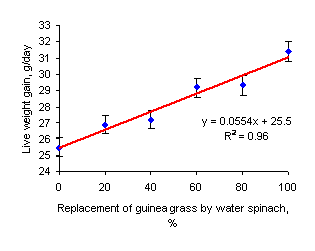
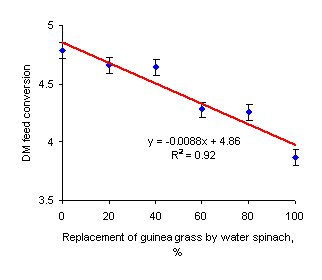
Table 7: Effect of replacement guinea grass with water spinach on weight change of the mother, live weight gain of the baby rabbit
Parameter
|
Level of replacement: % Guinea grass/water
spinach
|
||||||
100/0
|
80/20
|
60/40
|
40/60
|
20/80
|
0/100
|
SEM/P
|
|
Live weight of does, g
|
|
|
|
|
|
|
|
Initial
|
3 400
|
3 570
|
3 400
|
3 430
|
3 500
|
3 470
|
97.0/0.12
|
Final
|
3 660
|
3 900
|
3 730
|
3 900
|
3 967
|
3 760
|
21.7/0.2
|
Weight change
|
267
|
333
|
333
|
566
|
466
|
300
|
169/0.79
|
Milk yield, g
|
83.2a
|
86.0a
|
90.2ab
|
94.4b
|
97.8bc
|
100.9c
|
6.90/0.03
|
Litter size
|
|
|
|
|
|
|
|
At birth
|
6.0
|
6.3
|
7.0
|
7.0
|
8.0
|
7.67
|
0.7/0.42
|
30 days
|
5.7
|
6.0
|
6.7
|
6.7
|
7.7
|
7.3
|
0.50/0.12
|
Survival rate, %
|
95.2
|
95.8
|
96.3
|
95.2
|
96.3
|
96.3
|
4.16/0.91
|
Weight at birth, g
|
403
|
399
|
420
|
402
|
436
|
435
|
23.2/0.74
|
Weight at 21 days
|
1883
|
1930
|
2125
|
1903
|
2177
|
2230
|
135/0.36
|
Weight at 30 days
|
3267a
|
3900b
|
3933b
|
4567c
|
5133cd
|
5300d
|
169/0.01
|
Daily gain, g
|
15.9a |
18.5b |
18.7b |
19.8bc |
19.5bc |
21.1c |
0.57/0.01
|
a, b, c, d, e,f Means within rows with
different superscripts differ significantly (P<0.05)
The effect of the feed replace for lactating rabbits is mainly
on milk production. The results for live weight change and
calculated milk production (table 7). Live weight change of does
was not different (P=0.79) between treatments. The milk yield of
does increased in increasing level of water spinach in all
treatment led to had positive effect on live weight gain of the
baby rabbits in the full cycling (from at birth to
weaning).
|
|
|
|
Figure 3: Effect of replacing guinea grass with water
spinach on live weight gain of rabbits from birth to 30
days |
Figure 4: Effect of replacing guinea grass with water
spinach on litter size at 30 days |
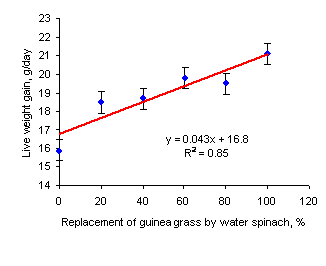
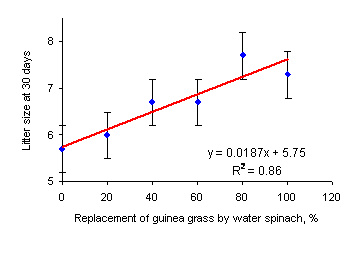
Figure 4: Effect of replacing guinea grass with water
spinach on litter size at 30 days
Conclusion
Two experiments reported in this paper were evaluated the
response of water spinach to fertilization of increasing levels of
compost from earthworm and urea; and developed feeding systems for
rabbits based on locally availabe forages. Based on the results
above, it can be concluded that:
-
There were positive effect in increasing level of Nitrogen on biomass yield and quality as crude protein content of water spinach. Use worm cast as fertilizer for water spinach improved soil fertility such as OM, N, P205 and K20 compared of using urea
-
Water spinach foliage is potential supplement for rabbits and can replace guinea grass of 100% in the diet with higher live weight gain (baby and weaning rabbits), milk yield (lactating rabbits) and lower feed cost comparing guinea grass.
Acknowledgments
The authors wish to thank the MEKARN project, financed by Sida/SAREC for supporting this research.
References
AOAC 1990. Official methods of analysis. Association of Official Analytical Chemists. 15th edition. Arlington pp1290
GöhlB 1981. Tropical Feeds. FAO Animal Production and Health Series. No 12
HongthongPhimmmasan, Siton Kongvongxay, Chhay Ty and
Preston T R 2004. Water spinach (Ipomoea aquatica) and
Stylo 184 (Stylosanthesguianensis CIAT
184) as basal diets for growing rabbits. Livestock
Research for Rural Development. Vol. 16, Art. # 34.
Retrieved April 29, 2004 , from http://www.cipav.org.co/lrrd/lrrd16/03/cero16020.htm
Le Ha Chau 1998a. Biodigester effluent versus
manure from pigs or cattle as fertilizer for production of cassava
foliage (Manihot esculenta). The international
journal for research into sustainable developing world agriculture.
Livestock Research for Rural Development. Volume 10, Number 3,
December 1998. http://www.cipav.org.co/lrrd/lrrd10/3/chau1.htm
Le Ha Chau 1998b. Biodigester effluent versus
manure, from pigs or cattle, as fertilizer for duckweed
(Lemnaspp.) The international journal for research into
sustainable developing world agriculture. Livestock Research for
Rural Development. Volume 10, Number 3, December 1998. http://www.cipav.org.co/lrrd/lrrd10/3/chau2.htm
Le Thi Men and Bui Hong Van 1993.Evaluation of diets
based on simulated sugarcane juice and water spinach (Ipomoea
aquatica) for breeding sows. In Sustainable Livestock
Production on Local Feed Resources. Ho Chi Minh City Vietnam
1994
Nguyen Quang Suc, Le Thi Thu Ha and Dinh Van Binh
2000. Manure from rabbits, goats, cattle and buffaloes as
substrate for earthworms. Workshop-seminar "Making better use of
local feed resources" SAREC-UAF, January , 2000. http://www.cipav.org.co/sarec2000/sarpro/sucew.htm
Van Soest, P.J., 1991. The Nutritional Ecology of the Ruminant.
O and Q Books.OR., pp.198-207 and 337-348