|
|
Figure 1: Daily weight gains of the ducks offered diets with or without GS |
|
Live stock production, climate change and resource depletion |
Colledge of Agriculture and Applied Biology,
Cantho University, Vietnam,
bxmen@ctu.edu.vn
*Agricultural
Extension Center, Dongthap province
Two on-farm experiments were conducted in Dongthap province and Cantho City of the Mekong Delta in rainy seasons of 2008 and 2009 to evaluate the use of golden apple snails (Pomacea) and Tra fish (Pangasius) by-products as protein supplements to replace the soybean meal in diets of ducklings. In experiment 1, 72 commercial meat ducks (Cherry Valley breed) were used in a completely randomized design, with 3 dietary treatments and 4 replicates. The ducks were fed 0, 50 and 100% of the diet protein from snails replacing that from soybean meal. In experiment 2, 480 crossbred meat ducks (crosses of Cherry Valley drakes and Nong Nghiep ducks) were allocated to 4 treatments with 3 replicates and 40 ducks balanced for sex per replicate (pen). The dietary treatments were 100% soybean meal (SBM) as protein supplement, 50% of SBM replaced by Tra fish by-products (TF50), 100% of SBM replaced by Tra fish by-products (TF100), and 50% of SBM replaced by golden apple snails (GS50). The diets were offered ad-libitum to the ducks from 21 to 60 days old.
Daily live weight gains of the ducks supplemented with the snails were higher and feed conversion better compared with ducks fed the SBM diets. Total DM intakes of the ducks offered the SBM and GS50 diets were higher than those fed the TF50 or TF100 diets, the lower intake on the latter reflecting the higher fat content of these diets. Weight gains were depressed with the highest level of TF but did not differ among the remaining. Feed conversion showed the opposite trend with best conversion on the TF 100 diet.
The use of golden apple snails and Tra fish by-products as protein supplements in the diets of meat ducks had several benefits including decreased feed cost, increased employment opportunities (gathering snails in the rice fields and working in the Tra fish processing plants) and decreased pollution (toxic chemicals are otherwise used to kill the snail pests).
Key words: Benefits, feed conversion, growth, pollution, soybean meal
Living in the marketing mechanism process the producers in the Mekong Delta are facing with big problems for animal and aquaculture production from high inputs due to dramatic increases of price of animal feeds and output fluctuations of product prices. At present, if producers use commercial feeds with rather high price to raise ducks they will get very low or no benefits from the activities.
Golden apple snails are seen be seriously damaging pests to the young rice fields and economic loss to rice producers. Also, use of toxic chemicals to eliminate the pests is difficult because of wide distribution of the population, high costs and environmental pollution. Beside the pests water hyacinth plants grow very well in the diches or canals in the Delta. Sometimes it is big problems for water traffic of the boats and use of the plants for animal feeds are rather few.
In recent years fish producers have been encouraged to increase Tra fish production for both for national consumption and export. Yield of the fish produced annually has been over 1 million tonnes (plan for 2020 being 2 M tons) of which 70% is in the form of by-products such as heads, backbone, skin, fat and internal organs. So, a big amount of the by-product could be recycled as energy (from the fat) and as feed (protein and mineral sources for poultry).
In order to maintain the duck production in a sustainable development several ways are carried out to partially replace the traditional system to keep the ducks, of which integrated duck-fish system has proved to have advantages to apply for producers of the Delta. In the integrated system, ducks will be kept in slat/wire floored houses built over the fish pond and fed several kind of feeds gathered from the village or purchased from local markets. The costs from litter and management will be decreased to minimum. The system is safe for ducks because producers can control and vaccinate against infectious diseases. Wastes (water, mud) from the fish pond can be used as fertilizers for rice or vegetables. Growing plants on the wastes also decreases or eliminates pollution to the environment.
The experiments were carried out on farmer holdings in Lapvo district, Dongthap province at the end of the rainy season in 2008 and in Omon district, Cantho City at the end of the rainy season in 2009. The main agricultural products of the farmers in the areas are rice, with some supplementary income from tree fruits, fish and animals (Men et al 2003, 2005, 2007, 2009a, 2009b).
Seventy-two 28-day-old ducklings were allocated at random to three treatments, with four replicates in one farm at the end of the rainy season in 2008. Each replicate group, consisting of 6 ducks was housed in a separate pen. The ducks were allocated to three diets that contained 16% crude protein (CP), but with different protein sources as follows:.
(1) Protein only from soybean meal (SBM) as a control diet (SBM100)
(2) A diet with golden apple snails (GS) replacing 50% protein of the SBM (SBM50)
(3) A diet with 100% protein replacement of SBM by the GS (SBM00)
These diets were offered to the ducks ad libitum five times per day up to 60 days of age.
The ducks were housed in a shed divided into pens. The pens were made from plastic net attached bamboo frames, with thatched roofs and sand floors covered with rice straw for bedding, and with an average density of one duck per 0.3 m2. The ducks also had access to outside covered sand yards combined with small ditches as baths with an area of 1 m2 per duck. Feeders used were rectangular plastic basins and drinkers were round plastic containers linked to a plate so that water was filled automatically. Natural and electric light was used to maintain a total of 24 hours light each day.
The chemical composition of the feeds is shown in Table 1. The moisture content of golden apple snails (without shells) was rather high (81.6%). However, the protein content of the GS was very high (56.4% in DM).
|
Table 1: Composition of experimental feeds (on DM basis except for DM which is on "as-fed" basis) |
|||||||
|
|
DM, % |
ME, kcal/kg |
Protein ,% |
EE, % |
CF, % |
Ca, % |
P, % |
|
Rice bran |
87.7 |
2715 |
10.9 |
12.0 |
5.3 |
1.6 |
1.8 |
|
Maize |
88.0 |
3306 |
9.39 |
2.62 |
2.64 |
1.96 |
0.58 |
|
Soybean meal |
89.1 |
2898 |
38.8 |
1.64 |
3.60 |
0.59 |
1.0 |
|
Golden apple snail |
18.43 |
561 |
10.39 |
0.74 |
0.30 |
5.37 |
0.12 |
The crude protein content in all diets was kept constant at 16% based on 88% of DM of the control diet. However, the amounts as fed in the SBM50 and SBM00 treatments were higher than of the control treatment (SBM100) because fresh golden apple snails with high moisture replaced soyabean meal. In order to make advantages for the ducks in the control treatment consuming the mash diets a small amount of fresh water was mixed with the mash before feeding to the ducks (Table 2).
|
Table 2: Chemical composition of the diets |
||||||
|
|
SBM100 |
|
SBM50 |
|
SBM00 |
|
|
As fed |
88 %DM |
As fed |
88 %DM |
As fed |
88 %DM |
|
|
Maize |
46.5 |
46.5 |
43.0 |
55.2 |
34.5 |
54.5 |
|
Rice bran |
32 |
32 |
20.2 |
26 |
19 |
30 |
|
SBM |
21 |
21 |
8.6 |
11 |
0 |
0 |
|
GS |
0 |
0 |
27.8 |
7.3 |
46.2 |
15 |
|
Premix |
0.2 |
0.2 |
0.16 |
0.2 |
0.12 |
0.2 |
|
Salt |
0.3 |
0.3 |
0.24 |
0.3 |
0.18 |
0.3 |
|
% |
100 |
100 |
100 |
100 |
100 |
100 |
|
Composition (based on 88% DM) |
||||||
|
Crude protein, % |
|
16 |
|
16 |
|
16 |
|
Ether extract, % |
|
5.4 |
|
5.0 |
|
5.6 |
|
Crude fibre, % |
|
3.7 |
|
3.3 |
|
3.2 |
|
Calcium, % |
|
1.6 |
|
3.5 |
|
5.5 |
|
Total phosphorus, % |
|
1.1 |
|
1.0 |
|
1.0 |
480 twenty-one day old ducklings were used for the experiment. The trial was carried out on a small farm in Omon district, Cantho City at the end of the rainy season in 2009. The ducks in the experiment were kept on plastic net floors with access to fish ponds for swimming and with biosecure controls, and were randomly allocated into four treatment groups, with three replicates. Each experimental unit (plot) consisted of 20 ducks, balanced for sex. The ducks were given four diets that contained 16% CP, but with different protein sources from SBM, Tra fish by-products (TF) and golden apple snails (GS).
The experimental treatments were:
CTL: rotein supplement only from SBM as a control diet
TF50: A diet with TF replacing 50% of the protein of the SBM
TF100: A diet with 100% replacement of the SBM by the TF
GS50: A diet with GS replacing 50% of the protein of the SBM
The ducks were given these diets ad-libitum up to 60 days of age.
The chemical composition of the feedstuffs is shown in Table 3. The moisture content of golden apple snails was highest (78.3%) and then Tra fish by-products (56.9%). The protein content of the GS was higher (54.9% in DM) than for TF (28.7%).
| Table 3: Composition of feeds (% of DM except for DM which is on “as-fed” basis) | |||||||||
|
|
DM, |
CP, |
EE, % |
NFE, |
CF, |
Ash, % |
Ca, % |
Pavai, % |
ME, kcal/kg |
|
Maize |
86.2 |
9.47 |
3.12 |
84.0 |
1.85 |
1.57 |
0.41 |
0.38 |
3766 |
|
Rice bran |
89.6 |
7.66 |
7.76 |
45.6 |
27.72 |
11.2 |
0.44 |
1.06 |
1547 |
|
SBM |
86.5 |
51.7 |
2.89 |
33.6 |
4.66 |
7.14 |
0.45 |
0.82 |
3036 |
|
TF |
43.1 |
28.7 |
53.2 |
5.83 |
- |
12.3 |
3.32 |
3.41 |
4581 |
|
GS |
21.7 |
54.9 |
2.85 |
22.3 |
0.92 |
19.1 |
5.16 |
13.1 |
3002 |
|
Bone meal |
95.3 |
21.3 |
5.02 |
0.59 |
1.72 |
71.4 |
18.5 |
6.37 |
1059 |
The crude protein content in all diets was kept constant at 16% based on 87% of DM (DM of the control treatment) .
|
Table 4: Ingredient composition (%) of the diets offered |
||||
|
|
CTr |
TF50 |
TF100 |
GS50 |
|
Maize, % |
68.3 |
46.5 |
30.0 |
51.5 |
|
Rice bran, % |
7.0 |
8.0 |
4.5 |
8.3 |
|
SBM, % |
20.8 |
10.4 |
- |
8.2 |
|
Lysine, % |
0.25 |
- |
- |
- |
|
Methionine, % |
0.1 |
- |
- |
- |
|
Bone meal, % |
3.0 |
- |
- |
- |
|
Salt, % |
0.25 |
0.35 |
0.25 |
0.25 |
|
Premix vit., % |
0.25 |
0.25 |
0.25 |
0.25 |
|
Tra fish by-product, % |
- |
34.5 |
65.0 |
- |
|
Golden apple snail, % |
- |
|
- |
31.5 |
|
Composition based on 87% DM |
||||
|
Protein, % |
16.03 |
16.06 |
16.01 |
16.02 |
|
ME, kcal/kg |
2897 |
3118 |
3439 |
2901 |
|
Ether extract, % |
2.65 |
11.86 |
23.75 |
2.92 |
|
Crue fibre, % |
3.72 |
3.81 |
2.37 |
4.30 |
|
Calcium, % |
0.86 |
0.88 |
1.62 |
0.80 |
|
Available phosphorus, % |
0.32 |
0.67 |
1.35 |
1.19 |
The feeds were analysed for proximate constituents by AOAC methods (AOAC 2000). Metabolizable energy (ME) of the diets was calculated from chemical analysis data using the equation of Nehring and Haenlein (1973): ME (kcal/kg) = 4.26 X1 + 9.5 X2 + 4.23 X3 + 4.08 X4. The calculated digestable protein, digestible fat, digestible fibre and digestible nitrogen free extractives (g/kg of feed) are represented by X1 through X4, respectively. Estimated digestibility coefficients are according to NIAH (1992). The diets of the ducks in both experiments 1 and 2 were formulated by WinFeed software (2004).
The data were analysed by analysis of variance using the ANOVA General Linear Model procedure of MINITAB (2003).
Economic analyses were carried out using current prices in Vietnamese Dong (VND: 18,000 (2008) and 19,000 (2009) VND=1US$) to compare feed cost per unit live weight gain among the diet treatments.
Feed intakes were similar except for Calcium which were much higher on the snail diets (Table 5).
|
Table 5: Feed intakes of the ducks |
||||||||
|
|
SBM100 |
SBM50 |
SBM00 |
SEM |
P |
|||
|
Total dry matter, g/duck |
146 |
151 |
152 |
12.8 |
0.801 |
|||
|
ME, kcal/duck |
499 |
514 |
519 |
20.6 |
0.785 |
|||
|
Crude protein thô, g/duck |
26.6 |
27.4 |
27.7 |
2.32 |
0.804 |
|||
|
Ether extract, g/duck |
8.99 |
8.59 |
9.64 |
0.769 |
0.204 |
|||
|
Crude fibre, g/duck |
6.08 |
5.69 |
5.58 |
0.48 |
0.352 |
|||
|
Calcium, g/duck |
2.58 a |
5.98 b |
9.50 c |
0.618 |
0.001 |
|||
|
Total phosphorus, g/duck |
1.77 |
1.63 |
1.65 |
0.142 |
0.341 |
|||
|
* Means without common superscripts within rows are different at P<0.05 |
||||||||
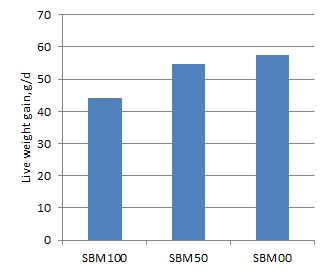
Growth rate and feed conversion were improved by replacing SBM with the golden apple snail (Table 6; Figure 1).
|
Table 6: Effect of the diets with different protein sources on final live weights, daily gains and feed conversion ratios of meat-type ducks |
|||||
|
|
SBM100 |
SBM50 |
SBM00 |
SEM |
P |
|
Live weight, g |
|
|
|
|
|
|
Initial |
1030 |
1050 |
1080 |
16.4 |
0.064 |
|
Final |
2400 a* |
2750 b |
2860 b |
97.2 |
0.001 |
|
Daily gain |
44.2 a |
54.8 b |
57.4 b |
3.24 |
0.001 |
|
FCR, kg DM/kg gain |
3.32 a |
2.75 b |
2.65 b |
0.100 |
0.001 |
|
* Means without common superscripts within rows are different at P<0.05 |
|||||
|
|
Figure 1: Daily weight gains of the ducks offered diets with or without GS |
Carcass weights tended to be heavier on the GS diets. The thigh and breast muscle weights were much higher in the ducks fed diets with GS even after considering the increased carcass weights (Table 7).
|
Table 7: Effect of diet on carcass parameters of the ducks |
|||||||
|
|
SBM100 |
GS50 |
GS100 |
SEM |
P |
||
|
Live weight, g |
2470 |
2650 |
2720 |
128.70 |
0.57 |
||
|
Carcass weight, g |
1730 |
1847 |
1930 |
127 |
0.139 |
||
|
Carcass yield, % |
70 |
70 |
71 |
0.014 |
0.541 |
||
|
Thigh muscle, g |
180 a |
226 b |
250 c |
9.88 |
0.001 |
||
|
Breast muscle, g |
175 a |
200 b |
203 b |
6.25 |
0.001 |
||
|
Liver weight, g |
56 |
58.5 |
57.5 |
3.12 |
0.546 |
||
|
Gizzard, g |
83 |
87 |
88 |
5.07 |
0.378 |
||
|
Heart weight, g |
16.5 |
17.6 |
17 |
0.620 |
0.092 |
||
|
Leaf fat, g |
4.4 |
4.5 |
5.0 |
0.494 |
0.283 |
||
|
* Means without common superscripts within rows are different at P<0.05 |
|||||||
The lowest feed costs per kg of live weight gain was for the SBM00 diet, in which the protein supplement was completely replaced by fresh golden apple snails (Table 8). There would thus appear to be marked economic benefits to the producers using golden apple snails gathered in the rice fields as a protein feed in diets of growing meat-type ducks.
|
Table 8: Effect of diet on feed cost per kg weight gain of meat-type ducks |
|||
|
|
SBM100 |
SBM50 |
SBM00 |
|
Feed cost, VND/kg |
5,594 |
4,222 |
3,247 |
|
Feed cost/kg gain, VND |
21,087 |
16,930 |
15,488 |
|
Rate, % |
100 |
80 |
73 |
|
Based on market price per kg for maize 4,500, golden apple snail 2,000, rice bran 3,800, soyabean meal 10,500, premix 40,000 VND; 18,000 VND=1US$. |
|||
Daily total DM intakes of the ducks offered the CTL and GS50 diets were higher than those fed the TF50 or TF100 diets (Table 9), the lower intake on the latter reflecting the higher fat content of these diets. Weight gains were depressed with the highest level of TF but did not differ among the remaining diets (Figure 2). However, feed conversion showed the opposite trend with best conversion on the TF 100 diet.
| Table 9. Effect of diets on final weights, daily gains and feed conversion ratios of crossbred meat ducks | ||||||
|
|
CTL |
TF50 |
TF100 |
GS50 |
SEM |
P |
|
DM intake, g |
148a |
132b |
104c |
148a |
2.92 |
0.001 |
|
Live weight, g |
|
|
|
|
|
|
|
Initial |
554 |
550 |
547 |
550 |
4.77 |
0.638 |
|
Final |
2289a* |
2276a |
2101b |
2308a |
15.8 |
0.001 |
|
Daily gain |
45.7a |
45.4a |
40.9b |
46.2a |
0.79 |
0.001 |
|
FCR, kg DM/kg gain |
3.24a |
2.91ac |
2.55b |
3.19c |
0.08 |
0.001 |
| Means without common superscripts within rows are different at P<0.05 | ||||||
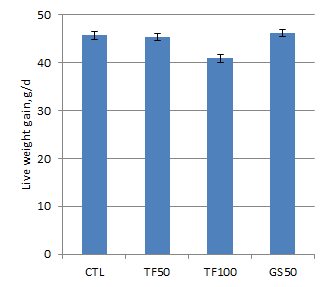 |
| Figure 2: Daily weight gains of the crossbred ducks supplemented with TF or GS |
The data in Table 10 show that there were no differences for carcass yields, breast and thigh muscle proportions and leaf fat yields of the ducks offered the diets with or without Tra fish by-products or golden apple snails as protein supplements.
|
Table 10: Effect of diet on carcass parameters of crossbred meat ducks |
||||||
|
|
CTL |
TF50 |
TF100 |
GS50 |
SEM |
P |
|
Carcass yield, % |
74.6 |
76.6 |
75.3 |
76.7 |
0.74 |
0.218 |
|
Breast muscle/carcass, % |
12.6 |
10.3 |
10.5 |
11.6 |
0.66 |
0.126 |
|
Thigh muscle/carcass, % |
13.3 |
13.0 |
13.0 |
13.1 |
0.43 |
0.935 |
|
Leaf fat/carcass, % |
1.0 |
2.6 |
2.7 |
1.7 |
0.45 |
0.082 |
|
VND/kg gain |
21,996 |
18,652 |
16,076 |
21,494 |
||
|
Based on market price per kg for maize 4,500, TF 3,200, GS 3,000, rice bran 2,800, SBM 10,000, bone meal 4,500, premix vit. 50,000, methionine 120,000, lysine 60,000 and salt 2,800 VND; 19,000 VND=1US$. |
||||||
The lowest feed cost per kg of live weight gain was with the TF00 diet, in which the protein supplement was completely replaced by fresh Tra fish by-products.
The ducks offered the diets with golden apple snail obtained daily weight gains, feed conversion ratios and breast and thigh muscle proportions, better than those with soybean meal.
Use of golden apple snail as a protein supplement to replace soybean meal decreased feed cost by 20 to 27%.
Tra fish by-product and golden apple snail can replace 50% of soybean meal in diets of growing crossbred meat ducks.
Use of Tra fish by-product and golden apple snail as a replacement for 50% of the protein from soybean meal in diets for growing crossbred meat ducks decreased the feed cost by 20-27%
AOAC 2000 Official methods of analysis. Association of Official Analytical Chemists, Washington, DC.
Bui Xuan Men and Ogle R B 2003
Productivity and environmental and economic
evaluation of integrated duck-rice-fish systems on small holdings in the Mekong
Delta of Vietnam. In:
Proceedings
of
Final National Seminar-Workshop on
Sustainable Livestock Production on
Local Feed Resources (Editors: Reg Preston and Brian Ogle).
Bui Xuan Men and Ogle R B 2003 Productivity and environmental and economic evaluation of integrated duck-rice-fish systems on smallholdings in the Mekong Delta of Vietnam. Proceedings National Workshop-Seminar “Sustainable Livestock Production on Local Feed Resources” Agricultural Publishing House. HCM city.
Bui Xuan Men, Ogle R B and Preston T R 2005 Production and use of fly larvae and termites as protein supplements for local growing chickens. Internatonal Workshop-Seminar “Sustainable Livestock
Bui Xuan Men, Ogle B and Preston T R 2005 Production and evaluation of Black Soldier fly larvae and termites as protein supplements for chickens. Workshop-seminar "Making better use of local feed resources" (Editors: Reg Preston and Brian Ogle) MEKARN-CTU, Cantho, 23-25 May, 2005. Article #24. RetrievedSeptember 15, 111, from http://www.mekarn.org/proctu/ba24.htm
Bui Xuan Men 2009a Evaluation of integrated systems and uses of water plants in diets for duck production in the Mekong Delta. Journal of Sciences. Cantho University (11).
Bui Xuan Men 2009b Integrated fish, ducks and rice to reduce pollution and improve resource utilization. http://www.mekarn.org/workshops/environ/proenv/content.htm
Minitab 2003. Reference Manual 2003 Release 14 for Windows, Mintab Inc. USA.
Nehring K and Haen G F W 1973 Feed evaluation and ration calculations based on net energy; Journal of Animal Science (36) pp 949-964.
WinFeed 2004 WinFeed UK Ltd. Cambridge United Kingdom.