 |
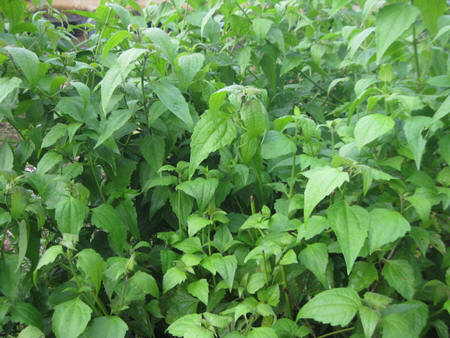 |
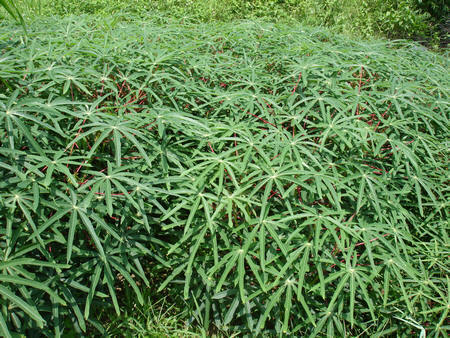
| Photo 1. The cassava foliage used in the experiment | Photo 2. The Eupatorium odoratum foliage used in the experiment |
| Back to contents |
The study was carried out in GRRC with 30 growing goats (3.5 – 4 months of age) which were allocated to the following treatments: G: Guinea grass alone (ad libitum); G-C: guinea grass ad libitum + cassava foliage (1.5% of LW DM basis); G-E: guinea grass ad libitum + Eupatorium odoratum foliage (1.5% of LW DM basis). The goats were not de-wormed before starting the experiment.
The live weight gain was the highest in treatment G-C (58.3 g/head/ day), meanwhile, live weight gains of goats in treatments control (Guinea grass alone) and G-E were 38.1 and 47.6g/ head/ day, respectively. The numbers of nematode eggs (Coccidian occysts, Strongyle, Cestode) were reduced significantly during the experimental period for goats fed the G-CF and G-EF diets. By contrast on the control diet of Guinea grass the fecal eg counts increased.
Key word: Ethnomedicine, Guinea grass, parasites, tannins
Many researchers (Khampa et al 2009; Seng et al 2007; Sokerya and Preston 2003) have suggested that a major constraint to goat production in the extensive system is the high rate of internal parasite infestation, which results in enormous socio-economic losses to small- holder farmers. Control of Gastro-Intestinal (GI) parasites in the past has relied heavily on the use of anthelmintics. These compounds have been used successfully but the development of anthelmintic resistance in GI nematodes gives a clear indication that control programs based on use of anthelmintics are not sustainable (Bunyeth and Preston 2006). Increasing interest is now being shown with regards to evaluating non-chemotherapeutic approaches to parasite control. Among these alternative approaches, the use of bioactive plants/forages has received recent research attention. For example the research by Sokerya and Rodriguez (2001) and Preston (no date) showed that growth rate of confined goats was higher and nematode infestation lower, when the forage supplement was cassava foliage.
Eupatorium odoratum originated in the humid tropics and sub-humid tropics of the New World where it occurs from southern Florida to northern Argentina. It has been introduced and is naturalized throughout humid, tropical Asia, from the Western Ghats in India throughout Indochina and Malaysia to south-eastern Australia and the Mariana Islands in the east (McFadyen 1988). Eupatorium odoratum is also found widely native distributed in Vietnam. Research by Panda et al (no date) suggested that Eupatorium odoratum foliage could be used not only as forage source for animal production but also as anthelmintic medicine..
On the basis of these considerations, a study was done on the effects of Eupatorium odoratum foliage compared with cassava foliage on growth and intestinal nematode infestation in goats.
Thirty growing cross bred goats (Saane-Bach Thao) with 3.4- 4 months of age were allocated to 3 treatments with 10 replications per treatment. The treatments were:
G: Guinea grass alone
G-CF: guinea grass + cassava foliage (Photo 1) (1.5% of LW DM basis)
G-EOF: guinea grass + Eupatorium odoratum foliage (Photo 2) (1.5% of LW DM basis)
|
|
| Photo 1. The cassava foliage used in the experiment | Photo 2. The Eupatorium odoratum foliage used in the experiment |
The goats were vaccinated against pasteurellosis, enterotoxaemia and foot and mouth disease, however, they were not de-wormed before starting the experiment.
Guinea grass was fed ad libitum in all treatments. It was chopped, put in the trough, and divided into 4 meals per day (at 7:30; 10:30; 14:30 and 16:30). Cassava and Eupatorium odoratum foliages were hung on the wall of the pen and divided into 2 meals per day. Water was given freely. The experiment lasted for 84 days
The chemical composition (DM, crude protein and condensed tannins) of cassava, Eupatorium odoratum and guinea grass was determined by AOAC (1990) methods. The goats were weighed every 2 weeks and samples of feces collected from the rectum at intervals. Feed intakes were recorded daily.
The data from the experiment were analyzed using the General Linear Model option in the ANOVA program of the Minitab software (2000). The statistical model used in the analysis was: Y= µ +Ti +ei .
Y is the dependent variable, µ is the overall mean, Ti is the effect of treatments (the diets), ei is the residual error.
Eupatorium odoratum foliage had the same content of crude protein as the cassava foliage but twice the level of tannins (table 1).
|
Table 1: The chemical composition of experimental feeds |
|||
|
Feeds |
% in DM except for DM which is on fresh basis |
||
|
DM |
CP |
Tannin |
|
|
Cassava foliage |
20.4 |
20.8 |
2.35 |
|
Guinea grass |
20.2 |
10.5 |
1.1 |
|
Eupatorium odoratum foliage |
17.6 |
20.5 |
4.7 |
DM and crude protein intakes were higher for the diets of G-CF and G-EF than for Guinea grass alone (Table 2). The live weight gain was highest for the G-CF diet followed by G-EF and Guinea grass
|
Table 2: Live weight again and Feed intake by goats fed different foliage |
|||||
|
|
G-CF |
G-EF |
G |
SE |
P - value |
|
Live weight, kg |
|||||
|
Initial |
13.8 |
13.9 |
13.7 |
0.35 |
|
|
Final |
18.7 |
17.9 |
16.9 |
0.34 |
|
|
Daily gain (g/day) |
53 a |
44b |
36c |
1.6 |
<0.001 |
|
Feed intake (Fresh basis), g/day |
|
|
|
|
|
|
Guinea grass |
2978 |
3002 |
3260 |
0.59 |
|
|
Cassava foliage |
530 |
- |
- |
1.92 |
|
|
Eupatorium odoratum foliage |
- |
520 |
- |
2.48 |
|
|
Feed intake, g DM/ day |
|||||
|
Guinea grass |
601.7 |
606.7 |
666 |
0.12 |
|
|
Cassava foliage |
108.2 |
- |
- |
0.34 |
|
|
Eupatorium odoratum foliage |
- |
91.6 |
- |
0.43 |
|
|
Total |
710a |
698a |
666b |
0.37 |
<0.001 |
|
CP intake, g/day |
|||||
|
Guinea grass |
63.1 |
63.6 |
70.1 |
0.12 |
|
|
Cassava foliage |
22.5 |
- |
- |
0.08 |
|
|
Eupatorium odoratum foliage |
- |
18.8 |
- |
0.08 |
|
|
Total |
85.6a |
82.4a |
70.1b |
0.15 |
<0.001 |
|
Feed conversion ratio |
|||||
|
Kg DM/kg LWG |
13.3 a |
15.8 b |
18.5c |
0.007 |
<0.001 |
|
Kg CP/kg LWG |
1.6a |
1.8b |
1.9c |
0.0015 |
<0.001 |
|
abc Mean within rows with different superscripts differ significantly ( P<0.05) |
|
||||
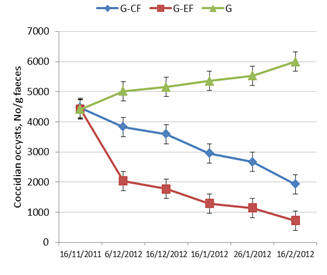
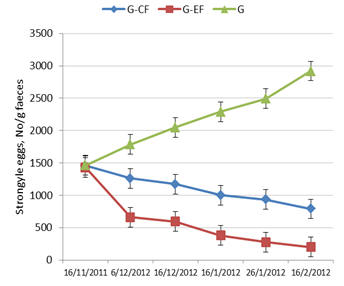
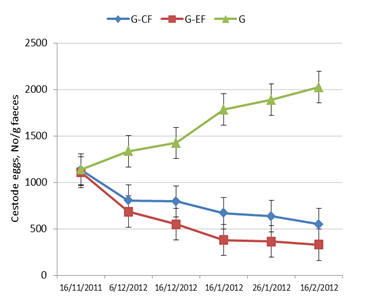
Generally, the numbers of nematode eggs (coccidian occysts, strongyle, Cestode) were reduced significantly during the experimental time for goats fed the G-CF and G-EF diets. The G-CF diet had higher effect on the reduction of strongyle eggs and occidian occysts as compared to the G-EF diet (P<0.05), but no difference in the reduction of cestode egg was found between these two diets (P>0.05). The number of nematode eggs increased gradually for goats fed Guinea alone. In other words, the diets with high content of tannin reduced significantly the number of parasite eggs as compared to the diet with low tannin content (Table 3 and Figures, 1-3).
|
Table 3: Mean values of Nematode egg count per g faeces in growing goats fed different foliages |
||||
|
Sample date |
G-CF |
G-EF |
G |
SEM |
|
Coccidian occysts, g faeces |
||||
|
16/11/2011 |
4465a |
4425a |
4410a |
393 |
|
6/12/2012 |
3830a |
2035b |
5020c |
335 |
|
16/12/2012 |
3590a |
1775b |
5155c |
337 |
|
16/1/2012 |
2955a |
1290b |
5360c |
325 |
|
26/1/2012 |
2665a |
1140b |
5525c |
335 |
|
16/2/2012 |
1930a |
720b |
6000c |
285 |
|
Strongyle eggs, g faeces |
||||
|
16/11/2011 |
1460a |
1430a |
1465a |
132 |
|
6/12/2012 |
1260a |
660b |
1785c |
124 |
|
16/12/2012 |
1170a |
595b |
2050c |
140 |
|
16/1/2012 |
1000a |
380b |
2290c |
156 |
|
26/1/2012 |
935a |
275b |
2495c |
169 |
|
16/2/2012 |
790a |
200b |
2920c |
185 |
|
Cestode eggs, g faeces |
||||
|
16/11/2011 |
1135a |
1110a |
1140b |
199 |
|
6/12/2012 |
805a |
685a |
1335b |
180 |
|
16/12/2012 |
795a |
550a |
1425b |
177 |
|
16/1/2012 |
670a |
380a |
1785b |
158 |
|
26/1/2012 |
635a |
365a |
1890b |
149 |
|
16/2/2012 |
550a |
330a |
2026b |
148 |
|
abc Means within rows with different superscripts differ significantly ( P<0.05) |
||||
|
|
|
|
Figure 1: Coccidia egg count in growing goats fed Guinea grass alone (G), plus Eupatorium odoratum (G-EF) or cassava (G-CF) foliages |
Figure. 2. Strongyle egg count in growing goats fed Guinea grass alone (G), plus Eupatorium odoratum (G-EF) or cassava (G-CF) foliages |
|
|
|
|
Figure 3. Cestode worm eggs ) in growing goats fed Guinea grass alone (G), plus Eupatorium odoratum (G-EF) or cassava (G-CF) foliages |
|
This study evaluated the effects of Eupatorium odoratum foliage compared with cassava foliage on the growth and intestinal nematode infestation in goats. The research showed that LWG of goats in the G-CF and G-EF diets were higher than on Guinea grass alone. Moreover, the numbers of Nematode egg/g faeces of the goats decreased significantly during the experimental time for these fed the diets of high tannin content such as the G-CF and G-EF diets. In contrast, the number of Nematode eggs increased gradually during this time for goats fed the control diet (Guinea grass alone) with low tannin content. Although, this observation was for a limited time period, it is consistent with other studies comparing diets with and without condensed tannins (Athanasiadou et al 2000a; Butter et al 2000; Kabasa et al 2000; Niezen et al 1998; Seng Sokerya and Rodríguez 2001; Seng Sokerya and Preston 2003; Nguyen Kim Lin et al 2003). The question of whether the effect of tannins on FEC is an indirect anthelmintic effect, a direct effect, or a combination of both (Athanasiadou et al 2000a) is a subject of debate. According to Niezen et al (1998) and Molan et al (2002) this illustrates that the condensed tannins have potential to control anthelmintic-resistant gastro-intestinal parasites by direct or indirect biological effect. The direct effect can be mediated through interaction between condensed tannins and nematodes, affecting physiological function of gastro-intestinal parasites through interference with parasite hatching and the development of infective stage larvae. Barry et al (2001) and Nieze et al (2000) indicated that the indirect effect of condensed tannins can be through increased resistance to gastro-intestinal parasite infection through enhancing the protein supply, which is prioritized for tissue repair and immune response.
The results support the view that foliage plants with high tannin content can decrease FEC in goats.
Natural foliages such as Eupatorium odoratum could be used in the farms where goats are in a free grazing system. This indigenous knowledge needs to be harnessed to reduce the use of anthelmintic drugs, or to increase the effectiveness of these drug and reduce the economic cost.
Anthanasiadou S, Kyriazakis I, Jackson F and Coop R L 2000 Effects of short-term exposure to condensed tannins on adult Trichostrongylus colubriformis. Veterinary Record 146:728-732
Barry T N and Mcnabb W C 1999 The implications of condensed tannins on the nutritive value of temperate forage fed to ruminant. British Journal of Nutrition.81, 263-272.
Butter N L, Dawson J M, Wakelin D and Buttery P J 2000 Effect of dietary tannin and protein concentration on nematode infection (Trichostrongyus colubriformis) in lambs. The Journal of Agricultural Science, 134 : pp 89-99
Ho Bunyeth and Preston T R 2006 Growth performance and parasite infestation of goats given cassava leaf silage, or sun-dried cassava leaves, as supplement to grazing in lowland and upland regions of Cambodia. Livestock Research for Rural Development. Volume 18, Article No. 28. http://www.lrrd.org/lrrd18/2/buny18028.htm
Kabasa J D, Opuda-Asibo J and terMeulen U 2000 The effect of oral Administration of polyethelene glycol on faecal helminth egg counts in pregnant goats grazed on browse containing condensed tannins. Tropical Animal Health Production 32:73-86
Khampa S, Chaowarat P, Singhaler R and Wanapat M 2009 Supplementation of cassava hay as Anthelmintics on Fecal parasitic egg in Heifer Grazing on RuZi grass pature. Pakistan Journal of Nutrion 8(5), 518- 520
McFadyen R 1988
History and distribution of Chromolaena odorata(L) Muniappan,
R. (editor.)
Proceedings of the
First International Workshop on
Biological Control of Chromolaena
odorata, February–March 1988, Bangkok,
Molan A L, Waghorn G C and McNabb W C 2002
Effect of condensed tannins
on egg hatching and larval development of Trichostrongylus colubriformis in
vitro. Vet.parasitol. 150, 65-69.
Nawaz M and George S 2004 Eupatorium ( Chromolaena odorata(L) King and Robinson) biomass as a source of organic manure in okara cultivation. J.Trop.Agric 42, 33-34.
Nguyen Kim Lin, Preston T R , Dinh Van Binh and Nguyen Duy Ly 2003 Effects of tree foliages compared with grasses on growth and intestinal nematode infestation in confined goats. Livestock Research for Rural Development 15) 6 Retrieved , from http://www.lrrd.org/lrrd15/6/lin156.htm
Niezen J H, Robertson H A, Waghorn G C and Charleston W A G 1998 Production, faecal egg counts and worm burdens of ewe lambs which grazed six contrasting forages. Veterinary Parasitology 80:15-27.
Panda D, Dash S K and Dash G K no date Qualitative phytochemicals analysis and investigation of althelmintic and wound healing potential of various extracts of chromolaena odoratalinn. Collected from the locality of mohuda village, berhampur ( south orissa)
Preston T R No date Production and Utilization of cassava in intergrated farming system for smallholder farmers in Vietnam and Cambodia. Cassava Research and Development in Asia: Exploring New Opportunities for an Acient Crop.,48 http://webapp.ciat.cgiar.org/asia_cassava/pdf/news_workshop_abstracts.pdf
Sajise P, Palis K, Norcio N and Lales J 1974 The biology of Chromolaena odorata (L). RM King and H Robinson.L >flowering behavior, Pattern of growth and nitrate metabolism. Phil.J. Weed Sci 1(1), 17-24
Seng Sokerya and Rodriguez L 2001 Foliage from cassava, Flemingia macrophylla and bananas compared with grasses as forage sources for goats: effects on growth rate and intestinal nematodes. Livestock Research for Rural Development (15) 8: http://www.lrrd.org/lrrd13/2/soke132.htm
Seng Sokerya and Preston T R 2003 Effect of grass or cassava foliage on growth and nematode parasite infestation in goats fed low or high protein diets in confinement. Livestock Research for Rural Development (15) 8 Retrieved , from http://www.lrrd.org/lrrd15/8/kery158.htm
Seng S, Waller P J, Ledin I and Hoglund J 2007 The effect of short – term feeding of fresh cassava ( Manihot esculenta) foliage on gastrointestinal nematode parasite infections in goats in Colombia. Tropical Biomedicine 24 (1), 47-54