|
Back to content |
Livestock-Based Farming Systems, Renewable Resources
and the Environment
|
|
Effect of fine or coarse rice bran as basal diet and Taro
leaf-stem silage or rice distillers'
by-product as supplementary source of protein on digestibility and nitrogen
retention in growing pigs
Nguyen Tuyet Giang
Department of Animal Husbandry and Veterinary Medicine,
Angiang University, Vietnam
ntgiang@agu.edu.vn
Abstract
Four crossbred, castrated
male pigs of average 10kg live weight were allocated according to a Latin Square
Design to four diets arranged as a 2*2 factorial. The factors were fine or
coarse grade of rice bran and Taro leaf-stem silage and
rice distiller’s
by-product as sources of supplementary protein. Measurements
were made of intake, apparent digestibility of DM and crude protein
and N balance.
The crude
protein content (DM basis) of fine rice bran was higher than coarse bran (13.2%
vs 9.05%), while the rice distillers' by-product was slightly higher than the
Taro leaf-stem silage (25.2% and 18.3% in DM, respectively).
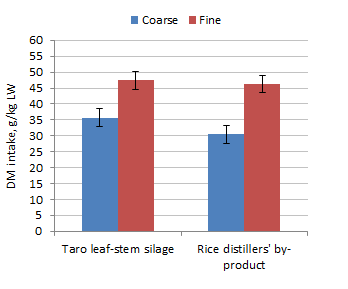
The daily DM intake, the coefficients
of apparent DM digestibility, and the N retention (Figures 1, 2 and 3), were higher for diets
based on fine than on coarse bran, but with no differences between Taro
leaf-stem silage and rice distillers' by-product except for N retention which
was less on rice distillers' by-product than on Taro leaf-stem silage,
especially on the coarse bran diet (Figure 4)..
The high values for N retention as a percentage of N
digested on all diets indicates a high and similar biological value of the
protein in Taro leaf-stem silage and in rice distillers' by-product.
Key words: Biological value, Colocacia esculenta, feed intake, local feed
resources, s
 |
 |
| Figure 1. Mean values for DM intake
of pigs fed
coarse or fine rice bran and taro silage or rice distillers'
by-product |
Figure 2. Mean values for apparent DM
digestibility in pigs fed coarse or fine rice bran and taro silage
or rice distillers' by-product |
 |
 |
| Figure 3 Effect of grade of rice
bran on N retention in pigs fed Taro
leaf-stem
silage or rice distillers' by-product |
Figure 4. Effect of Taro
leaf-stem
silage or rice distillers' by-product
on N retention in pigs fed fine or coarse rice
bran |