| Improving Livelihood and Food Security of the People in Lower Mekong Basin through Climate Change Mitigation (MEKARN II) | Guide for preparation of reports |
Cassava has become a major crop in Lao PDR mainly because of the export of starch that is extracted from the cassava root. There are five cassava starch factories with total planted area of 43,975 ha, giving an average yield of fresh roots of 24 tonnes/ha. Annual production is of the order of one million tonnes (Department of Agriculture, crop statistic year book 2012).
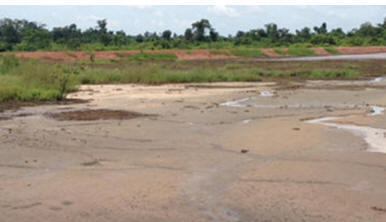
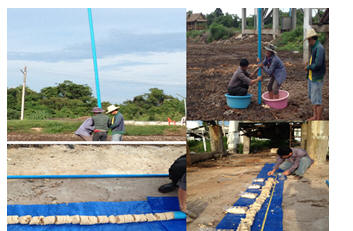
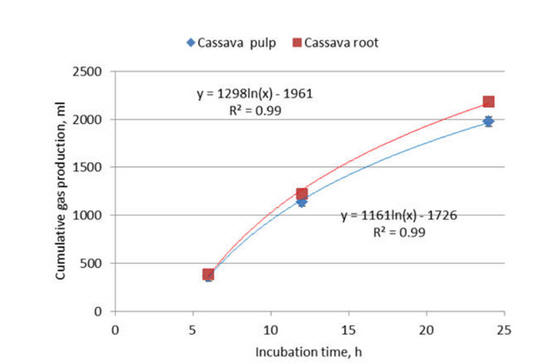
The cassava for the starch factory in Nashaw village, Pakngum District in Vientiane Capital is supplied by 235 households in 85 villages with total cassava harvested area of 5,207 ha producing 100.000 tonnes per year of cassava roots. During the 6 -7 month harvest season from October to March-April (the dry season in Lao PDR) this amounts to 480 tonnes of roots daily. The byproduct remaining after starch extraction, known as cassava pulp, represents from 10 to 15% of the original weight of fresh roots. Over the past 4 years, very little of the cassava pulp was bought by farmers and almost all of it had been stored in a pit adjacent to the factory, which had not been covered or protected in any way (Figure 1). Samples were taken to a depth of 7 m (Figure 2) and showed that the stored pulp had ensiled perfectly with a pH of 3.5, and that its potential feed value was only slightly less than that of the fresh whole cassava root (Figure 3).
|
|
| Figure 1. The pit holding an estimated 100,000 tonnes of cassava pulp in the cassava factory in Nashaw village, Pakngum District, Vientiane | Figure 2. Taking samples of the contents of the pit |
 |
|
Figure 3. Gas production from cassava pulp compared with cassava root |
For every tonne of cassava roots that are harvested there are an additional 600 kg of stems and leaves. The protein content in cassava leaves is around 22-25% in dry matter, and it has been shown that these have a high feeding value for cattle, and can be the only source of protein in diets for fattening cattle based on molasses-urea (Ffoulkes and Preston 1978).
The varieties used for industrial starch production are known as “bitter” varieties due to the high content of cyanogenic glucosides that are converted into the highly toxic hydrocyanic acid when consumed by animals and people. The cassava varieties that are planted for human consumption are known as “sweet” varieties as they have a lower content of cyanogenic glucosides. Much research on evaluating the use of cassava for livestock feeding has thus concentrated on methods to reduce the HCN content, such as sun-drying and ensiling (Bui Phuc 2005).
Recent research showed that from the point of view of the environment, and especially the problem of global warming, the presence of the cyanogenic glucosides in cassava could be an advantage. Methane emissions in an in vitro fermentation were found to be lower when the cassava leaves in the fermentation substrate were from “bitter” varieties rather than from “sweet “varieties” (Phuong et al 2014).
Cassava pulp is high in fermentable carbohydrate (contains up to 60% of residual starch) but is very low in protein (<3.00% in the dry matter). In this respect it is similar to molasses with the difference that the carbohydrate in molasses is sugar while in cassava it is mainly as starch.
Research carried out in the Dominican Republic (Ffoulkes and Preston 1978) showed that cattle could be fattened with growth rates of 0.9 kg/day by supplementing the molasses with urea as a source of fermentable nitrogen for the rumen and by fresh cassava foliage as a source of ‘bypass” protein (bypass protein is protein which escapes the rumen and is digested in the intestine contributing amino acids directly to the animal).
It was hypothesized that a similar feeding system could be developed using cassava pulp instead of molasses.
An experiment was set up on the farm of Mr Khalma situated some 10 km from the cassava factory. Two groups each of 4 local Yellow cattle of about 100 kg live weight were fed a basal diet of ad libitum cassava pulp enriched with urea at the rate of 3% of the cassava pulp dry matter. The experiment was done in the dry season (April-May 2015). As cassava foliage was not available, fresh Brewer’s grains were used as replacement for the planned cassava foliage. Rice straw was given as a source of “roughage” to stimulate rumen function.
The ingredients in the diet are shown in Table 1.
|
Table 1. Composition of the diet fed to the Yellow cattle |
|
|
Ingredient |
Kg/day |
|
Ensiled cassava pulp |
10 |
|
Urea |
0.60 |
|
Fresh brewers’ grains |
4 |
|
Rice straw |
1 |
|
These quantities were provided on the basis of 100 kg live weight. They were increased proportionately as the animals increased in weight |
|
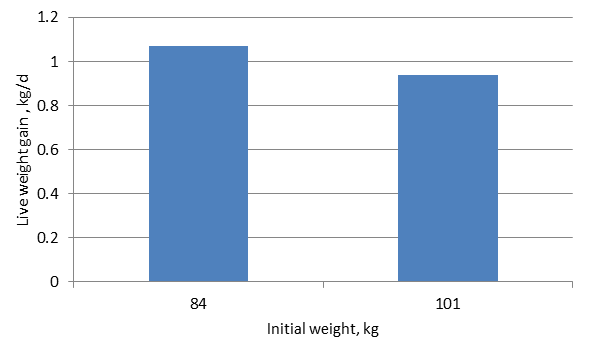
The data in table 2 are the results for the performance of the cattle over the first 3 months of the fattening period.
|
Table 2. Mean values for the feed intake, growth rate and feed conversion over the first 88 days of the fattening period |
||
|
Group 1 |
Group 2 |
|
|
Live weight, kg |
||
|
Initial |
101 |
84 |
|
After 88 days |
191 |
164 |
|
Daily gain |
1.07 |
0.939 |
|
Feed intake, kg/day |
||
|
Cassava pulp |
11.3 |
9.57 |
|
Brewers grains |
4.87 |
4.13 |
|
Urea |
0.11 |
0.09 |
|
Rice straw |
1.23 |
1.04 |
|
S-rich minerals |
0.08 |
0.07 |
|
Total DM |
4.82 |
4.10 |
|
DM feed conversion |
4.50 |
4.37 |
|
On a DM basis, the diet contained: cassava pulp 51%, Brewers grains 23%, urea 2.2%, Rice straw 22%, minerals 1.4% |
||
 |
 |
|
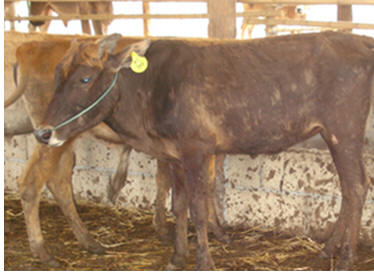
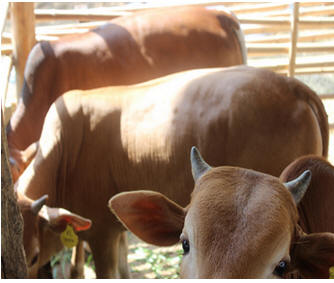
Photo 1. Condition of the animals at the start of the experiment |
Photo 2. The cattle after 88 days of fattening with cassava pulp diet |
The excellent performance of the cattle (Figure 3), with growth rates of 1 kg/day and a DM feed conversion of 4.5, is reflected in the body condition. It is estimated that the cattle will be ready for slaughter in one more month, that is after a total fattening period of 4 months.
 |
|
Figure 3. Live weight gain of local Yellow cattle fattened for 88 days on a basal diet of ensiled cassava pulp, urea and Brewers’ grains |
For this first demonstration, Brewers’ grains were used as the source of ‘bypass” protein as cassava foliage was not available. With the start of the rainy season, cassava foliage is now available and 4 groups, each of 5 Yellow cattle, are being fattened; two groups are fed the same diet as in Experiment 1 with Brewers’ grains as the protein source; the other two groups are fed with fresh cassava foliage as the protein source.
The other issue that has to be evaluated is the relative palatability of the foliage of “ bitter” versus “sweet” cassava.
Based on the data in Table 2 it can be estimated that over a fattening period of 4 months the total intake of cassava pulp will be of the order of 1426 kg, of urea 14 kg and of cassava foliage 739 kg.
On this basis the cassava pulp stored in the pit in the cassava factory in Vientiane province could support the fattening of 70,000 Yellow cattle and have a value of over one million US dollars.
Department of Agriculture 2012 Crop statistic year book, Lao PDR
Ffoulkes D and Preston T R 1978 Cassava or sweet potato forage as combined sources of protein and roughage in molasses based diets: effect of supplementation with soybean meal. Tropical Animal Production, Volume 3, Number 3 pp186-192 http://www.utafoundation.org/UTAINFO1/TAP/TAP33/3_3_1.pdf
Phanthavong V, Viengsakoun N, Sangkhom I and Preston T R 201 4: Cassava pulp as livestock feed; effects of storage in an open pit. Livestock Research for Rural Development. Volume 26, Article #169. http://www.lrrd.org/lrrd26/9/phan26169.htm
Phanthavong V, Viengsakoun N, Sangkhom I and Preston T R 2015 : Effect of biochar and leaves from sweet or bitter cassava on gas and methane production in an in vitro rumen incubation using cassava root pulp as source of energy. Livestock Research for Rural Development. Volume 27, Article #72. http://www.lrrd.org/lrrd27/4/phan27072.html