A substrate of sugar cane stalk supplemented with cassava leaf meal or fresh cassava leaves was fermented in a simple in vitro system in which the sources of fermentable N were calcium nitrate or urea.
Replacing urea with calcium nitrate reduced methane production in an in vitro system in which the substrate was sugarcane stalk and dried or fresh cassava leaf. Increasing the fermentation time increased the production of methane, probably because of reduction of the VFA. After 5h of fermentation the methane percentage in the gas was lower with fresh than with dried cassava leaf, but there were no differences with longer fermentation times. The potential of HCN precursors in cassava leaf and roots to reduce methane production in ruminants merits further investigation.
Methane resulting from fermentative digestion of organic matter in the rumen
represents a loss of dietary energy to the animal (Johnson and Johnson 1995)
and ruminants are a significant contributor to world greenhouse gas
emmissions(Steinfeld et al 2006). These factors have led to a global search
for
strategies
to mitigate methane emissions from ruminants.
In ruminants, H2 produced in the pathways of conversion of organic matter to VFA with growth of cells, is normally removed by the reduction of CO2 to form methane. However, nitrate (present in some fresh pasture grasses) has a higher affinity for H2 than CO2 and, when it is present, H2 is effectively used in the reduction of NO3 to ammonia (NH3) thereby lowering the production of methane. The possibility of nitrate as an alternative hydrogen sink to carbon dioxide has been discouraged because of the possible toxic effects of nitrite, which is spilled into the medium under some feeding regimes (Lewis 1951).
After comprehensively reviewing the literature, Leng (2008) concluded that the inclusion of nitrate in feed supplements appeared to be entirely feasible as a means of reducing enteric methane emissions from ruminant livestock. While there is a risk of nitrite toxicity, nitrate supplementation also has potential advantages in addition to inhibiting methane emissions, viz. (i) the end product of nitrate reduction is ammonia, which for ruminants on low digestibility diets, is a major source of N for microbial growth; and (ii) nitrate reduction to ammonia is accompanied by formation of ATP from ADP and therefore theoretically microbial growth efficiency should also be improved.
The protein in cassava (Manihot esculenta, Crant) leaves is considered to be a good source of bypass protein (Ffoulkes and Preston 1978; Wanapat et al 1997, Keo Sath et al 2008). It is widely cultivated in all tropical counties and is thus a logical forage produced locally to provide the additional protein required in low protein high energy diets
Cassava contains cyanogenic glucosides, mainly linamarin (92-98%); which release hydrogen cyanide after hydrolysis in the rumen by an endogenous linamarase (Butler et al 1965; Com 1969). Anaerobic digestion can be inhibited by cyanide, because of the high sensitivity of methanogenic bacteria to this compound (4 mg 1itre-1 in pure culture) (Eikmanns and Thauer 1984; Smith et al 1985).
Cuzin and Labat (1992) showed that additions of 5, 10, and 25 mg 1itre-l cyanide (KCN or linamarin) temporarily inhibited methanogenesis but when the concentration of cyanide reached its initial value (before KCN or linamarin addition), methane production recovered. The biodigester methanogenic microflora were sensitive to cyanide addition, but tolerated the low concentrations (6 mg 1itre-1) normally present in the fermenter.
As production of HCN from cyanogenic glucosides is reduced by drying (from 190 mg/kg DM in the fresh leaf to 20 mg/kg after sun-drying according to Bui Huy Nhu Phuc et al 1995), it is possible that methane production in an in vitro fermentation would be less when the substrate contained fresh cassava leaves rather than dried leaves.
The purpose of the present study was to develop and use a simple in vitro method to determine methane production from a diet based on sugar cane stalk as substrate supplemented with protein from cassava leaf meal or fresh cassava leaf using calcium nitrate and urea as sources of non-protein nitrogen.
The experiment was conducted in the laboratory of An Giang University, Vietnam from August to October 2010.
A 2 x 2 factorial design was used to evaluate the effect of (i) supplementation of cassava leaf meal or fresh cassava leaf; and (ii) supplementation of urea or calcium nitrate using sugar cane stalk as basal substrate. There were four replications of the following treatments.
The sugar cane stalk and cassava leaf meal (or fresh cassava leaf) were milled in a coffee grinder and mixed with the sources of N (urea or calcium nitrate). A representative sample (12 g DM) of the mixtures (Table 1) were put in a 1500 ml flask (a recycled water bottle) to which was added 0.96 litres of buffer solution (Table 2) and 240ml of rumen fluid (obtained immediately after slaughter of a buffalo in the municipal abattoir), prior to eliminating the remaining air in the flask with carbon dioxide. The incubation flask was connected by a plastic tube (id 3mm) to a second flask (a calibrated recycled water bottle with the bottom removed) suspended in water so as to measure the gas production by water displacement. The incubation flasks were then incubated at 38 0 C in a water bath for 48h. Full details of the in vitro system (Photo 1) are given in Sangkhom et al (2011).
|
Table 1. Ingredients (g) in the substrate |
||||
|
CLM-U |
FCL-U |
CLM-CaN |
FCL-CaN |
|
|
Sugar cane stalk |
8.76 |
8.76 |
8.76 |
8.76 |
|
Cassava leaf meal |
3.00 |
3.00 |
|
|
|
Fresh cassava leaf |
3.00 |
|
3.00 |
|
|
Urea |
0.24 |
0.24 |
|
|
|
Ca(NO3)2.4H2O |
0.46 |
0.46 |
||
|
Table 2. Ingredients of the buffer solution (adapted from Tilly and Terry 1964) |
|||||||
|
Ingredients |
CaCl2 |
NaHPO4.12H2O |
NaCl |
KCl |
MgSO4.7H2O |
NaHCO3 |
Cysteine |
|
(g/liter) |
0.04 |
9.30 |
0.47 |
0.57 |
0.12 |
9.80 |
0.25 |
|
|
|
|
Photo 1. The in vitro fermentation system using recycled water bottles and water displacement to measure gas production |
Photo 2. Measurement of percentage of methane in the gas |
Gas production was measured after 5, 15 and 43h and samples analyzed for methane percentage using an infra-red analyser (Crowcon Instruments Ltd, UK) (Photo 2). Each time, after the gas volume was measured and analyzed for methane, the gas was released to empty the bottles for the next measurement. Residual undigested substrate in the fermentation flask was determined by filtration through cloth (Photo 3) and drying of the residue in the oven at 105°C for 24h.
|
|
|
Photo 3. The residual substrate filtered through cloth
|
The data were analyzed by
the General Linear Model (GLM) option in the ANOVA program of the Minitab
Software (version13.2) (Minitab 2000). Sources of variation in the model
were: N source, cassava leaf, interaction N*cassava leaf and error.
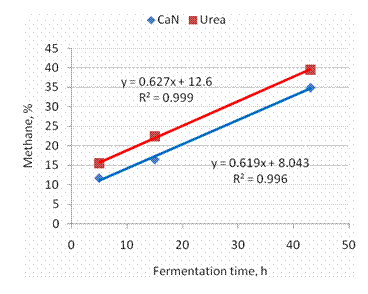
Gas production was higher for fresh than for dried cassava at 5h and for urea versus nitrate at 15h; however, there were no treatment differences at other sampling times and only a tendency (P=0.15) for total gas production at 43h to be higher on urea than on nitrate (Table 3). After 5h (Figure 1) and at all subsequent sampling times the per cent methane in the gas, and the quantity of methane produced, were reduced in presence of nitrate compared with urea. Comparing fresh with dried cassava leaves, after 5h the per cent methane in the gas was lower for the former both before and after correcting the data for differences in gas volume (Figure 2). However, there were no differences at 15 and 43 h, and no differences at all times for volume of methane produced. The proportion of substrate fermented, and the gas production per unit substrate fermented, were not affected by the treatments. However, the production of methane as per cent of total gas production (Figure 3) , and as total volume per unit substrate fermented (Figure 4), were lower for nitrate than for urea. There were no interactions between N source and cassava leaf processing for any of the measurements.
|
Table 3. Mean values for gas production and concentration of methane after 5, 15 and 43h of in vitro fermentation of fresh sugarcane in presence of urea or calcium nitrate and fresh or dried cassava leaves |
|||||||
|
|
Effect of cassava |
Effect of N source |
P values |
SEM |
|||
|
|
CLM |
FCL |
CaN |
Urea |
Cassava |
N source |
|
|
0- 5h |
|
|
|
|
|
|
|
|
Gas production, ml |
875 |
975 |
950 |
900 |
0.030 |
0.24 |
28.9 |
|
Methane, % |
14.4 |
12.9 |
11.8 |
15.5 |
0.040 |
<0.001 |
0.46 |
|
Methane, %# |
14.3 |
12.9 |
12.1 |
15.2 |
0.046 |
<0.001 |
|
|
Methane, ml |
125 |
125 |
111 |
138 |
0.92 |
<0.001 |
4.46 |
|
5-15h |
|
|
|
|
|
|
|
|
Gas production, ml |
925 |
900 |
831 |
994 |
0.71 |
0.03 |
47.2 |
|
Methane, % |
19.6 |
19.3 |
16.5 |
22.4 |
0.68 |
<0.001 |
0.62 |
|
Methane, ml |
182 |
174 |
136 |
220 |
0.35 |
<0.001 |
5.99 |
|
15-43h |
|
|
|
|
|
|
|
|
Gas production, ml |
450 |
444 |
425 |
469 |
0.88 |
0.30 |
28.9 |
|
Methane, % |
37.4 |
37.0 |
34.9 |
39.5 |
0.74 |
<0.001 |
0.79 |
|
Methane, ml |
167 |
164 |
147 |
184 |
0.81 |
0.01 |
8.41 |
|
At 43h |
|
|
|
|
|
|
|
|
Total gas production, ml |
2250 |
2319 |
2206 |
2363 |
0.51 |
0.15 |
72.3 |
|
Total methane, ml |
474 |
464 |
395 |
543 |
0.04 |
<0.001 |
13.9 |
|
Overall methane, % |
21.0 |
19.9 |
17.9 |
23.0 |
0.60 |
<0.001 |
0.33 |
|
DM substrate fermented, g |
6.56 |
6.89 |
6.67 |
6.78 |
0.21 |
0.68 |
0.18 |
|
DM substrate fermented, % |
52.4 |
57.2 |
54.8 |
54.9 |
0.19 |
0.97 |
2.39 |
|
Gas production, ml/g substrate DM fermented |
343 |
337 |
331 |
348 |
0.79 |
0.56 |
16.9 |
|
Methane, ml/g DM substrate fermented |
72.6 |
67.6 |
59.8 |
80.4 |
0.27 |
<0.001 |
3.08 |
|
# Corrected for differences in gas production |
|||||||
|
|
|
|
Figure 1. Effect of CaN vs urea on methane content of gas after 5h of incubation of sugar cane and cassava leaf |
Figure 2. Effect of fresh vs dry cassava leaf on methane content of gas after 5h incubation (corrected for differences in gas volume) |
|
|
|
|
Figure 3. Effect of CaN vs urea on methane content of gas after 43h incubation of sugar cane and cassava leaf |
Figure 4. Effect of CaN vs urea on methane per unit substrate fermented after 43h incubation |
The lowering in methane production when nitrate, compared with urea, was the NPN source with an energy substrate of sugar cane stalk, mirrored the findings of Sangkhom et al (2011) who used cassava root as the substrate. Comparable comparisons for cassava root versus sugar cane showed the proportion of substrate fermented to be higher, while the production of methane per unit substrate fermented was lower, for the former.
The values recorded in this study for total gas production, percentage of methane at the end of the incubation period, and amount of methane production per DM substrate fermented, were higher than those reported by Le Thi Ngoc Huyen et al (2010). The differences can be attributed to the nature of the substrate: NaOH-treated rice straw in the experiment of Le Thi Ngoc Huyen et al (2010) compared with the more digestible sugar cane stalk in the present study.
The linear increase in the methane content of the gas with fermentation time (Figures 5 and 6) showed the same tendency as was reported by Sangkhom et al (2011). As discussed by those authors, these changes almost certainly reflected changes in the nature of the fermentation as carbohydrate was fermented first to VFA, methane and carbon dioxide followed by secondary fermentation of the VFA to methane and carbon diooxide.
|
|
|
|
Figure 5. Effect of duration of fermentation on methane production in flasks containing sugar cane and cassava leaf: nitrate vs urea |
Figure 6. Effect of duration of fermentation on methane production in flasks containing sugar cane and cassava leaf : fresh vs dry cassava leaf |
The results of this research provide further evidence for the mitigating effect on methane production of providing a nitrate salt instead of urea as the source of fermentable N in an in vitro fermentation of a substrate of low protein solubility (Guo et al 2009; Sangkhom et al 2011).
The indications that in the early phase of
fermentation, methane production was less on fresh cassava leaf than on dried
leaf meal, merit further investigation. The content of cyanogenic
glucosides in the two samples was not determined but on past evidence would be
expected to be higher in the fresh leaves. Future research should examine
cassava varieties with known high content of cyanogenic glucosides and
increasing the cassava leaf content in the substrate.
Replacing urea with calcium nitrate reduced methane production in an in vitro system in which the substrate was sugarcane stalk and dried or fresh cassava leaf.
Increasing the incubation time increased the production of methane, probably because of reduction of the VFA to methane and carbon dioxide (as happens in the biodigester).
After 5h of incubation the methane percentage in the gas was lower with fresh than with dried cassava leaf, but there were no differences with longer incubation times times.
The potential of HCN precursors in cassava leaf and roots to reduce methane production in ruminants merits further investigation.
The authors would like to thank SIDA-SAREC for funding this research through the regional MEKARN project. Special thank to Mrs. Le Thi Thuy Hang and Mr. Ho Xuan Nghiep for support in the laboratory and to An Giang University for providing the location to conduct the experiment.
Allison M. J, Reddy C A, and Cook H M. 1981 The effects of nitrate and nitrite on vfa and ch4 production by ruminal microbes.J. Anim. Sci. 53(Suppl.):283. (Abstr.)
Butler G.W, Bailey R W and Kennedy LD 1965 Studies on the glucosidase 'linamarase', Phytochemistry, 4, 369-381.
Conn E E 1969 Cyanogenic glycosides, Journal of Agricultural and Food Chemistry, 17, 519-526.
Cuzin N and Labat M 1992 Reduction of cyanide levels during anaerobic digestion of cassava. ORSTOM, Brazzaville, R. P. Cong. International Journal of Food Science and Technology (1992) 27, 329-336.
Eikmanns B and Thauer R K 1984 Catalysis of an isotopic exchange between COz and the carboxyl group of acetate by Methanosarcina barkeri grown on acetate, Archives of Microbiology, 138, 365-370.
Ffoulkes D and Preston T R 1978 Cassava or sweet potato forage as combined sources of protein and roughage in molasses based diets: effect of supplementation with soybean meal. Tropical Animal Production Volume 3, Number 3, pp 186-192 http://www.utafoundation.org/TAP/TAP33/3_3_1.pdf
Guo W S, Schafer D M, Guo X X, Ren L P and Meng Q X 2009: Use of nitrate-nitrogen as a sole dietary nitrogen source toinhibit ruminal methanogenesis and to improve microbial nitrogen synthesis in vitro. Asian-australas. J. Anim. Sci. 22:542–549.
Johnson K A and Johnson D E 1995 Methane emissions from cattle. J. Anim. Sci. 73:2483–2492.
Khan M M H and Chaudhry A S 2009: Effect of spice supplementation on in vitro methane production using ground wheat as a substrate. Proceedings of the British Society of Animal Science.
Leng RA 2008: The potential of feeding nitrate to reduce enteric methane production in ruminants. Report to Department of Climate Change, Commonwealth Government, Canberra. Available at http://www. penambulbooks.com/Downloads/Leng-Final%20Modified%20%2017-9-2008.pdf [Verified 17 July 2010]
Lewis D 1951 The metabolism of nitrate and nitrite in the sheep; the reduction of nitrate in the rumen of the sheep. Biochem. J.48:175–180.
Menke K H and Steingass H 1988 Estimation of the energetic feed value obtained from chemical analysis and in vitro gas production using rumen fluid. Animal Research and Development. Volume 28. pp. 7-55.
Ngoc Huyen L T, Do H Q, Preston T R and Leng R A 2010: Nitrate as fermentable nitrogen supplement to reduce rumen methane production. Livestock Research for Rural Development. Volume 22, Article #146. http://www.lrrd.org/lrrd22/8/huye22146.htm
Nolan J V, Hegarty R S, Hegarty J, Godwin I R and Woodgate R 2010: Use of supplementary nitrate to mitigate methane production and provide rumen degradable N for ruminants. Proceedings Australian Society of Animal Production. Volume 28 http://www.asap.asn.au/asap28/files/nolan081.pdf
Ørskov E R, DeB Hovell F D and Mould F 1980 The use of the nylon bag technique for the evaluation of feedstuffs. Tropical Animal Production Volume 5, Number 3. http://www.utafoundation.org/TAP/TAP53/53_1.pdf
Sath K, Borin K and Preston T R 2008 Effect of levels of sun-dried cassava foliage on growth performance of cattle fed rice straw. Livestock Research for Rural Development. Volume 20, supplement. http://www.lrrd.org/lrrd20/supplement/sath2.htm
Smith M R, Lequerica J L and Hart M R 1985 Inhibition of methanogenesis and carbon metabolism in Methanosarcina sp. by cyanide, Journal of Bacteriology, 162, 67-71.
Steinfeld H, Gerber P, Wassenaar T, Castel V, Rosales R, and Haan C 2006: Livestock’s long shadow. Food and Agriculture Organization of the United Nations, Rome, Italy.
Tilley J M A and Terry R A 1963 A two stage technique for the in vitro digestion of forage crops. Journal of the British Grassland Society 18: 104.
Wanapat M, Pimpa O, Petlum A and Boontao U 1997 Cassava hay: A new strategic feed for ruminants during the dry season. . Livestock Research for Rural Development. Volume 9 (2), Article #18 http://www.lrrd.org/lrrd9/2/metha92.htm
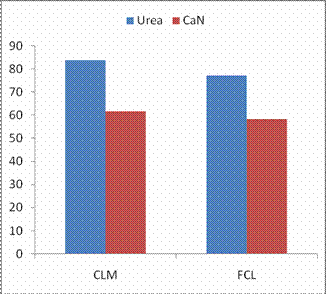
No interaction of N source and bypass protein on the overall total gas production, percentage of methane, methane gas production and amount of methane production per DM substrate fermented were observed in this experiment (tables 3) were superior to that reported by Ngoc Huyen L T et al (2010) in recent experiment. The improvement in gas production compared with previous trials can partly be attributed to a change in basal substrate, since the fresh sugarcane as basal substrate was ground fresh immediately after it was chopped. In previous trials, the basal substrate as rice straw is known that this feed generally leads to less gas production in ruminants.
|
Table 3. Means values for gas production, percentage of methane and methane production per substrate fermented during 48 hours |
|||||
|
Source of N Bypass protein |
Urea |
CaN |
Probability |
||
|
CLM |
FCL |
CLM |
FCL |
||
|
Total gas production, ml |
2,325 |
2,400 |
2,175 |
2,237 |
0.95 |
|
Percentage of CH4, % |
23.6 |
22.4 |
18.4 |
17.5 |
0.76 |
|
CH4 gas production, ml |
549 |
536 |
399 |
390 |
0.93 |
|
Methane production substrate fermented, ml/g |
83.7 |
77 |
61.5 |
58.2 |
0.70 |
CLM: Cassava leaf meal; FCL: Fresh cassava leaf
Effect of N source: Interestingly, the results indicated a positive effect on methane reduction due to the inclusion in the substrate of additional calcium nitrate. The effect may have been related to methanogenesis is inhibited by the presence of nitrate, since recent results were claimed by Nolan et al (2010) that sheep were fed oat hay and either potassium nitrate or urea (5.4 g N/kg hay). Methane production was reduced by feeding nitrate instead of urea.
|
|
|
Figure 1. |
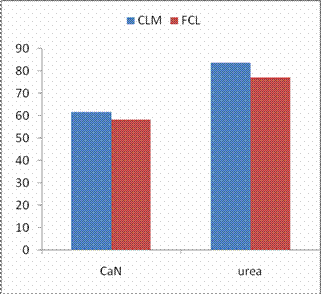
Effect of cassava leaf : There were no differences between cassava leaf meal and fresh cassava leaf effects. Surprisingly, the means values for the effect of fresh cassava leaf on total gas production, percentage of methane and methane production per substrate fermented (Table 4.) were slightly reduced higher than the effect of cassava leaf meal. A factor which certainly contributed to the low overall means values were higher HCN in fresh cassava leaf. According to Eikmanns & Thauer (1984); Smith et al (1985) reported that anaerobic digestion can be inhibited by cyanide, because of the high sensitivity of methanogenic bacteria to this compound.
|
Table 4. Overall means for effects on gas production, percentage of methane and methane production per substrate fermented of bypass protein and source of N |
|||||||
|
Effect of N source |
Probability |
Effect of cassava leaf |
Probability |
||||
|
Urea |
CaN |
CLM |
FCL |
||||
|
Total gas production, ml |
2362 |
2206 |
0.15 |
2250 |
2318 |
0.51 |
|
|
Percentage of CH4, % |
23.0 |
17.9 |
<0.01 |
21.0 |
19.9 |
0.04 |
|
|
CH4 gas production, ml |
543 |
395 |
<0.01 |
474 |
464 |
0.60 |
|
|
Methane, ml/g substrate fermented |
80.4 |
59.8 |
<0.01 |
72.6 |
67.6 |
0.27 |
|
|
|
|
Figure 1. Effect of calcium nitrate or urea on methane production per substrate fermented, ml/g |
Figure 2. Effect of cassava leaf meal or fresh cassava leaf on methane production per substrate fermented, ml/g |
Adding fresh cassava leaf or calcium nitrate to sugarcane stalk as basal basal substrate reduced methane production. Moreover, the inclusion of fresh cassava leaf and calcium nitrate on methane production were additive.
I would like to thank to the SIDA-SAREC for funding this research of the MSc course through the regional MEKARN project. Special thank to Dr. Thomas Reg Preston who gave me some good advice. And also thanks to Mrs. Le Thi Thuy Hang and Mr. Ho Xuan Nghiep who support us the facilities and in methane’s experiment. Finally, I also thank to An Giang University that provide the location to conduct the experiment.
Allison M. J, Reddy C A, and Cook H M. 1981 The effects of nitrate and nitrite on vfa and ch4 production by ruminal microbes.J. Anim. Sci. 53(Suppl.):283. (Abstr.)
Butler G.W, Bailey R W and Kennedy LD 1965 Studies on the glucosidase 'linamarase', Phytochemistry, 4, 369-381.
Conn E E 1969 Cyanogenic glycosides, Journal of Agricultural and Food Chemistry, 17, 519-526.
Cuzin N and Labat M 1992 Reduction of cyanide levels during anaerobic digestion of cassava. ORSTOM, Brazzaville, R. P. Cong. International Journal of Food Science and Technology (1992) 27, 329-336.
Eikmanns B and Thauer R K 1984 Catalysis of an isotopic exchange between COz and the carboxyl group of acetate by Methanosarcina barkeri grown on acetate, Archives of Microbiology, 138, 365-370.
Ffoulkes D and Preston T R 1978 Cassava or sweet potato forage as combined sources of protein and roughage in molasses based diets: effect of supplementation with soybean meal. Tropical Animal Production Volume 3, Number 3, pp 186-192 http://www.utafoundation.org/TAP/TAP33/3_3_1.pdf
Guo W S, Schafer D M, Guo X X, Ren L P and Meng Q X 2009: Use of nitrate-nitrogen as a sole dietary nitrogen source toinhibit ruminal methanogenesis and to improve microbial nitrogen synthesis in vitro. Asian-australas. J. Anim. Sci. 22:542–549.
Johnson K A and Johnson D E 1995 Methane emissions from cattle. J. Anim. Sci. 73:2483–2492.
Khan M M H and Chaudhry A S 2009: Effect of spice supplementation on in vitro methane production using ground wheat as a substrate. Proceedings of the British Society of Animal Science.
Leng RA 2008: The potential of feeding nitrate to reduce enteric methane production in ruminants. Report to Department of Climate Change, Commonwealth Government, Canberra. Available at http://www. penambulbooks.com/Downloads/Leng-Final%20Modified%20%2017-9-2008.pdf [Verified 17 July 2010]
Lewis D 1951 The metabolism of nitrate and nitrite in the sheep; the reduction of nitrate in the rumen of the sheep. Biochem. J.48:175–180.
Menke K H and Steingass H 1988 Estimation of the energetic feed value obtained from chemical analysis and in vitro gas production using rumen fluid. Animal Research and Development. Volume 28. pp. 7-55.
Le Thi Ngoc Huyen, Ho Quang Do, Preston T R and Leng R A 2010: Nitrate as fermentable nitrogen supplement to reduce rumen methane production. Livestock Research for Rural Development. Volume 22, Article #146. http://www.lrrd.org/lrrd22/8/huye22146.htm
Nolan J V, Hegarty R S, Hegarty J, Godwin I R and Woodgate R 2010: Use of supplementary nitrate to mitigate methane production and provide rumen degradable N for ruminants. Proceedings Australian Society of Animal Production. Volume 28 http://www.asap.asn.au/asap28/files/nolan081.pdf
Ørskov E R, DeB Hovell F D and Mould F 1980 The use of the nylon bag technique for the evaluation of feedstuffs. Tropical Animal Production Volume 5, Number 3. http://www.utafoundation.org/TAP/TAP53/53_1.pdf
Sath K, Borin K and Preston T R 2008 Effect of levels of sun-dried cassava foliage on growth performance of cattle fed rice straw. Livestock Research for Rural Development. Volume 20, supplement. http://www.lrrd.org/lrrd20/supplement/sath2.htm
Smith M R, Lequerica J L and Hart M R 1985 Inhibition of methanogenesis and carbon metabolism in Methanosarcina sp. by cyanide, Journal of Bacteriology, 162, 67-71.
Steinfeld H, Gerber P, Wassenaar T, Castel V, Rosales R, and Haan C 2006: Livestock’s long shadow. Food and Agriculture Organization of the United Nations, Rome, Italy.
Tilley J M A and Terry R A 1963 A two stage technique for the in vitro digestion of forage crops. Journal of the British Grassland Society 18: 104.
Wanapat M, Pimpa O, Petlum A and Boontao U 1997 Cassava hay: A new strategic feed for ruminants during the dry season. . Livestock Research for Rural Development. Volume 9 (2), Article #18 http://www.lrrd.org/lrrd9/2/metha92.htm
Bui Huy Nhu Phuc, Nguyen van Lai, Preston T R, Ogle B and Lindberg J E 1995 Replacing soya bean meal with cassava leaf meal in cassava root diets for growing pigs. Livestock Research for Rural Development. Volume 7 (3), Article #21 http://www.lrrd.org/LRRD73/lrrd7/3/9.htm
Received 10 December 2010; Accepted 31 December 2010; Published 1 January 2011