 |
 |
|
| Mini-project Research
protocol |
MSc in Tropical Livestock Systems (2005-2007) |
|
|
|
|
| Mini-project Research
protocol |
MSc in Tropical Livestock Systems (2005-2007) |
| Contents |
Tree crops are highly appropriate for the tropical countries.
They capture a large amount of solar energy and, in high and low
rainfall areas; they produce sustainable yields of biomass. They
reduce erosion, improve soil structure and fertility and plants
with shallow roots can be grown under the trees (Preston and Leng
1987).
Tithonia diversifolia (Wild sunflower) is a shrub native to Central America but which has become naturalized in countries throughout the tropics, being found in Kenya, India, Ceylon, Cuba, Colombia (Katto and Salazar 1995) and we are also found it in Lao, Vietnam and Cambodia. Katto and Salazar (1995) also reported that it is used as forage for sheep and guinea pigs as well, with protein levels of up to 28.5% in the leaves (dry weight). Mahecha and Rosales (2005) showed that this species has many qualities which give it a high potential for animal production in the tropics. Important features are its high biomass yield and rapid rate of re-growth after cutting, tolerance to acid soils of low fertility and high protein content (about 20% in dry matter) and dry matter degradability in sacco (90% after 48h). The content of secondary plant compounds, especially tannins, appears to be low. Martin Price (1997) said that they occasionally feed rabbits on the leaves of Tithonia. The in vitro DM digestibilityof Tithonia diversifolia leaves is 52.8% to 61.7% (Edmundo Barrios 2004).
Planted as a hedge Tithonia has great potential to supply
plants with essential nutrients (Abednego Kiwia et al 2003).
Scientists at the International Centre for Research in Agroforestry
(ICRAF) in Kenya have recently determined that the weedy shrub
Tithonia diversifolia has potential as a green manure crop. It is
also useful for fencing (hedges), ornamental
and wild breaks (SACRED AFRICA 2000)
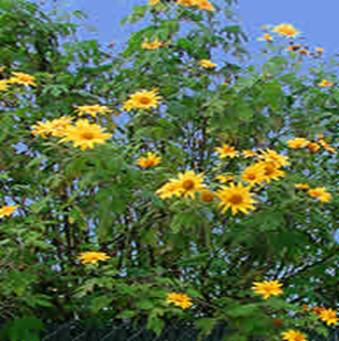
Tithonia diversifolia is a perennial and polycarpic plant that flowers in late April- May. It reproduces from seeds and vegetative re-growth of the basal stem when the plant is slashed. Tithonia diversifolia produces higher number of capitula and seeds per plant (Muoghalu and Chuba 2005). The widespread use of trees as a component of integrating farming systems greatly depends on tree propagation, and in this connection, it is a common practice to use cuttings from trees and shrubs instead of seeds.
Sorn Suheang (2003) reported that when peeling the bottom 3 to 4 cm of
cuttings it increased the rate of appearance of
green shoots compared with non-peeling. However, there are few data
on methods of Tithonia diverifolia stem germination and
growth rates.
Large diameter stems which are peeled at the lower end will germinate more rapidly than this stems which are not peeled, and that germination will be fasters when planted in in polyethylene bags containing ratios of 2:2 (soil to compost) than with ratios of 2:1.
The aims of the study are to determine effects of different soil:composition
ratios, diameter of stake and peeling on germination of Tithonia
diversifolia.
The study will be carried out at the Livestock Research Center, Lao from September to October, 2005.
There are 8 treatments in a 2*2*2 factorial arrangement with 4
replications in a Split Plot Design. The factors are:
L: Large
S: Small
NP: No peeling
P: the cortex of the lower 5 cm is removed
S21: Soil: compost (2:1)
S22: Soil: compost (2:2 )
|
|
Soil 2:2 |
Soil 2:1 |
||||||
|
Block 1 |
S-P |
L-NP |
S-NP |
L-P |
L-NP |
S-NP |
S-P |
L-P |
|
Block 2 |
S-NP |
S-P |
L-NP |
L-P |
S-P |
L-P |
L-NP |
S-NP |
|
Block 3 |
L-P |
L-NP |
S-NP |
S-P |
L-NP |
S-NP |
S-P |
L-P |
|
Block 4 |
S-NP |
L-P |
L-NP |
S-P |
S-NP |
S-P |
L-P |
L-NP |
Thirty two cuttings about 30 cm long will be taken from Tithonia
diversifolia trees. The stems of Tithonia
diversifolia are divided into thick stems (L) and thin stems
(S). For treatment P the cuttings will be peeled
with a knife, removing the bark from the lower 2 to 3 cm of the
cutting. The cuttings will be planted about 10 cm depth at the same
time in plastic bags (2 liter capacity) filled with a mixture of
soil and composted organic matter with different ratios: 2:1 (Soil:
compost) and 2:2. Plastic bags with 2 liter capacity are filled
with the substrate according to treatment. The bags will be placed
at spacings of 30 x 30 x30 cm under in a shaded area and watered
daily.
Each day the stems are observed for first appearance of buds and then the leaves. Every 5 days the numbers of stems with leaves are counted. Samples of compost and soil are analyzed forOM and N following standard procedures (AOAC) and for DM by the micro-wave radiation method of Undersander et al (1993).
The data will analyzed by the GLM option of the Minitab ANOVA
software, version 13.31. Sources of variation in the model are:
peeling, diameter, substrate, interaction peeling*diameter,
interaction peeling*substrate, interaction diameter*substrate and error
AbednegoKiwia et al 2003 Annotated Inventory of
Agroforestry Related Work in western Kenya (1987-
2003)
AOAC 1995 Official methods of Chemical Analysis.
Association of Official Analytical Chemists. 16th edition.
Arlington
Barrios Edmundo 2004. The In Vitro Dry Matter
Digestibility (IVDMD) Method
http://www.ciat.cgiar.org/tsbf_institute/pdf/nut_mgt_full_text.pdf
Rios Clara I and Salazar A 1995
Botón de oro
(Tithonia diversifolia (Hemsl.) Gray) una fuente proteica
alternativa para el trópico. Livestock Research for Rural
Development 6 (3) 1995.
http://www.cipav.org.co/lrrd/l
Mahecha Liliana and Rosales M 2005: Valor Nutricional
del Follaje de Botón de Oro Tithonia diversifolia
(Hemsl.) Gray, en la Producción Animal en el Trópico.
Livestock Research for Rural Development.Volume 17,
Article # 100. Retrieved, from http://www.cipav.org.co/lrrd/lrrd17/09/mahe17100.htm
Martin Price. 1997. A new way to preserve viability of
seed in remote locations. http://www.echonet.org
Muoghalu J I and. Chuba D K 2005 Seed
germination and reproductive strategies of two Tithonia species. Applied Ecology
and Environmental Research 3(1): 39-46.
http://www.ecology.kee.hu
Preston T R and Leng R A 1987 Matching Ruminant
Production Systems with Available Resources in the Tropics and
Sub-Tropics. Penambul Books, Australia.
SACRED AFRICA 2000. Using Tithonia as an Organic
Fertilizer. http://www.acts.or.ke/sacred/ANNUAL%20REPORT%20-%20SACRED.pdf
SornSuheang. 2003 Increasing the onset of budding of tree
cuttings.