 |
 |
|
| Mini-project Research
protocol |
MSc in Tropical Livestock Systems (2005-2007) |
|
|
|
|
| Mini-project Research
protocol |
MSc in Tropical Livestock Systems (2005-2007) |
| Contents |
Livestock are an important component of smallholder farms in the
Lao PDR with sales of livestock accounting for more that 50% of
cash income in many upland and highland areas. Over 95% of all
livestock is produced by smallholders (Stür
et al 2002). Goat production
plays an important role in the agricultural sector in the rural
areas, especially in the mountainous areas, supplying meat, milk
and fertilizer. Goat production is not yet performed properly on
the grass-root level. Farmers raise local breeds, which have a
small body size and there is a lack of feed during the dry season
resulting in low productivity and poor reproduction (Sopha Xaypha
2005) Tree leaves have been used traditionally by farmers as animal
feed but relatively little is known about their potential to
replace conventional protein-rich concentrates such as soya bean
meal and fish meal (Keir et al 1997). Jackfruit
(Artocarpus heterophyllus) is a multipurpose tree
that can be successfully used in goat production (Theng
Kouch et al 2003). The method of offering the browse has also been
found to be important with higher intakes and digestibility when the foliage is
offered hanging as a branch (Theng
Kouch et al 2003; Le Thi Thuy Hang 2003; Keopaseuht Toum et al 2005). It has been shown that this method resulted in
higher intake and digestibility by goats of tree foliages such as Jackfruit
compared with giving only the leaves in the feed trough (Theng
Kouch et al 2003).
Goats will have higher feed intake when offered the hanging
branch of jackfruit or mixture of the branch and leaves rather than just the
leaves.
The digestibility of the foliage from jackfruit by goats will be higher when hanging in the pen compared with offering it in the feed trough.
To study the effect on digestibility and N retention when offered
the foliage of jackfruit by hanging it in the pen compared with
putting it in the feed trough.
The experiment will be conducted at the Livestock Research Center,
Nam Xuang about 44 km from Vientiane City, Lao PDR. The experiment
started on 12 September 2005 and will be finished on 12 October
2005.
Three growing male goats (local breed) of 9.6 to 12.9 kg live
weight will be confined in cages made from wood with plastic mesh and
plastic sheet to collect separately the faeces and urine.
The experimental design is a 3*3 Latin Square arrangement. The treatments are:
Jackfruit leaves alone [ L]
Hanging the whole branch of jackfruit [B]
Free access to hanging branch of jackfruit and the separated leaves in the trough [MB]
The layout of the experiment is in Table 1.
|
Table 1. Layout of the experiment |
||||
|
Adaptation (days) |
Data collection (days) |
Goat 1 |
Goat 2 |
Goat 3 |
|
Period 1: 1 – 4 |
5-10 |
L |
B |
MB |
|
Period 2: 11 – 14 |
15-20 |
B |
MB |
L |
|
Period 3: 21 – 24 |
25-30 |
MB |
L |
B |
The jackfruit will be harvested within the Livestock Research
Center or around the households near the center. For treatment [L] the leaves
are separated from the
stem and put in the feed trough, [B] the branch is hanging above the
feed trough, and [MB] the leaves are separated putting them in the
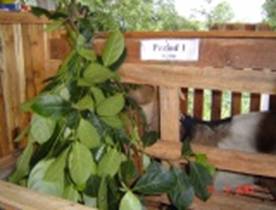
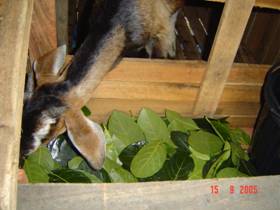
feed trough and also hang the whole branch. The methods for "B" and "L" are
shown in Figures 1 and 2. In all cases feeding is ad libitum with an offer level
of about 20% above actual intake. Feeds are offered twice daily: about 7.00am and 16.30pm. Days
1 to 5 of
each period are for adaptation to the new treatment; and days 6 to 10
for data collection.
 |
 |
|
|
Figure 1. Hanging the branch of jackfruit |
Figure 2: The separated leaves in the feed trough | |
The goats are weighed at the beginning and end of each period (every 10 days). Feed offered and refused is recorded. Faeces and urine are collected every day and a 10% sample kept in the refrigerator at -20ºC. At the end of each period samples for each treatment are mixed and representative amounts used for the analysis. Urine is collected in a bucket with 50 ml of 25% sulphuric acid to maintain the pH below 4 so as to prevent escape of ammonia. Feeds offered and refused are weighed and samples separated into leaves, petiole and stems, which were then analyzed for DM to determine the amounts that were consumed. Dry matter is determined by microwave radiation (Undersander et al 1993), crude fibre according to procedures of (AOAC 1990) and water extractable DM and N by the method of Ly and Preston (1997).
The data are analyzed using the GLM option of the
ANOVA software of Minitab (Version 13.31). Sources of variation are periods,
animals, feeding method and error.
Keir B, Dinh Van Bien, Preston
T R and Ørskov E R 1997 Nutritive value
of leaves from tropical trees and shrubs Intake; growth and
digestibility studies with goat, Livestock
Research for Rural Development 9 (4) 1997 .
1997,
Volume 9, Number 4 http://www.cipav.org.co/lrrd/lrrd9/4/bren942.htm
Le Thi Thuy Hang 2003: Effect of method of offering foliage from Muntingia (Muntingia calabura) to young goats on digestibility and N retention; Retrieved September 18, 2005, from MEKARN Mini-projects. http://www.mekarn.org/msc2003-05/miniprojects/webpage/hangag.htm
Ly J and Preston T R 1997 An approach to the estimation
of washing losses in leaves of tropical trees. Livestock
Research for Rural Development 9(3):
http://www.cipav.org.co/lrrd/lrrd13/1/ly131.htm
Sopha Xaypha and Ledin I 2005 Evaluation of foliages
for growing goats. MSc thesis, Swedish University of Agricultural
Sciences, Uppsala http://www.mekarn.org/procsr/sopha.pdf
Keopaseuht Toum, Chhay Ty, Bouahom Bounthong and Preston T R 2005: Effect of method of offering foliages of Gliricida sepium and Stylosanthes guianensis CIAT 184 (Stylo) to goats on intake and digestibility. Workshop-seminar "Making better useof local feed resources" (Editors: Reg Preston and Brian Ogle) MEKARN-CTU, Cantho, 23-25 May, 2005. Article #15. Retrieved September 18, 2005 , from http://www.mekarn.org/proctu/toum15.