Effect on feed intake and growth of
depriving rabbits access to soft faeces
Chiv Phiny
Center for Livestock and Agriculture Development
CelAgrid-UTA, Cambodia, Phnom Penh
phiny_kh@yahoo.com
Abstract
Twelve young rabbits with average live weight of 713 g were
allocated to four treatments in a 2*2 factorial
arrangement with three replications in a randomized block
design. The treatments were water spinach with: access to soft faeces
The water spinach offered had a a similar (about 50% of each) proportion of leaves and stems, while the refusals were much higher in stems, reflecting selection for the leaf component in the foliage consumed. Daily DM intakes of water spinach and rice bran were not affected by the rabbits having access or not to soft faeces. However, supplementation with rice bran led to decreased intake of water spinach but an increase in total DM intake. The growth rate was reduced by almost 50% when the rabbits were denied access to their soft faeces. There were no apparent advantages in supplementing the water spinach with rice bran. Feed conversion rates tended to be better when the rabbits had access to soft faeces. Soft faeces had lower contents of DM and crude fibre but almost 50% higher content of crude protein.
It is concluded that fresh water spinach can be given as the sole feed for growing rabbits; that there appears to be no advantage in supplementing it with rice bran; and that the practice of coprophagy confers important nutritional benefits.
Key words: Coprophagy, growth, feed intake, rabbits, soft faeces, water spinach.
Introduction
In tropical countries such as Laos, Vietnam and Cambodia, most
farmers keep livestock for their main source of income.
Rabbit production is a relatively new development in the region, which
nevertheless promises to play an increasing role in view of the economic risks
posed by the spread of bird flu (Benigno et al 2005). .
Water spinach (Ipomoea aquatica)
is a vegetable that is consumed by people and animals; it has a short growth period, is
resistant to common insect pests and can be cultivated either in
dry or flooded soils. Moreover, it has been found that water
spinach has a high potential to convert
nitrogen from biodigester effluent into edible biomass with high
protein content (Kean Sophea and Preston 2001). Water spinach has the potential to play an important role for farmers and animasl
in rural areas, because it is easy to plant and has a very high yield of
biomass, which is rich in protein. The crude protein content in the leaves and
stems can be as high as 32 and 18 % in dry basis, respectively (Ly Thi Luyen and
Preston 2004).
Digestion in rabbits begins in the mouth. The food is mashed up by
the teeth and mixed with saliva, which begins breaking down the
food as it moves into the stomach and then into the small intestine
where nutrients are absorbed into the body. The digesta continues on
into the large intestine where the food particles are sorted by
size. The larger particles of indigestible fiber drive the smaller
fragments of digestible fiber backwards into the cecum,
which is a large blind-ended sac located at the junction of the
small and large intestines. The indigestible particles are then
passed out in the fecal pellets (regular faeces) and then begins
the fermentation process that will produce what is commonly
referred to as night feces or cecotropes, which a rabbit will
ingest directly from the anus (Anon No date).
The hard pellets of rabbit are expelled, but the soft pellets
are recovered by the rabbit directly upon being expelled from the
anus. To do this the rabbit twists itself round, sucks in the soft
faeces as they emerge from the anus, then swallows without chewing
them. The soft pellets consist half of imperfectly broken-down food
residues and what is left of the gastric secretions and half of
bacteria.
The hard faeces, which are produced in the large intestines, are the faecal pallets commonly seen. The faeces that are consumed via coprophagy are the soft faeces, produced in the caecum. McNitt et al (1996) fed rabbits with different feed sources, which were either balanced concentrate feeds, or green and dry forage, and measured the nutrients in the hard and soft faeces. The major difference in composition was in the DM content (lower in soft faeces) and crude protein (much higher in the soft faeces) ( Proto 1980).
The following experiment was designed to study the effects on growth and feed conversion of depriving rabbits of access to the soft faeces, when they were fed a diet based on fresh water spinach.
Hypothesis
The hypothesis to be tested was that rabbits would
have a lower feed intake and lower growth rate when
they were prevented from consuming the soft faces, and that growth
rate would be improved when when the basal diet of water spinach
Materials and methods
Location
This experiment was conducted in the Livestock Research Center,
Nam Xuang, over the period 17 September to 17
October 2005.
Experimental design and treatments
Twelve young rabbits with average live weight of 713g were allocated to four treatments in a 2*2 factorial arrangement with three replications in a randomized block design (see Table1). The rabbits were confined in individual cages constructed from wood and iron net. The treatments were:
-
Y-WS : Water spinach with access to soft faeces
-
Y-WSRB : Water spinach and rice bran separately with access to soft faeces
-
N-WS: Water spinach without access to soft faeces
-
N-WSRB : Water spinach and rice bran separately without access to soft faeces
|
Table 1: Layout of experiment |
||||||
|
Block |
I |
II |
III |
|||
|
Cages |
Y-WS |
N-WS |
Y-WSRB |
Y-WS |
N-WS |
N-WSRB |
|
N-WSRB |
Y-WSRB |
N-WSRB |
N-WS |
Y-WS |
Y-WSRB |
|
Feeding and management
Water spinach was harvested from plots in the
research centre, cutting the stems about 1 cm above soil level, in order
to facilitate the re-growth. The leaves combined with the stems of the
water spinach were hung in the cage, by tying as a bunch at the
side of the cage (Photo 1). The rice bran was bought from neighbouring farmers.
It was put in a small feeder, made from
wood and was tied to the individual cage wall.
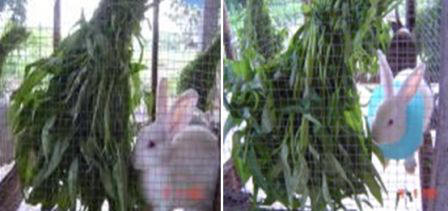
Photo 1: Rabbits with or without access to
soft faeces (by fitting a plastic collar around the neck)
The two kind of feed were offered to the
rabbits two times a day, beginning in the morning at 6:00 am.
Observations was made, mainly at midday (12:00 m) and in the
evening (4:30 pm), in order to ensure the permanent availability of
water spinach and rice bran. The proportions of leaves and stems
(fresh basis) in the water spinach were recorded daily in the foliage
that was offered and refused. Water was not provided.
Animal housing
The cages were made from wood and iron net with dimensions of
length 0.5m, width 0.5m and height 0.7m. There were holes in the
cage floor of approximately 1cm2 (See Photo1).

Photo
2: Rabbits in the individual cages
Measurements
Faeces were collected and weighed daily. About 10% of the daily amount was kept frozen in plastic bags until analysis at the end of every four days. Water spinach offered and refused was recorded every day, and separated into leaves and stems. Samples of each plant component, offered and refused, and fresh faeces were analysed for DM, N and crude fibre. Analyses were done on fresh material after grinding in a coffee grinder.
The rabbits were weighed at 5 day intervals before offering fresh feed in the morning.
Chemical analyses
Chemical analyses of the diets, refusals, normal faeces and soft
faeces were undertaken following the methods of AOAC (1990) for
ash, N and crude fibre. DM was determined using the micro-wave radiation method of Undersander et al (1993). Water extractable DM and N
were
determined by the methods described by Ly and Preston
(2001).
Statistical analysis
The data were subjected to analysis of variance using the General Linear Model (GLM) option of the MINITAB
software (Release 13.31, 2000). Sources of variation were: blocks,
access (or not) to faeces, rice bran, interaction access to faeces*rice bran
and error.
Results and discussion
Feed characteristics
DM and N contents were higher and crude fibre lower in leaves compared with the stems of the water spinach (Table 2). The low N content and high fibre of the rice bran probably reflected contamination with rice husks. The water spinach offered had a a similar proportion of leaves and stems, while the refusals were much higher in stems, reflecting selection for the leaf component in the foliage consumed (Table 3; Figure 1). The degree of selection for leaves was greater when the rabbits had no access to soft faeces as opposed to having access, and when they were supplemented with rice bran.
|
Table 2: Feed characteristics (% in dry basis, except for DM which is on fresh basis) |
||||
|
|
DM |
N |
Ash |
Crude fibre |
|
Rice bran |
87.3 |
1.32 |
10.0 |
26.6 |
|
Water spinach |
|
|
|
|
|
Leaves |
12.9 |
2.46 |
11.2 |
14.2 |
|
Stem |
8.43 |
2.18 |
14.4 |
20.3 |
|
Table 3 . Mean values for leaf fraction in water spinach, according to the rabbits having access or not to soft faeces and supplementation with rice bran |
|||||||
|
|
Soft faeces |
Rice bran |
|
||||
|
Leaf fraction (DM basis) |
No |
Yes |
Prob. |
No |
Yes |
Prob |
SEM |
|
Offered |
0.499 |
0.499 |
|
0.499 |
0.499 |
0.499 |
0.0039 |
|
Refused |
0.131 |
0.181 |
0.001 |
0.152 |
0.160 |
0.131 |
0.0086 |
|
Consumed |
0.6483 |
0.6208 |
0.014 |
0.6108 |
0.6583 |
0.001 |
0.0078 |
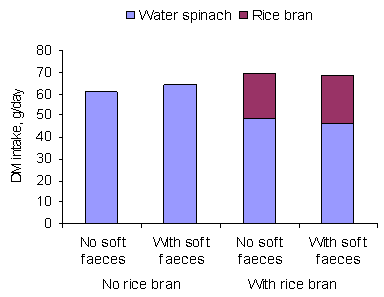
Figure 1: DM intake of water spinach and rice bran of rabbits with and without access to soft faeces
Feed intake
Daily DM intake of water spinach and rice bran was not affected by the rabbits having access or not to soft faeces (Table 4 and Figure 1). However, supplementation with rice bran led to decreased intake of water spinach but an increase in total DM intake.
|
Table 4. Mean values for DM intake of feeds, according to the rabbits having access or not to soft faeces and supplementation with rice bran |
|||||||
|
|
Soft faeces |
Rice bran |
|
||||
|
|
No |
Yes |
Prob. |
No |
Yes |
Prob. |
SEM |
|
Water spinach |
54.9 |
55.3 |
0.74 |
62.6 |
47.7 |
0.001 |
0.91 |
|
Rice bran |
10.2 |
10.7 |
|
0.0 |
20.9 |
|
|
|
Total |
65.1 |
66.1 |
0.53 |
62.6 |
68.6 |
0.001 |
1.1 |
Growth and feed conversion
The growth rate was reduced by almost 50% when the rabbits were denied access to their soft faeces (Table 5 and Figure 2). There were no apparent advantages in supplementing the water spinach with rice bran. Feed conversion rates tended to be better (P=0.02) when the rabbits had access to soft faeces (Table 5).
|
Table 5. Mean values for changes in live weight and in DM feed conversion of rabbits fed water spinach with access or not to soft faeces and supplementation or not with rice bran |
|||||||
|
|
Soft faeces |
|
Rice bran |
|
|
||
|
|
No |
Yes |
Prob |
No |
Yes |
Prob. |
SE |
|
Live weight, g |
|
|
|
|
|
|
|
|
Initial |
877 |
765 |
|
867 |
775 |
|
49 |
|
Final |
1187 |
1323 |
|
1293 |
1217 |
|
44 |
|
Daily gain |
11.1 |
21.4 |
0.001 |
16.3 |
16.2 |
0.94 |
1.04 |
|
DM conversion |
5.53 |
3.86 |
0.2 |
4.93 |
4.46 |
0.4 |
0.82 |
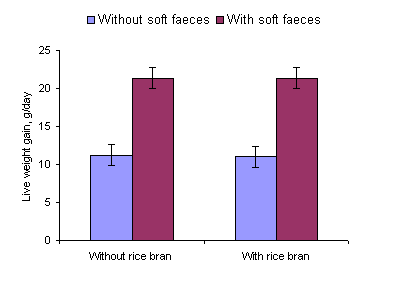
Figure 2: Effect of access or not
to soft faeces on the growth rate of rabbits fed water spinach
with or without supplementation with rice bran
Faecal characteristics
There were major differences in the composition of the hard faeces with increases in DM, N and crude fibre content when the rabbits were deprived of access to their soft faeces (Table 6). Supplementation with rice bran led to increases in DM content and ash content but no effect on crude fibre content.
|
Table 6. Mean values for composition of hard faeces of rabbits fed water spinach with access or not to soft faeces and supplementation or not with rice bran |
|||||||
|
|
Soft faeces |
Rice bran |
|
||||
|
No |
Yes |
Prob. |
No |
Yes |
Prob. |
SEM |
|
|
DM, % |
52.8 |
44.1 |
0.001 |
43.5 |
53.4 |
0.001 |
0.72 |
|
As % of DM |
|||||||
|
N |
3.33 |
2.84 |
0.001 |
3.51 |
2.67 |
0.001 |
0.06 |
|
Crude fibre |
35.6 |
33.2 |
0.001 |
34.0 |
34.9 |
0.31 |
0.62 |
|
Ash |
14.1 |
13.8 |
0.19 |
13.4 |
14.6 |
0.001 |
0.16 |
A comparison of composition of soft and hard faeces was made using the data for rabbits denied access to the soft faeces (Table 7 and Figure 3). Soft faeces had lower contents of DM and crude fibre but almost 50% higher content of crude protein. These findings are similar to those reported by Proto (1980).
|
Table 7. Composition of soft and hard faeces from rabbits not allowed to consume the soft faeces (DM is % on fresh basis; the rest as % of DM) |
||||
|
|
Hard faeces |
Soft faeces |
SEM |
Prob. |
|
DM |
53.2 |
27.6 |
0.671 |
0.001 |
|
Crude fibre |
35.2 |
20.1 |
0.370 |
0.001 |
|
Crude protein |
21.0 |
27.9 |
0.523 |
0.001 |
|
Ash |
14.2 |
13.1 |
0.135 |
0.001 |
|
N in DM |
3.36 |
4.47 |
0.084 |
0.001 |
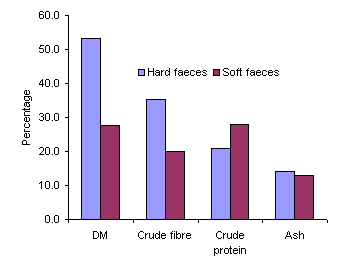
Figure 3. Comparison of soft and hard faeces from rabbits
fitted with collars
to prevent consumption of the soft faeces
Conclusions
-
Depriving growing rabbits of access to soft faeces did not affect DM intake; led to 50% poorer growth rate and feed conversion; and stimulated slightly the selection of leaf of water spinach rather than stem
-
Supplementing fresh water spinach with rice bran appeared to confer no benefits in terms of rate of growth and feed conversion in growing rabbits
-
The soft faeces from rabbits fed water spinach, with or without rice bran, were much richer in nutrients than the hard faeces.
Acknowledgments
First I would like to express my appreciation to the MEKARN
program funded by SIDA-SAREC project for providing me an
opportunity and budget to learn and conduct a mini-project.
Specially, I am very grateful to Dr. T R Preston as very good
supervisor and providing much advice about carrying out research. Thanks are also given to Mr. Chhay Ty, Miss Lampeuy and
the Director of the Livestock Research Center including staff members, for
their help in facilitating the execution of my experiment.
References
Anon 1 No date Rabbit diet and Nutrition. http://www.mybunny.org/info/rabbit_Nutrition.htm.
Anon 2 No date
Nutrition and Feeding
http://www.fao.org/docrep/x5082e/x5082E05.htm
Akinfala E O, Matanmi O and Aderibigbe A O 2003.
Preliminary studies on the response of weaned rabbits to whole
cassava plant meal basal diets in the humid tropics. Livestock
Research for Rural Development 15(4): http://www.cipav.org.co/lrrd/lrrd154/akin154.htm
AOAC 1990. Official methods of analysis. Association of
Official Analytical Chemists. 15th edition. Arlington
pp1290
Benigno C, Wagner H and Wantanee Kalpravidh 2005 Outbreak of avian influenza in Asia. Proceedings AHAT-BSAS Conference (Editors: P Rawlinson and M Wanapat) Khon Kaen University, November 15 to 18, 2005
Hongthong Phimmmasan, Siton Kongvongxay, Chhay Ty and
Preston T R 2004: Water spinach (Ipomoea aquatica) and
Stylo 184 (Stylosanthesguianensis CIAT
184) as basal diets for growing rabbits. Livestock
Research for Rural Development. Vol. 16, Art. #34.Retrieved
, from http://www.cipav.org.co/lrrd/lrrd16/5/hong16034.htm
Kean Sophea and Preston T R 2001
Comparison of
biodigester effluent and urea as fertilizer for water spinach
vegetable.
Livestock Research for Rural Development (13) 6; http://www.cipav.org.co/lrrd/lrrd13/6/Kean136.htm
Lebas F, Coudert P, Rochambeau H de and Thebault R G
1997 Rabbit Husbandry, Health and Production. FAO Animal
Production and Health Series No. 21.
Ly Thi Luyen and Preston T R 2004: Effect of level of
urea fertilizer on biomass production of water spinach (Ipomoea
aquatica) grown in soil and in water. Livestock Research
for Rural Development. Vol. 16, Art. #81. Retrieved
, from http://www.cipav.org.co/lrrd/lrrd16/10/luye16081.htm
Ly J and Preston T R 2001. In vitro estimates of nitrogen
digestibility for pigs and water-soluble nitrogen are correlated in
tropical forages feeds. Livestock Research for Rural Development
13(11): http://www.cipav.org.co/lrrd/lrrd13/1/ly131.htm
McNitt J I, Patton N M, Lukefahr S D and Cheeke P R 1996. Rabbit production ( 7th edition). Interstate Publishers Inc. Danville, Illinois. Pp 144-278.
Proto V 1980 Alimentazione del coniglio da carne. Coniglicoltura, 17(7): 17-32.
Raharjo Y C, Cheeke P R, Patton N M and Supriyati K
1986b Evaluation of tropical forage and by-product feeds for
rabbit production. I. Nutrient digestibility and effect of heat
treatment. J. Appl. Rabbit Res., 9: 56-66.
Ramchurn R, Raggoo J and Ruggoo A
2000 Digestibility and growth in the domestic rabbit using
multi-nutrient blocks as a feed supplement. Livestock Research for
Rural Development. 12 (1): http://www.cipav.org.co/lrrd/lrrd12/1/ram121b.htm
Raharjo Y C 1987 Evaluation of tropical forages and byproduct feeds for rabbit production (Ph.D. dissertation). Corvallis, OR, Oregon State Univ.
Sarawatt S V, Laswai G H and Ubwe R 2003: Evulation of the potential of Trichanthera gigantean as a source of nutrients for rabbits diets under small holder production system in Tanzania. Livestock Research for rural Development(15) 11 Retrieveed September 21, 2003, from http://www.cipav.org.co/lrrd15/11/sarw1511.htm
Undersander D, Mertens D R and Lewis B A 1993.Forage analysis procedures. National Forage Testing Association. Omahapp 154