Back to contents research projects
Effect of grass or cassava foliage
on growth and nematode parasite infestation in goats fed low or high protein
diets in confinement
Seng Sokerya
University of Tropical Agriculture
kerya@uta.edu.kh
The hypotheses that Kerya
will test are:
1.
The infective nematode larvae come from leaves of
plants that are very close to the ground (goats will become infected with grass
and not with cassava foliage)
2.
Condensed tannins are secondary compounds in cassava leaves which have a
direct effect to destroy the parasites in the gastro-intestinal tract
3.
With a good quality diet (protein rich) the parasite effect may be small
even when the EPG is found at a high level
4.
In a poor nutritional diet,
the effect of the parasite may result in loss of body condition and low growth
rate
The design of the experiment is three treatments of G:
Brewer’s Grain + grass, C: Brewer’s Grain + cassava foliage, GC: Brewer’s Grain
+ mixture of grass and cassava foliage (50:50 DM basis), with four replications
in a randomized block design (CRD). Experimental periods will be 70 days
excluding the adaptation period.
In the second experiment
there are 4 treatments in a CRD with 2*2 factorial arrangement of
-
Protein level:
High (HP) or low (LP)
-
Foliage: Cassava
foliage (CF) or grass (G) as forage supplement
Measurements will be made of:
growth rate of the goats and Eggs Per Gram (EPG) of faeces
at every 10
days interval.
|
|
|
|
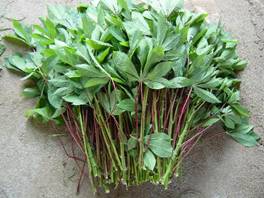
The cassava foliage as
offered to the goats |
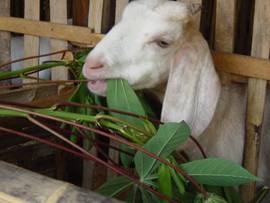
No problem feeding the
fresh cassava foliage |
|
|
|
|
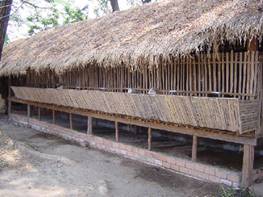
The goat shed |
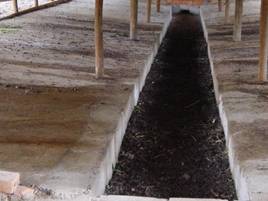
The manure from the goats
is a substrate for earthworms, in the space below the cages |